Category Archives: article

chacun des articles indiduels publiés dans un numéro du bulletin

Exiles of the interior

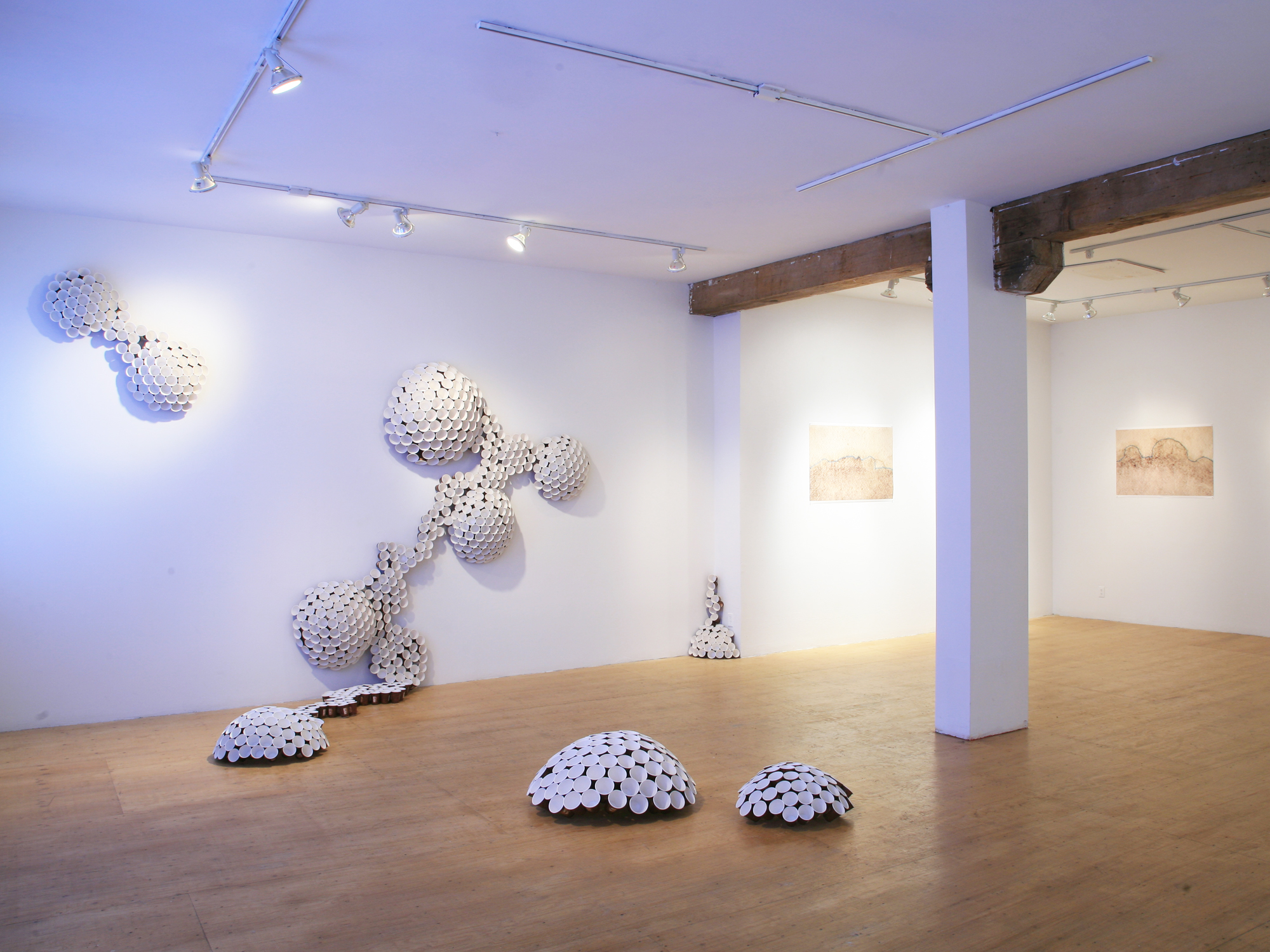
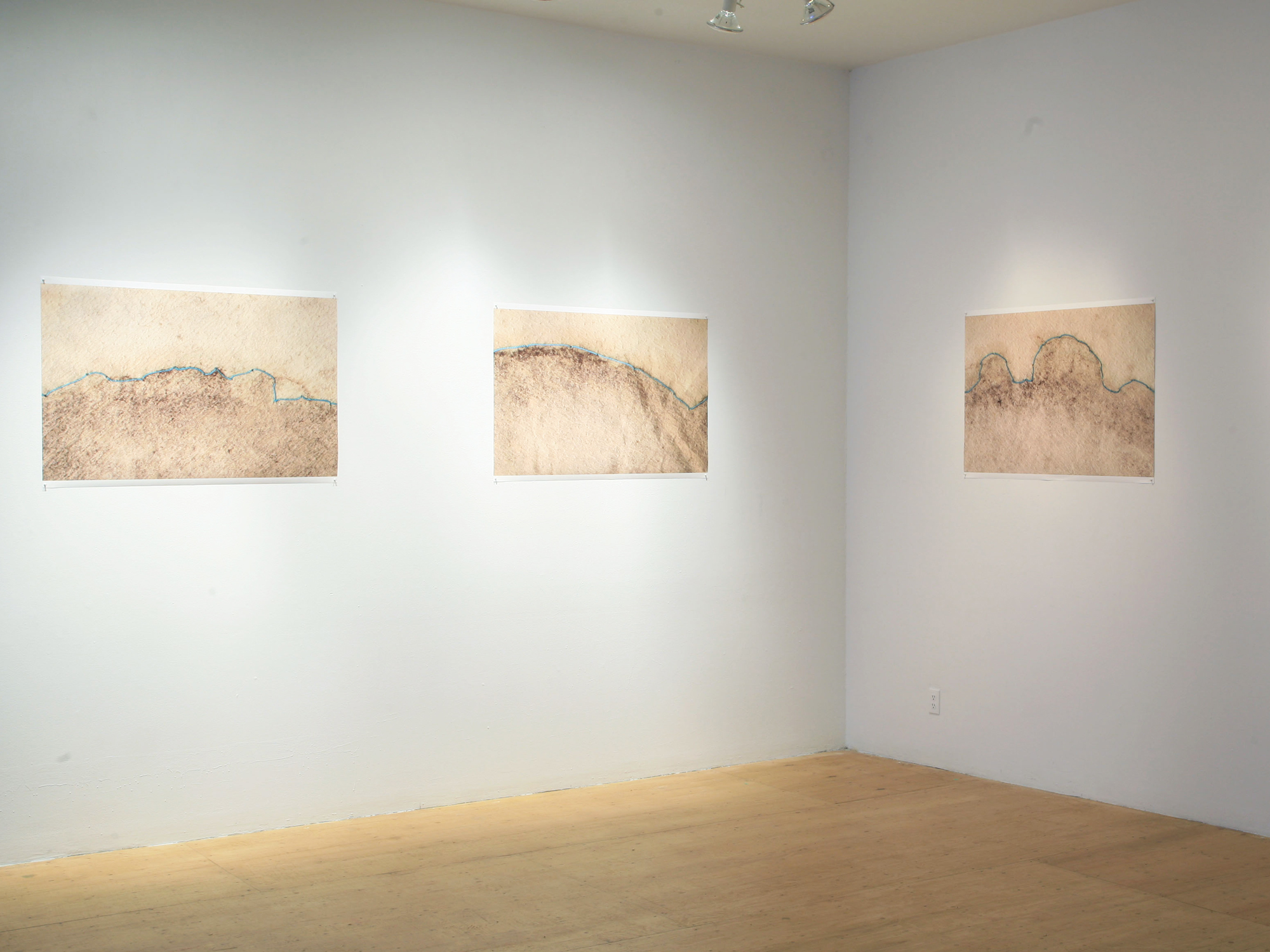
The fourth edition of the Manif d’art TOI/YOU: La Rencontre was held in the capital in May and June of 2008, offering an opportunity to immerse ourselves in the work of a number of renowned contemporary artists. Amongst them, was the work of Els Vanden Meersch, who had travelled from Belgium to undertake a residency at LA CHAMBRE BLANCHE. The installation that Vanden Meersch presented, entitled Intérieurs exclus, left no one indifferent.

A retrospective tour

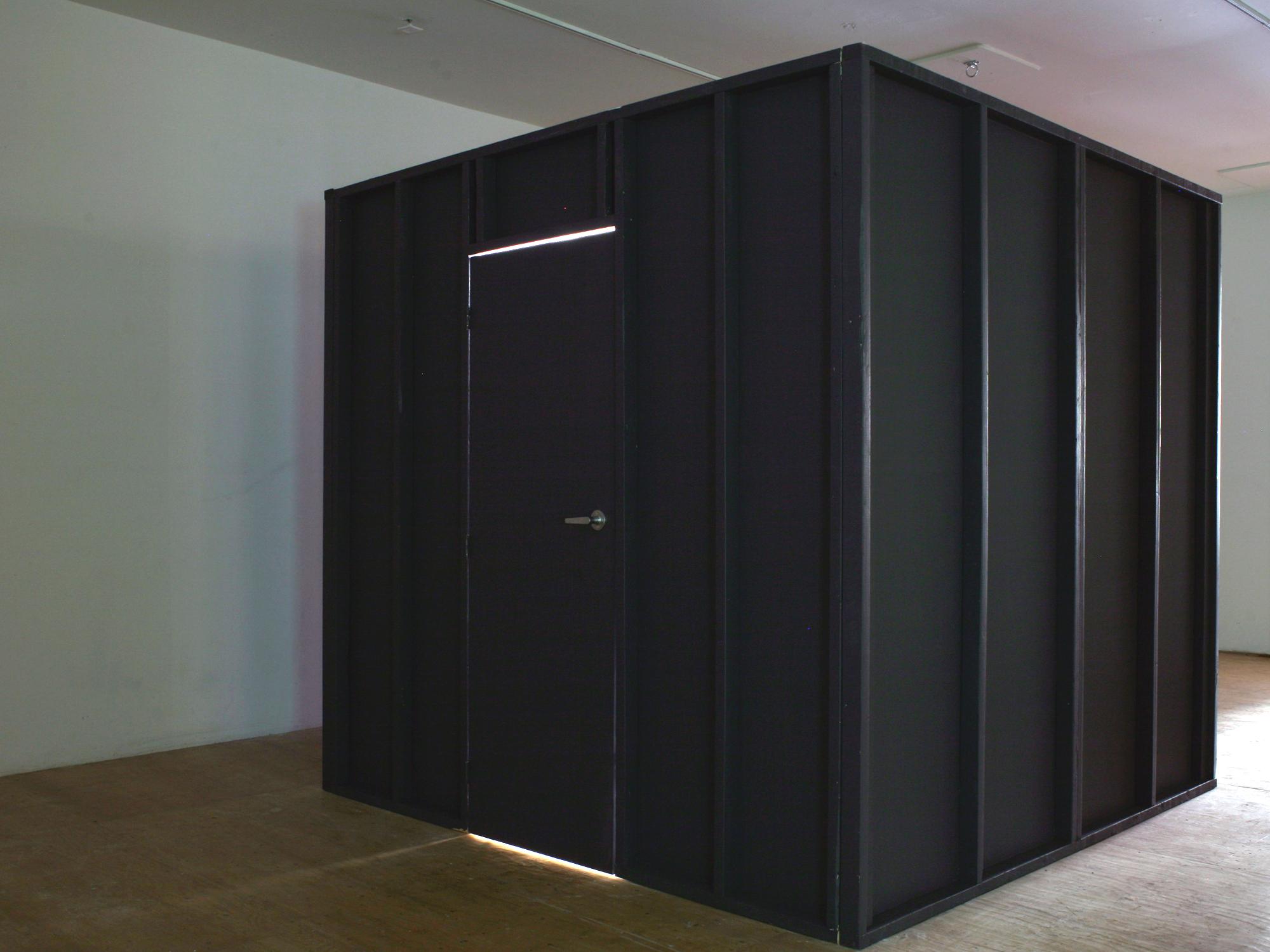
In the high-ceiling gallery space, a glow is reflected on the wall facing us as we enter. To this presence is added the echo of our footsteps. To the right, a black structure evokes the form of containers that are used in maritime transport. Our attention is first drawn towards this form, this abyss-like block, resembling an improvised anti-nuclear bunker. A narrow doorway gives us access to the form: the most daring enter closing the door behind them.
crédit photo: Ivan Binet

crédit photo: Ivan Binet

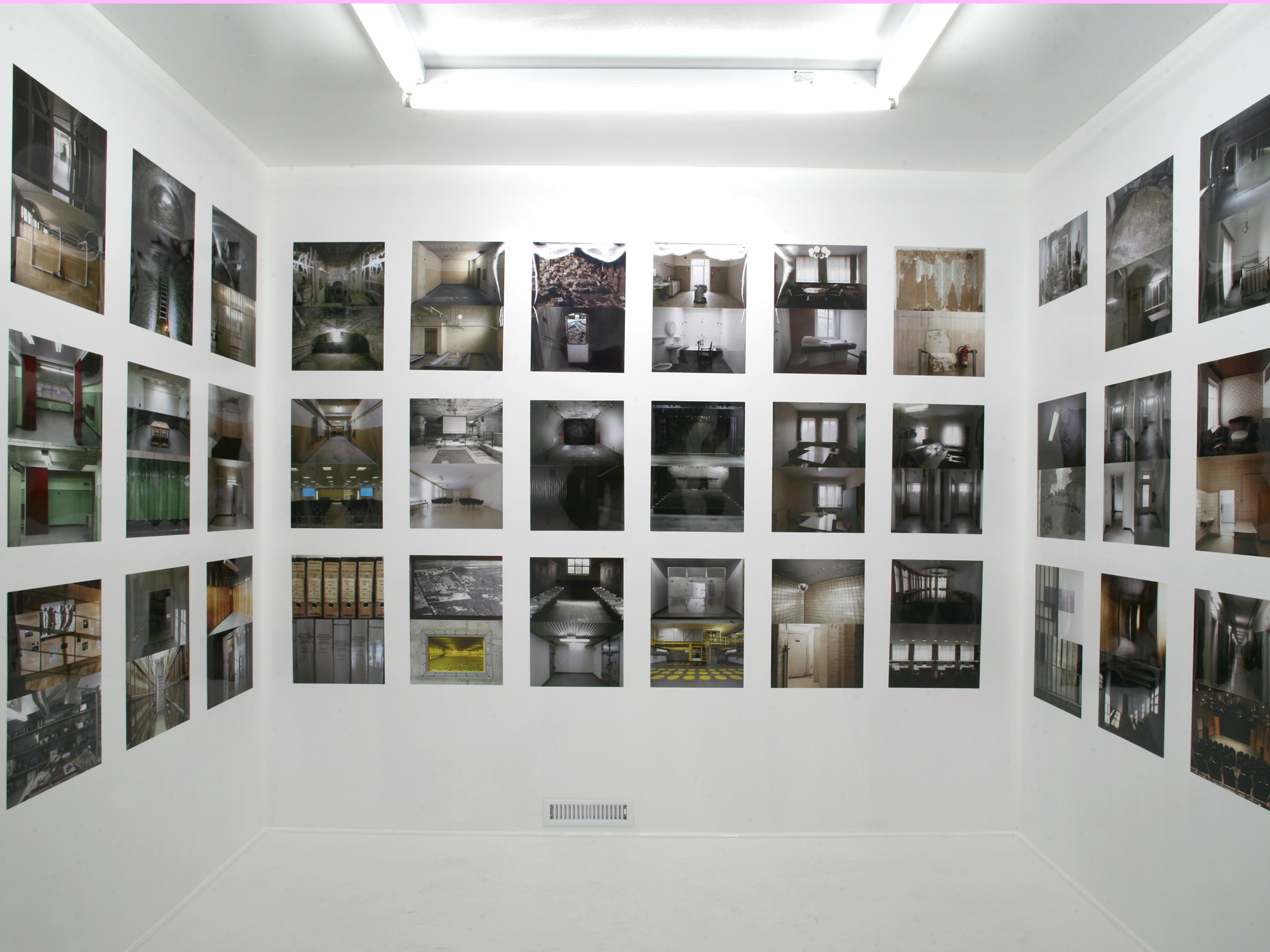
Inside, a number of fluorescent tubes assault our eyes, forcing us to readjust our vision from the dimly-lit space that went before. A cold and raw light is reflected within the white walls of the space, which are covered with gloss-finish photographic prints. The bright colors in the photographs draw us to them, eager to discover the subject matter that is depicted within: places and rooms denuded of all human presence, creating a mise en abîme of the senses and the situation in which we find ourselves.
crédit photo: Ivan Binet

crédit photo: Ivan Binet

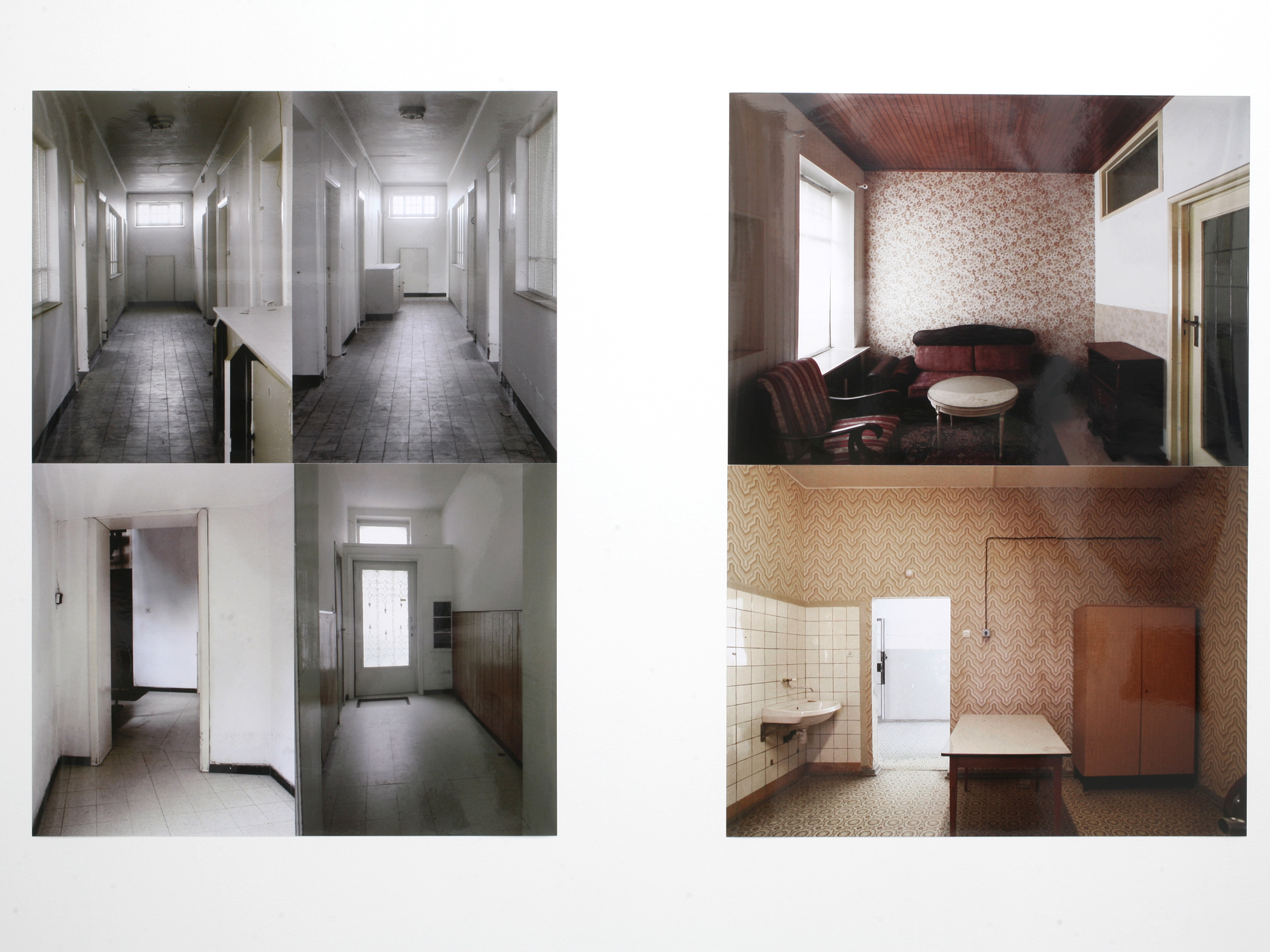
On first glance, the criteria governing the arrangement of images – in groups of three and four, attached directly to the wall – is not clear to us. These ephemeral compositions1 are arranged according to strict geometric patterns. The colours, spaces and points of view depicted (with their subjective framing at eye level) seem to echo one another, as the architecture that they portray all seems to be have been created by the same hand. The atmosphere is heavy, stifling our breathing. Where are we ? It is impossible to know; no indications are given as to the whereabouts of these places. As one image follows another, the sense of claustrophobia becomes overwhelming. These seem to be warehouses, decontamination rooms. Then, an image of an image of the tracks leading to the Auschwitz concentration camp gives us a clue as to the symbolic significance of the spaces that we have witnessed.

In our minds, all of the unknown places on view take on an uncertain presence. They are, in fact, abandoned bunkers, gas chambers and the cramped apartments constructed by totalitarian regimes in the course of the last century. There is a sad awakening: our faulty memory is not able to discern the specific whereabouts of any of the scenes portrayed. They all look the same; a similar atmosphere reigns. Even though we are seeing them for the first time, they seem familiar, as though the horror and uncomfortableness of those who have passed through the space before us is imbibed in the walls. The grease and soot marks of the many histories to which we no longer have access seem to linger in the space; a form of suffocating poetry emerges. No longer able to endure it, we leave.
crédit photo: Ivan Binet

crédit photo: Ivan Binet

Elsewhere, in the main space, a series of images is projected, following a steady rhythm. The images dissolve, one by one. The tightly and identically framed photographs display a series of brightly-colored, deserted rooms. A window – always the same window – opens out onto a landscape that reoccurs as far as the eye can see. Once again, we have no way of knowing where we are.

After a few minutes, doubt takes hold: what we see before us is not a hospital, not a hotel. Its sense escapes us, yet its sense is everywhere in the succession of images. Each room has the same silence, or almost, save for the effect of time on the blistering of the paint on the walls, the crumbling their surfaces, and the rusting of radiators. Today, these once-identical interiors have taken on the patina that only time and nature know how to inflict on man’s pride and his possessions. The lesson is an eloquent one and an ironic one: each room has become unique. Life has taken hold once more. However quiet and perfectly white the surfaces before us once were (walls, floors and ceilings) they have all become textured and, to the contemporary eye, beautiful. However unclear we are about what this succession of images depicts, it would never have crossed our minds that what we are witnessing is a site that is highly-charged with significance: a seaside resort designed according to modernist and functionalist principles under Nazi Germany. Built to be indestructible, the three-kilometer length of the Prora complex on Rügen island has resisted all attempts to demolish it.

As these links reveal, the places presented by Els Vanden Meersch in the exhibition are the vestiges of totalitarian ideologies that sought to destroy all sense of individuality. They did so by purging all decorative features in space, in favor of an implacable and moribund standardization of the spaces in which man lives and works. The coldness of the places portrayed by the artist invokes both the imperative that we remember, and constitutes a photographic document of the utopian formulas and eugenic visions of these decrepit regimes for whom instrumentalized reason took precedent over fundamental differences between human beings. Thus, a single, unique being is repeated, endlessly, in the same environment, reified by the staggering domination of the State and industry, and drawn towards the certain death of individual creativity. Here is humanity objectified, become an inert, mineral statue, difference washed away with quicklime, difference betrayed by a fascinating machine that seems to have penetrated all spheres of life, and the very habitat of life itself. And yet, time does its work… Man has naturally and completed deserted this concrete microcosm to find a place to live freely, in the suburbs.

  1. Throughout her residency, Els Vanden Meersch adjusted the content and the arrangement of the imagery on display.
Crickets in residence

crédit photo: Ivan Binet

crédit photo: Ivan Binet

He rests,
before winding his tiny watch.
Is it finished, broken ? He rests a little more,
returns home and closes the door.
And so time slips away, as he turns the key in the watch’s delicate mechanism.
– Jules Renard – Histoires naturelles
1

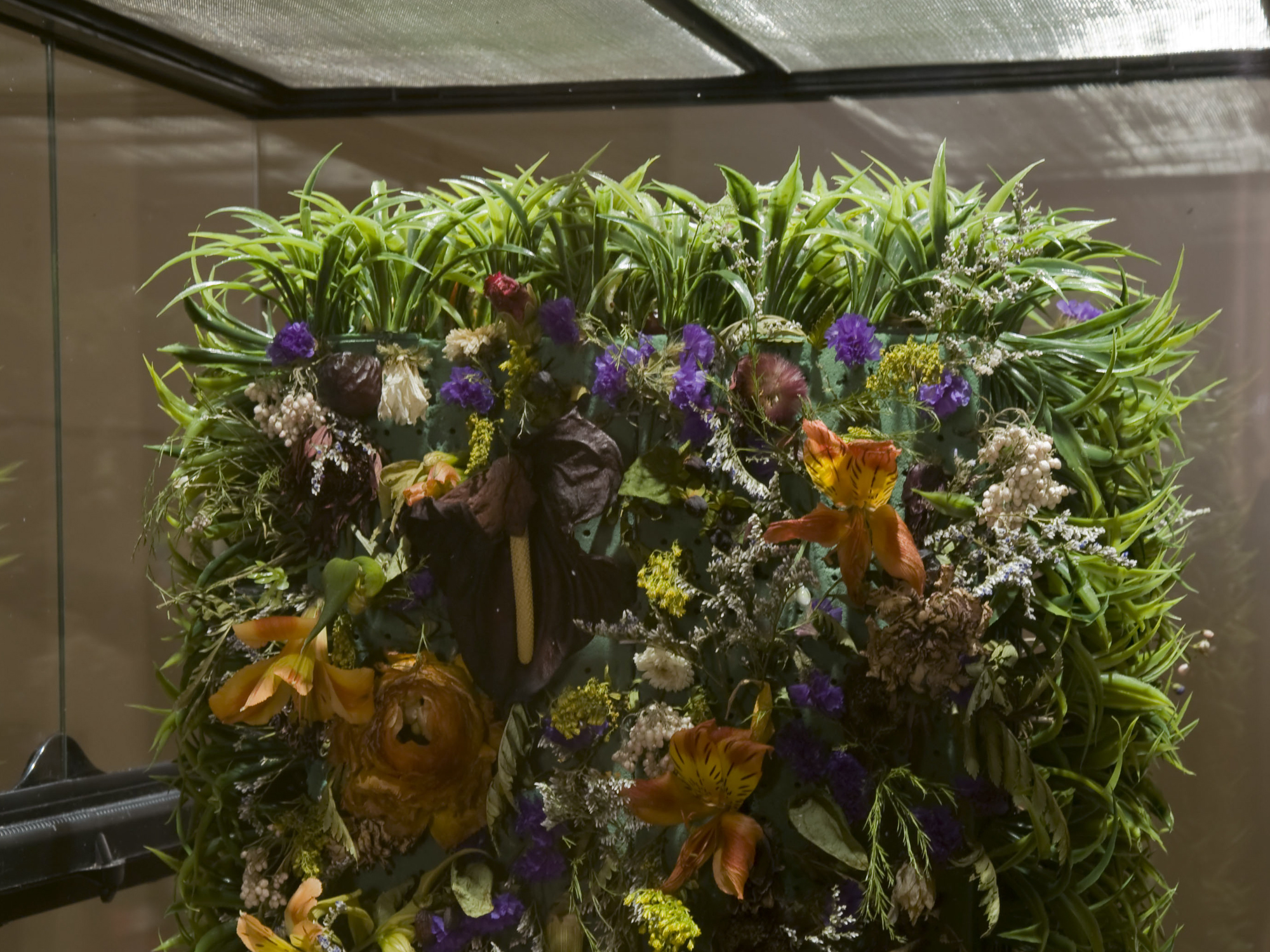
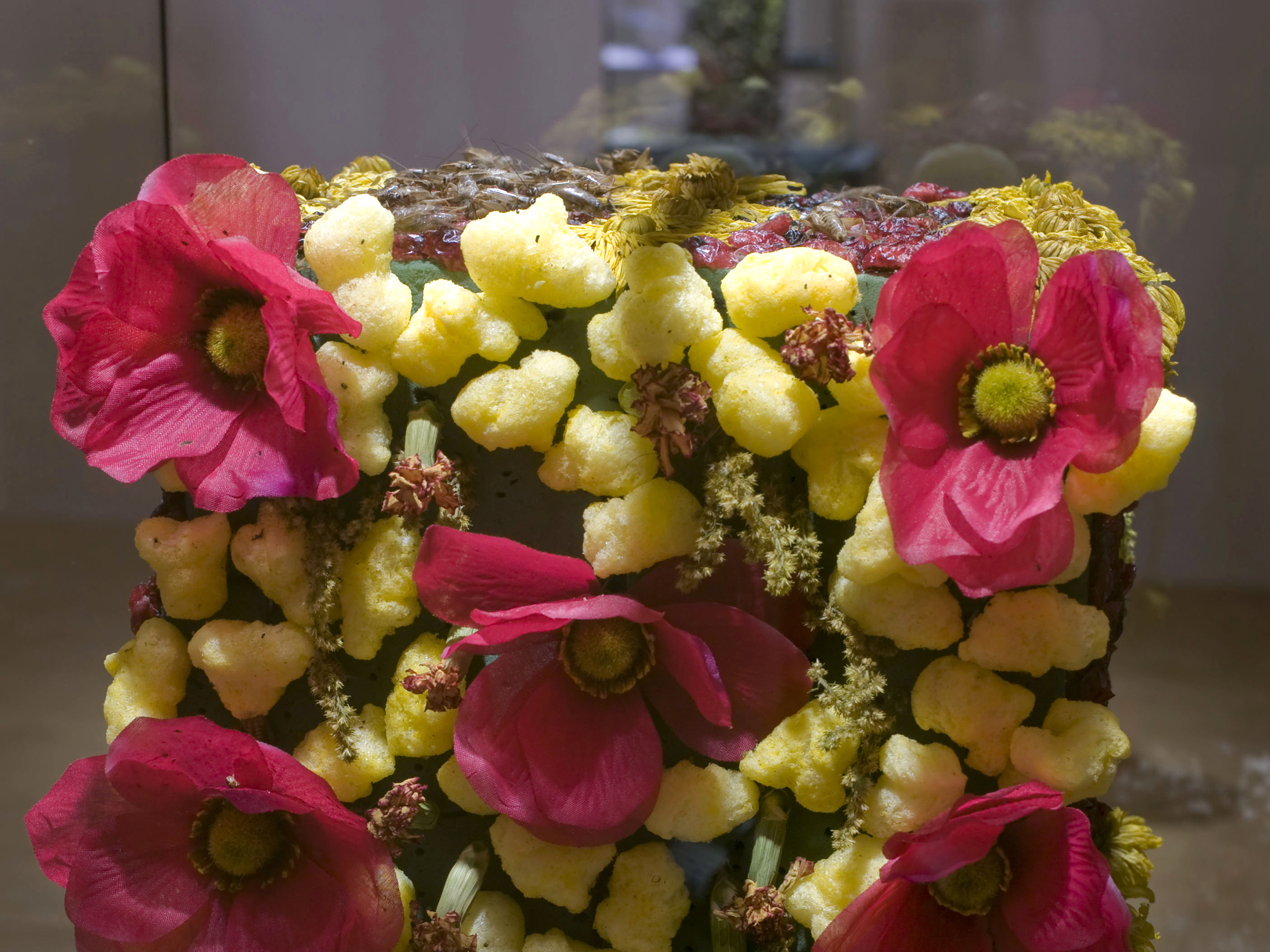
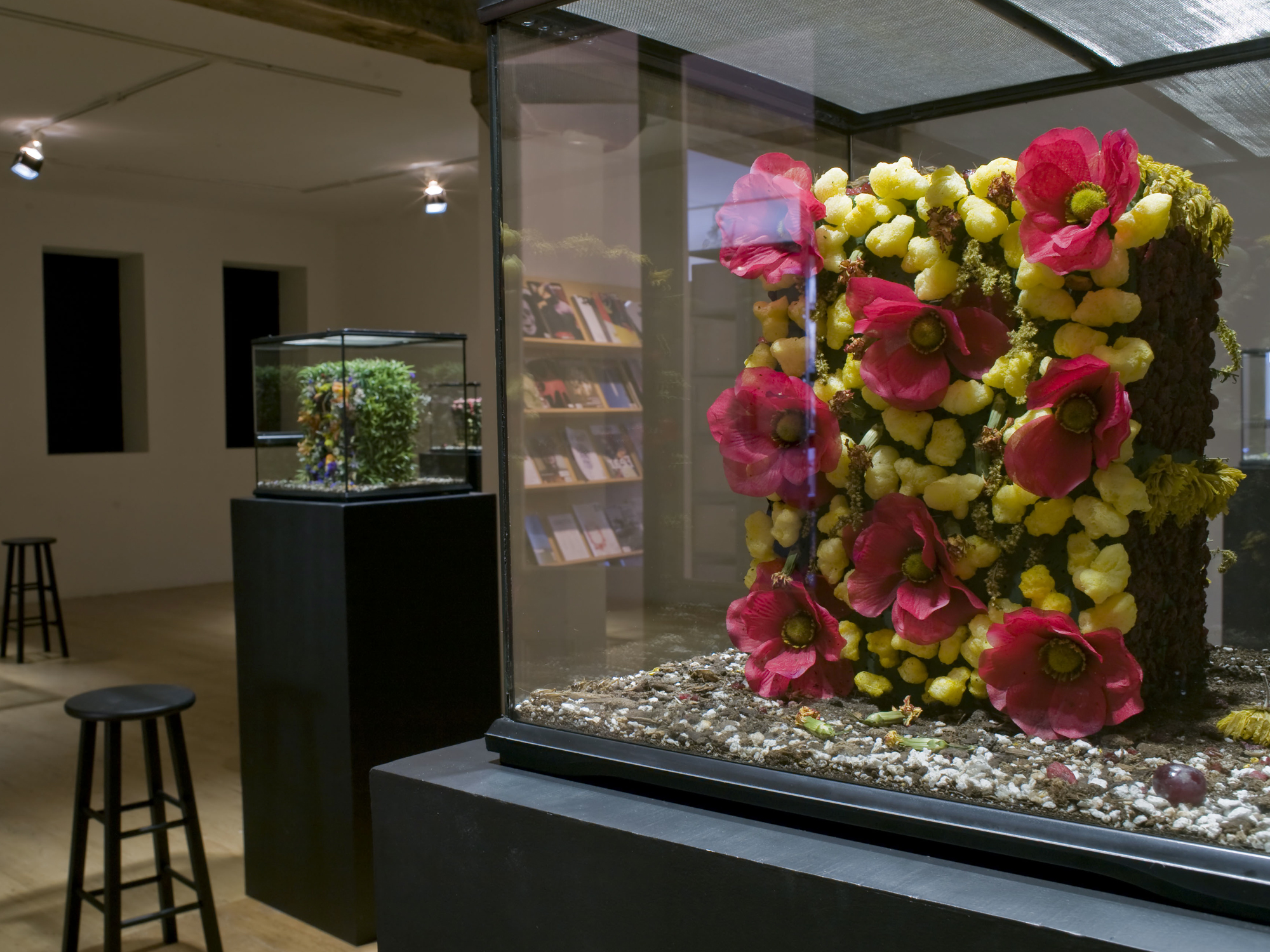
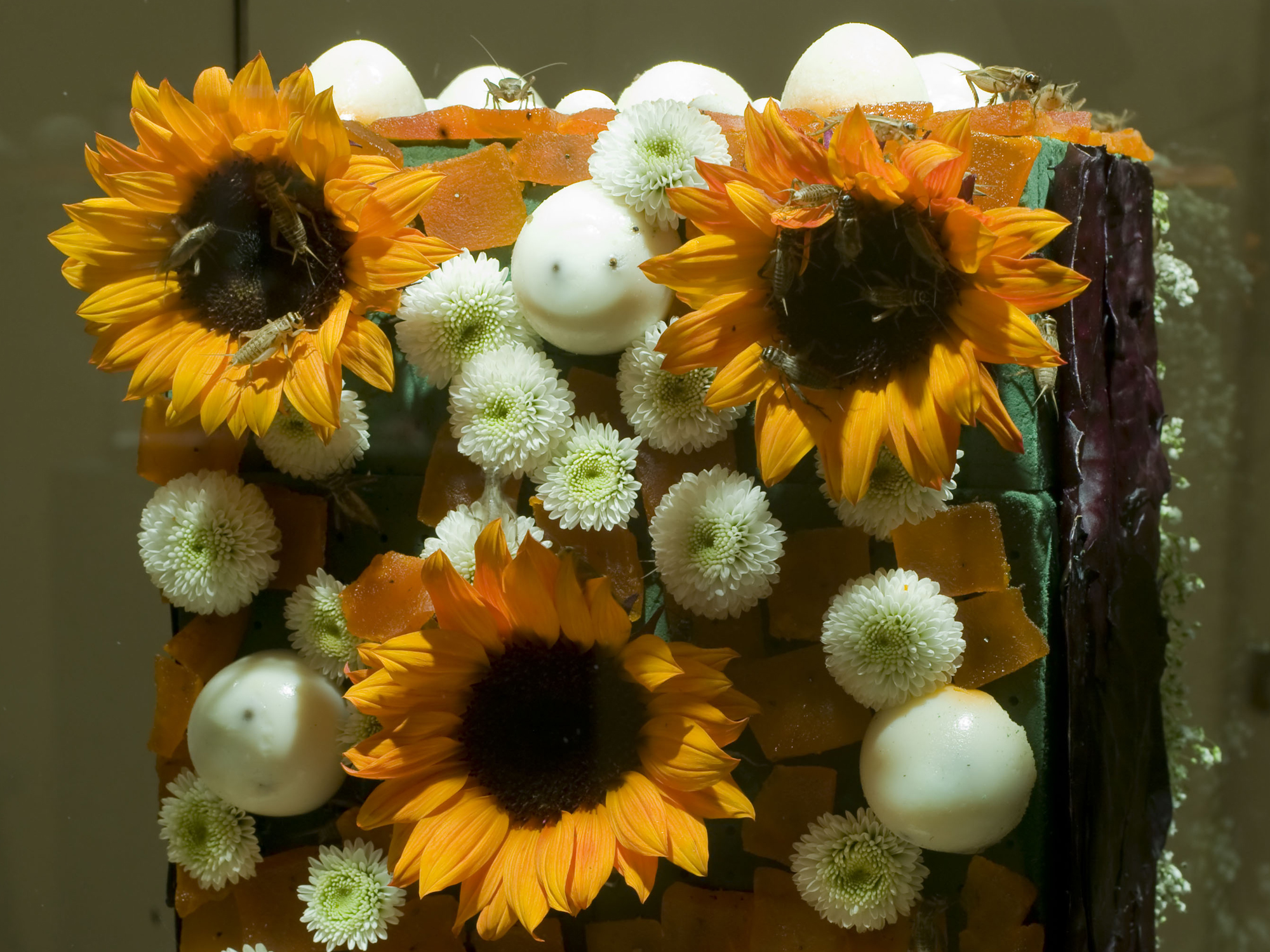
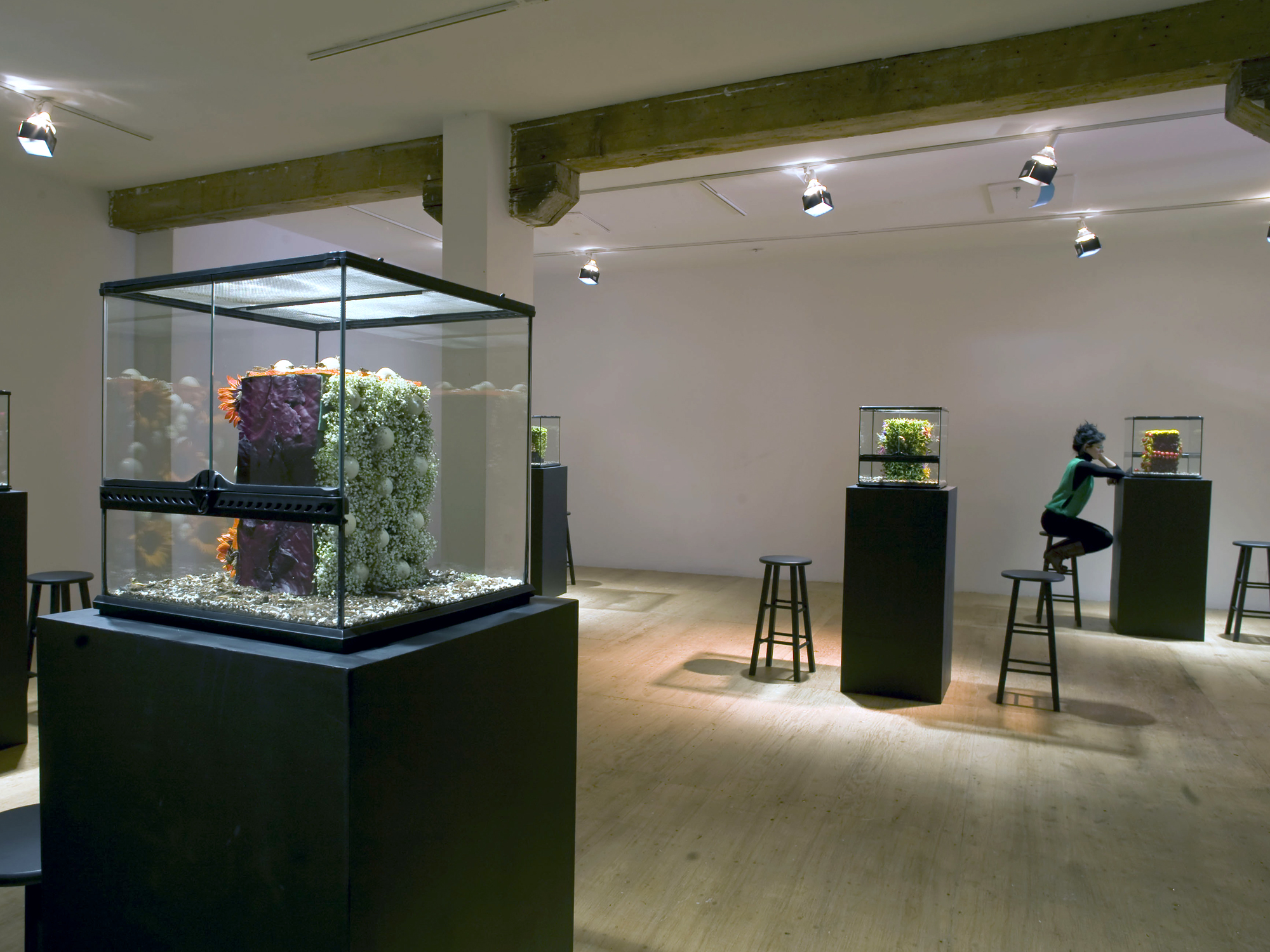
In the depths of winter, the first thing that we hear upon entering Adaime Makac’s installation at LA CHAMBRE BLANCHE is the sound of crickets. A pair of stools is positioned either end of six vivaria, in a game of mirroring. The receptacles house a ‘sculpture’ composed of a range of items that are planted in a bed of foam: flowers, fruit, and snacks. The scene evokes a Dutch still-life, with its mix of natural and artificial flowers. A forest of broccoli is sprinkled with pebble forms that reveal themselves to be rice balls. A carnival of fresh and dried tropical fruit offers up larger-than-life colors. As we look closer, we see that that each vivarium is inhabited by a colony of domestic crickets.

Adaime Makac’s Le Banquet lends a voice to these insects. She gives them center stage, as she has done with other animals in previous projects.2 The spectator is positioned in the role of voyeur, catching his/her reflection and the gaze of the other in the glass of the vivaria. Adaime Makac created a similar scenario in Observatoire (2007), an installation that took the form of a large table covered with mirrored tiles. Visitors were invited to sit at the table and observe the behavior of living mice, who made their way out from a small cube-shaped refuge at one end of the table. In this work, the mouse was a form of stand-in for the artist, the performer, the clever animal whose prowess we anticipate. In formal terms, the cube-shaped refuge that housed the rodents, which was also covered with mirrors, resembled the monolithic sculptures found in Le Banquet.

Le Banquet explored duration. It was as though the artist had created a situation, and then withdrawn leaving it to evolve, limiting herself to a few gestures of upkeep of the space, such as the selection of which detritus to conserve, and which elements to replace. In a manner of speaking the work ″makes itself,″ following its course in an almost-autonomous fashion, almost independently of the author/maker. In this respect/regard, the author Évelyne Toussaint speaks of, ″the artist who is content to lay out an arrangement of elements, setting the stage for improvisation.″3 Much time slips away before we see any ‘results’″4 remarks Adaime Makac, commenting on her video works. The artist, « seeks to accentuate a certain slowness and sense of repetition.″ The absence of spectacle is offset by the setting, whether the monoliths featured in Le Banquet, or the often-dramatic, color-saturated lighting that bathes the scenes she portrays in her video and photographic works. As the artist underlines, ″light acts as a costume.″

crédit photo: Ivan Binet

crédit photo: Ivan Binet

In Le Banquet, Adaime Makac once again chooses to work with insects, and more specifically orthopterans, having employed the shed skins of migratory locusts in Collection (Ready-dead) (2006), an installation presented at bbb in Toulouse. Spread out on a bed of black quartz, the cricket remains, which were collected on a beach in Libya, were embellished with sequins and adorned with makeup. This work prefigures Le Banquet, the title of a video installation created in 2005. The artist, working with live crickets this time, documented three stages of the destruction of a bouquet of flowers placed in a cage housing the insects. The staging of Le Banquet at LA CHAMBRE BLANCHE did not result in the production of video or photographic traces. Instead, a sequence of views of the vivaria at night was presented on a monitor placed in one of the gallery’s windows, offering an insight into the installation within, and arousing the curiosity of passers by.

crédit photo: Ivan Binet

crédit photo: Ivan Binet

Adaime Makac explains that the three-dimensional compositions placed in the vivaria are inspired by Sans titre (Structure qui mange) (1968) by the artist Giovanni Anselmo, who was associated with Italian Arte povera movement. In this work, granite monoliths combine with organic and perishable matter (such as lettuce) in a way that suggests that the material is being consumed, as the title suggests [in English: Untitled (Structure that Eats)]. Adaime Makac’s Le Banquet reverses this proposition, in offering structures for the crickets to eat; crickets that are, in a manner of speaking, actors in the installations in each of the six vivaria.

In society, insects are usually associated with the abject and with calamity, with few exceptions, butterflies for example. By and large however, insects are regarded as harmful, and therefore as undesirable. They destroy crops and infest houses. The extermination business is booming, barely managing to hide its play on our fears.

crédit photo: Ivan Binet

crédit photo: Ivan Binet

The Bible is perhaps at the root of man’s troubled relationship with insects. Amongst the famous plagues of Egypt cited in Exodus, and sent by Jehovah, targeting the Pharaoh who was holding the Israelites captive, three of the ten forms of pestilence involved insects, namely locusts, mosquitoes and horse flies. Given the exponential rate at which insects reproduce, a few specimens may result in an invasion. Rest assured, in Le Banquet, any overflow is contained ; the living processes take place on the inside of four sheets of glass.

Children are particular sensitive to all forms of animal life, and do not seem repulsed by insects. Occasionally, they even return home with their little discoveries, much to the disconcertment of their parents. Amongst adults, such a sensitivity appears out of the question, stifled even. It is as though, later in life, insects are only of interest to scientists. Adaime Makac’s installation introduces these creatures into the domain of art.

crédit photo: Ivan Binet

crédit photo: Ivan Binet

In pet shops, tarantulas, lizards and frogs are offered for sale….crickets also, though in the case of the latter, they are sold to feed others in the food chain. The space in which they are housed is usually rudimentary, with perhaps only a few empty egg boxes in an otherwise empty vivarium. In Le Banquet, Adaime Makac challenges this economy and celebrates the humble creature that is the cricket; she allows them to live, feast, copulate and die.

Insects in contemporary art

Artists have been putting insects ‘to work’ for several decades, introducing objects and materials into their environment, which the creatures ultimately transform.

I recently came across a work by the French artist Hubert Duprat, cited in a passage from a text in connection with the work of Adaime Makac.5 In a practice that encompasses a number of approaches, Duprat transforms the aquatic larvae of trichoptera or caddisflies into goldsmiths, equipping them with gold sequins and pearls, as well as precious and semi-precious stones, to create a protective nest that more usually would consist of twigs and grains of sand. The Canadian artist Aganetha Dyck places everyday objects in beehives, which the insects begin to coat in wax, creating cells.6 then removes the everyday items and uses them to create installations.7

However, in both these cases the artists appropriate the insects’ ‘productions’ and the creatures are ultimately absented from the work, leaving only their trace behind. In contrast, in Adaime Makac’s installation not only are they the principle actors, they are also the intrinsic content of the work, ‘what is to be seen’. The crickets live and die in the closed receptacle that is the installation. They are nourished by, and in turn alter, its form, leaving behind their waste and their skins.

Crickets in literature and music

Upon learning that Ivana Adaime Makac planned to work with crickets, a story by Charles Dickens, entitled The Cricket on the Hearth immediately came to mind: “[the cricket] has inspired numerous tales and stories. Once upon a time, it was considered to be a familiar, even a bringer of good fortune […].”8 Henry David Thoreau (1817-1862) frequently mentions crickets and their song in his diary, analyzing their behavior in detail. He salutes their seasonal return and marvels at the sounds they make as autumn advances. He observes them bore into mushrooms and apples, almost completely disappearing into the object that they are consuming. As an adolescent, I read Jules Renard’s Histoires naturelles, published in 1896. Later, I discovered that five of the stories he recounts – including that of Le Grillon [The Cricket] – had been put to music by Maurice Ravel. The cricket seemed to him “a fantastic creature, somewhere between the human and the machine, a creature with which the composer was perhaps the first to identify.”9

Despite the considerable difference of scale that separates us from crickets, we cannot help but feel empathy for them; we identify with their fragility. In the artist’s enlargements of video and photographic images of the insects, our sense of scale alters dramatically: under the color-saturated lighting, the creatures’ vital functions become dramatized, and aestheticized.

Ivana Adaime Makac’s Le Banquet creates a form of dynamic suspense, charged with meaning, somewhere between the abject and the delicious. A pleasure to the eye, her ephemeral sculptures elevate our gaze and propose a form of precarious beauty, aimed at transformation. The insects live and die at the bottom of the vivaria, moving around and going about their business, climbing the monoliths, and freely traversing the art that constitutes their habitat.

  1. Renard, Jules. 2010, Histoires naturelles. Paris: Presses universitaires de France, 91 p.
  2. I am thinking notably of Ivana Adaime Makac’s series of infra-red, silver-print photograpgs entitled Bestiaire (2004) that set insects against a backdrop of natural and artificial elements (flowers, stuff animals), and also of her video works Dormeur no. 1 (2005) and Limites No. 2 which, respectively, document the behavior of crickets and mice. The video installation Zophobas morios (2007) also comes to mind, featuring images of beetle larvae in movement.
  3. Toussaint, Évelyne. ″Les mondes éthologiques et esthétiques d’Ivana Adaime-Makac″. 2007, in ″ Flux-2: Parcours d’art contemporain en vallée du lot ″. Arles: Maison des arts Georges-Pompidou editions, p. 7.
  4. All citations of the artist’s comments are taken from an unpublished text (2008).
  5. Toussaint, Évelyne, art. cit.
  6. Fréchuret, Maurice, Roland Recht et Stephen Bann. 1998, Hubert Duprat. Antibes, Genève, Limoges: Musée Picasso editions, 132 p.
  7. See notably Madill, Shirley, Bruce Grenville, Joan Borsa, Sigrid Dahle et Gilles Hebert. 1995, Aganetha Dyck. Winnipeg: Winnipeg Art Gallery Editions, 64 p.
  8. Ivinec, Yann. 2006, ″The Cricket on the Hearth/Le grillon du foyer″. Traduit par Francis Ledoux. Paris: Gallimard, pp. 11-12. Ivinec’s preface makes a number of references to allusions to small insects from the orthoptera family in literature and music.
  9. Uwe Kraemer, from the program notes that accompany the recording Histoires naturelles by Ravel, with Gérard Souzay and Dalton Baldwin, released by the Philips record label. [Author’s translation].

Possible Worlds

In our spirit, spaces overlap. Our view of the world is colored by the construct of space, both those in which we live and the space of fiction constituted by images and other forms of representation. The boundaries and poles that were once used to mark out our view of the world are fading, enabling us to see gain a glimpse of the transitory spaces that constitute this world. The spaces in question are open, spaces of possibility, to paraphrase the title of Erik Olofsen’s residency Possible Worlds. And so it was that Olofsen transformed the exhibition space at LA CHAMBRE BLANCHE into a veritable laboratory of creation, employing time as means of deconstructing space, thereby revealing the spatial relations with which temporality is bound.

crédit photo: Ivan Binet

crédit photo: Ivan Binet

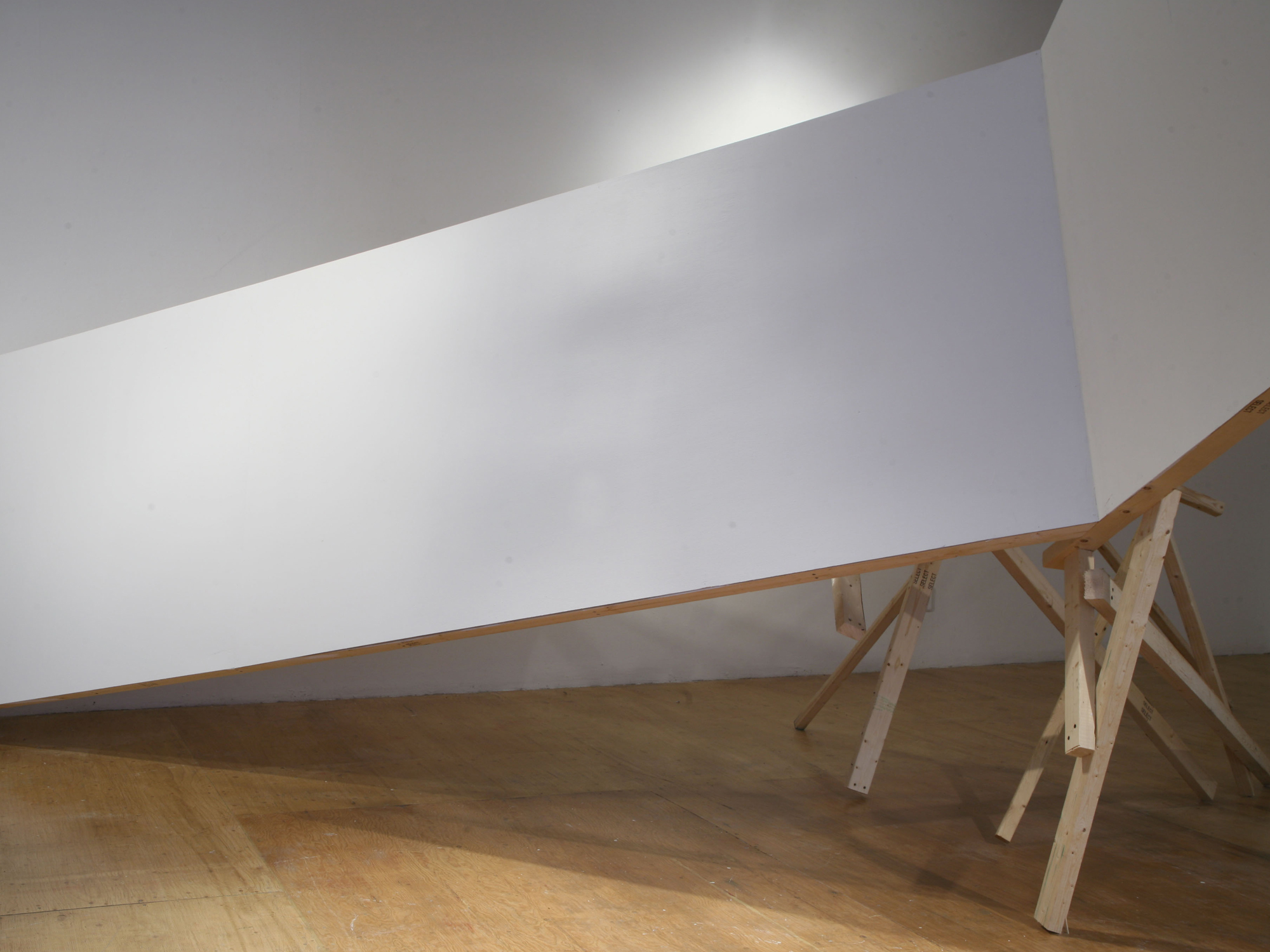
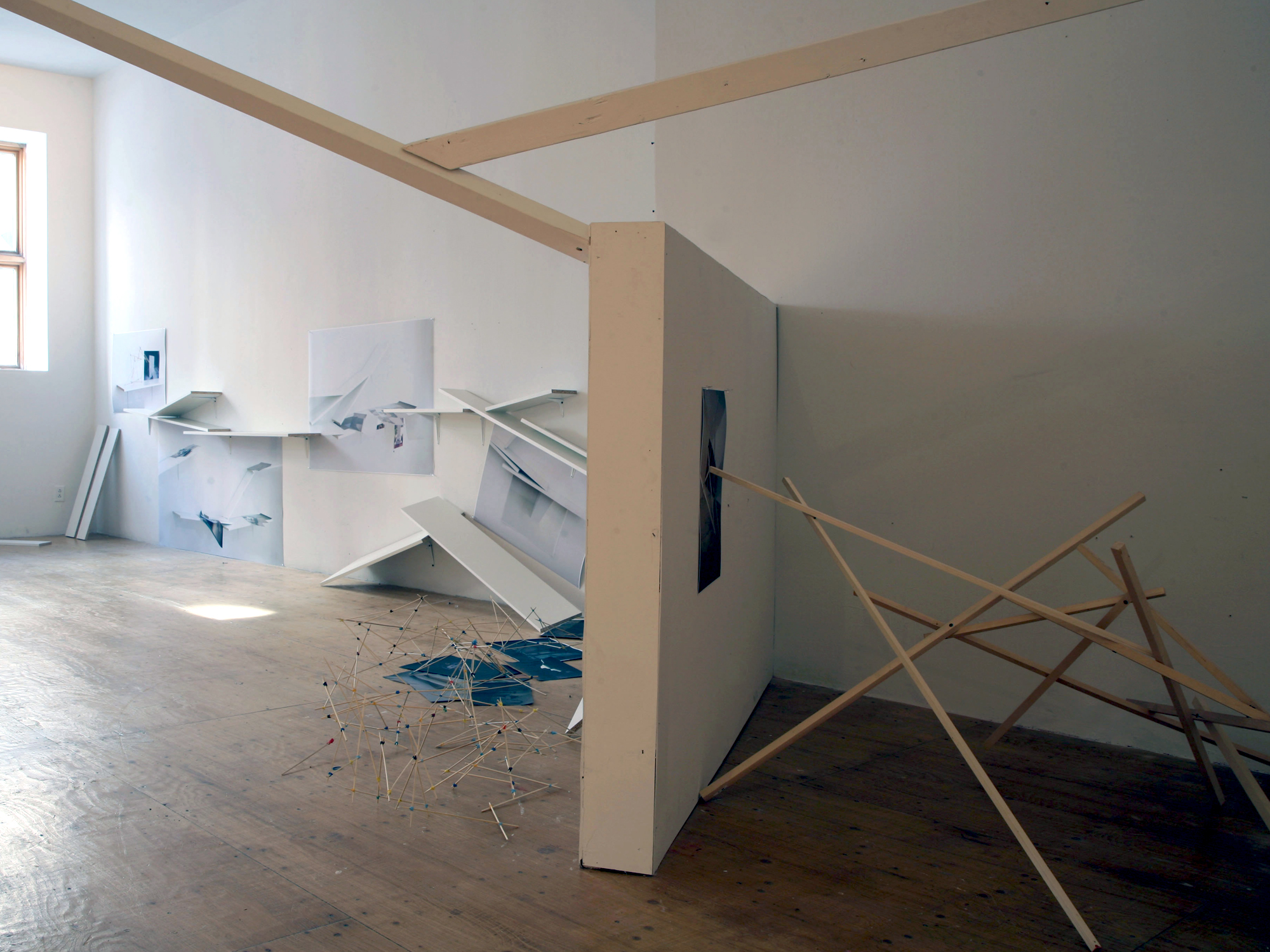
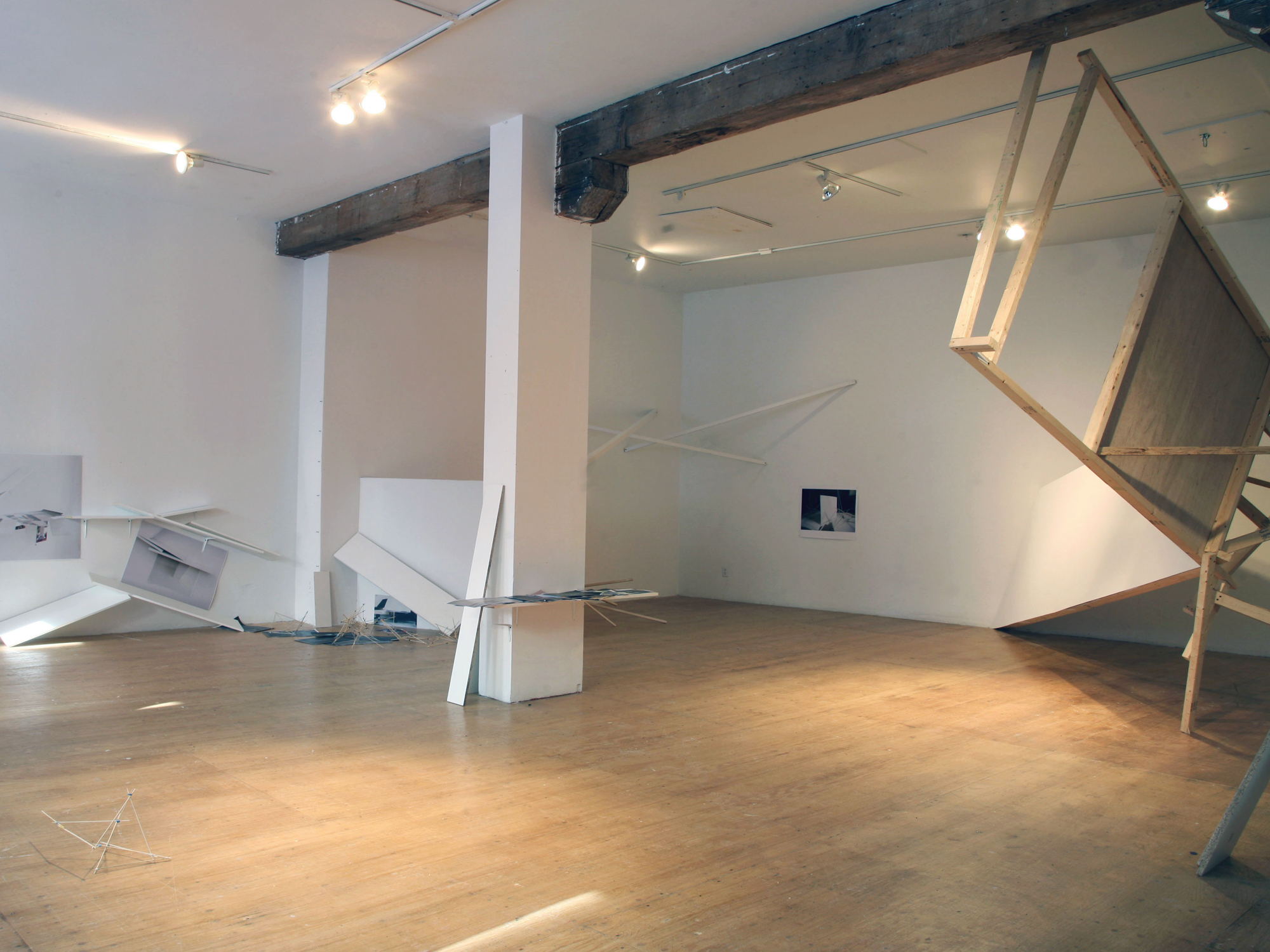
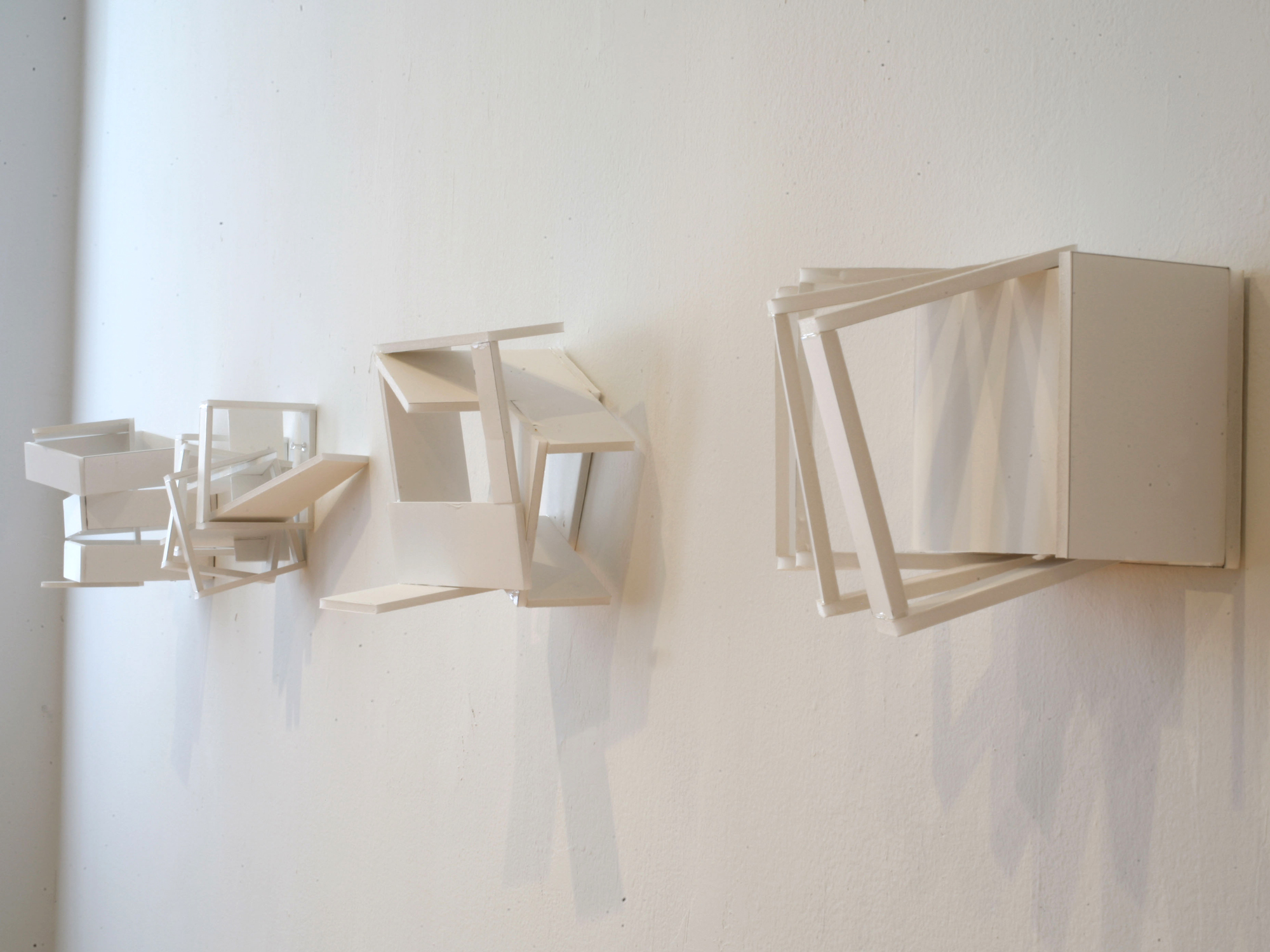
Erik Olofsen’s work evoked the feeling of being on a construction site whose purpose had deliberately been left uncertain, as he transformed the space into an exploratory work in progress. Olofsen’s approach to space echoes Michel de Certeau’s concept of “space as a practice of place.”1The forms of mobility and movement arising from the artist’s actions during his residency engendered such a feeling. A fixed and stable place was thus transformed into a space of movement inscribing Olofsen’s work an in-between space charged with possibilities. The spatial dynamic created was enabled by a play with deceptively ordinary structures which acted as vectors in the space. During the creative process, the artist created assemblages from strips of wood, which protruded from the gallery walls or were placed on the floor, resembling parts of models or shelving. These structures combined with a large quantity of images that were either fixed to the wall, or spread out randomly on the gallery floor.

crédit photo: Ivan Binet

crédit photo: Ivan Binet

Olofsen’s creation of a sense of dislocation in the exhibition space unsettled viewers’ perception of the artist. As a critic of the omnipresence of the image in our experience of space, Erik Olofsen used his residency at LA CHAMBRE BLANCHE to pursue a body of work that began with the poetic exploration of Mental Pollution (2007), this time focusing his research on the way that our sense of space is effected. The space set in motion by the artist was above all a sensory space, of both precision and ambiguity, in which a variety of elements were interrelated, each echoing the other, as well as responding to the features of the gallery (the angle of windows, luminosity etc.) Thus, the shape of the work emerged through a network of complex interrelations. Erik Olofsen’s Possible Worlds revealed a number of mechanisms of cognition, not by employing the lure or charm of illusion, but rather by simultaneously staging a number of temporalities and spatial forms, thereby creating slippages in perception. Thus we experienced a deconstruction of space that foregrounded the complexity of perception.

Two key procedures employed by the artist to unsettle the gaze are those of doubling and mise en abîme. The tone is set upon entering the space of Possible Worlds, as we encounter the underside of a large structure held together with an assemblage of wood that seems both incongruous and precarious. The same wooden assemblage is reprised in a photograph elsewhere in the exhibition. Visitors have only to scan the space to catch sight of another doubling of structures, in the form of full-scale images of shelving on a wall, placed alongside the real structures that they represent. For all viewers inclined to be the least bit curious and attentive, the game is already underway: that of seeking out possible combinations and correspondences between two and three-dimensional forms in space. This play on the space between fiction and structure – at times breathtaking – was underscored by the use of mise en abîme processes in the exhibition space. For example, an assemblage composed of small pieces of multicolored wood and elastic was pictured in a photograph, next to another image depicting a similar structure, placed beside a third photograph of the composition. Thus structural, fictional and imaginary spaces are interwoven within the core of our perception. Our gaze is unsettled by the juxtaposition and repetition of similar elements in the space, but also the presence of photographs that depict various stages of the creative process. A form of living memory emerges in the evolving space of the residency project. The past, present and future of the work appear side by side; photographs of the space prior to the project were on show early on, inviting the viewer to speculate on the transformations to which the space would be subject later on in the residency. Thus, visitors to the space are repeatedly invited to reevaluate the space in which they find themselves, through the range of photographic imagery and points of view with which they are confronted. That said, a certain distance emerges between our initial encounter and later perception of the space, enabling the shaping of a critical perspective on the project.

crédit photo: Ivan Binet

crédit photo: Ivan Binet

Possible Worlds offered a space of reflection, enabling the setting aside of fixed, stable and singular view points that emphasize functionality, in order to explore and experiment with the experience of fleeting spaces. As shown, these spaces came to the fore through our temporal experience of space, as well as our experience of moving between physical and cognitive forms. The artist’s focus on strategies of doubling, juxtaposition and mise en abîme enabled the activation of such fleeting spaces and the dawning of a sense of the richness and complexity of these worlds.

  1. Certeau, Michel de. 1980, L’invention du quotidien, Arts de faire tI. Paris: Gallimard Editions, p. 172.

Universos relativos: the final voyage, in three movements

crédit photo: Ivan Binet

crédit photo: Ivan Binet

“We must bear witness to our great loss.”1

Shortly before commencing her residency at LA CHAMBRE BLANCHE, Gabriela Garcia-Luna lost her father, a doctor, to an incurable illness. The artist’s project Universos relativos drew on her experience of seeing her father, for the first time in her life, as a weakened and vulnerable man. Such was Garcia-Luna’s journey in this work. Universos relativos was first presented as a photographic exhibition in Mexico City in 2006, whilst her father was still alive, and subsequently as an installation at LA CHAMBRE BLANCHE at the end of 2007. Faced with the inevitable death of her father, the artist began a creative project focusing on time and memory. As the philosopher Alexis Klimov writes, “To create, is to go through the experience of death.”2

Writing about her project, Gabriela Garcia-Luna explains that, “To deal with my experience of life moving on, whilst the feeling of an unexplainable loss remains, I have begun to explore time as a concept, as a means of investigating other codes and changes in our experience and memory, reflecting on the still-thereness of his presence and the absence to come.”3

Universos relativos seeks to create the memory of an experience lived by the artist at her father’s bedside…During her residency, Gabriela Garcia-Luna sought to illuminate three movements of time: that of existence (cut short in her father’s case) ; sensory time (in which experience and sensations are intensified by an awareness of the time of existence); and conceptual time (alternative, vast and timeless, traced in the movement of our thoughts).”4

Blue: the time of existence

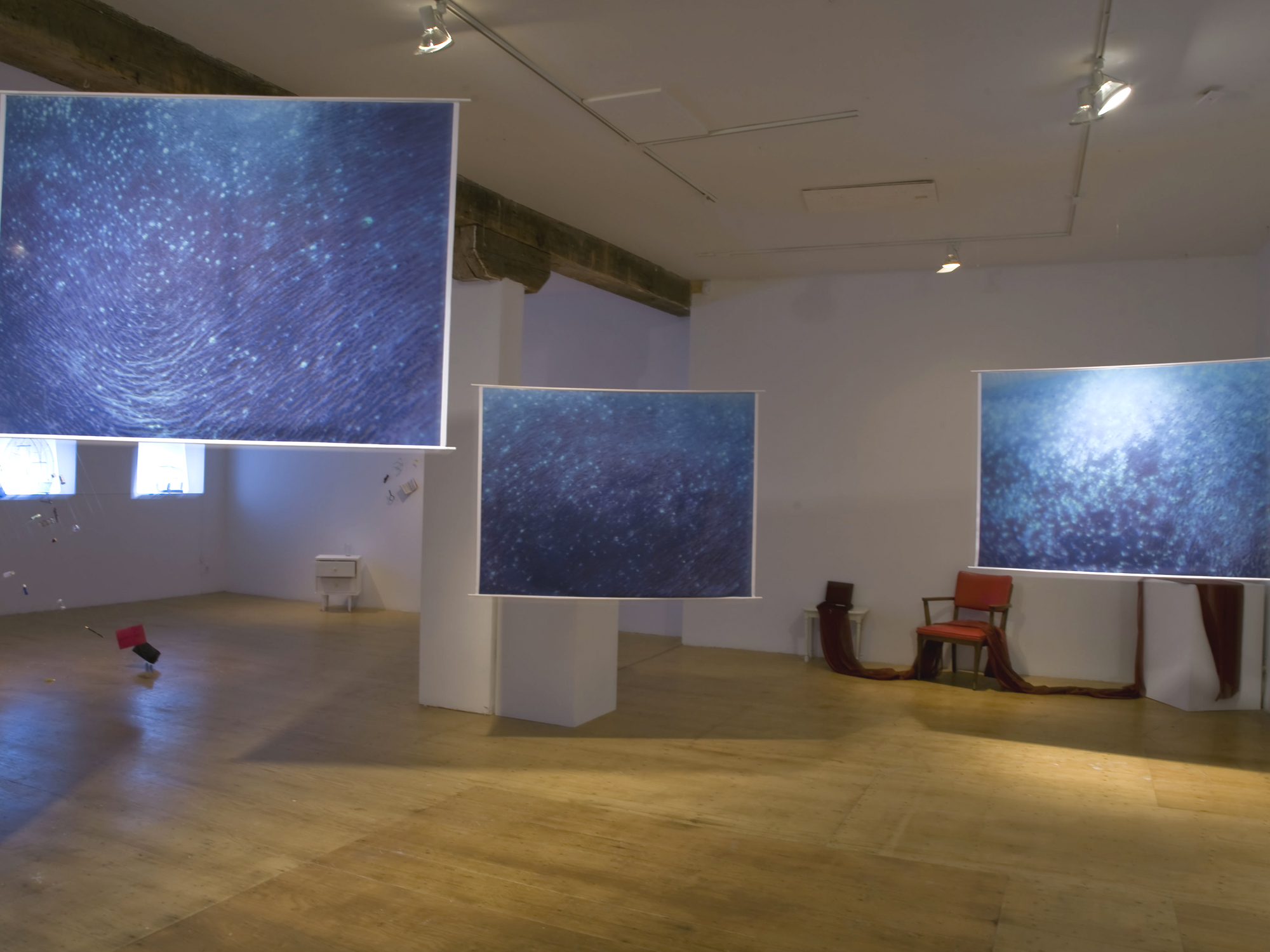
Upon entering the exhibition space, the viewer was struck by the color blue, an effect arising from the presence of nine large-format photographs, three of which were suspended in front of us, with other six arranged in pairs on the wall to our right.

Once this initial impression subsides, we notice a text to our left, printed on the wall, at the foot of which is stood an atlas, its pages open at a map of the sky. The text is taken from L’Atlas de notre temps, and notably explains that, “All of these stars travel together through space, forming a wandering family or a group of suns, which in all likelihood share the same origins.”5 The images that we see in the space are scaled-up negatives of photographs that the artist has taken of numerous small red spots on her father’s skin, symptoms of his terminal illness. Garcia-Luna had no choice from there on in, other than to find a new universe of meaning to accept fatality. She not only transformed these tiny points into a metaphor for the immensity of the universe, but also the relative importance of life. Incidentally, the blue that was revealed in the negatives is also the symbol for infinity, from which all life comes. Beyond the zone of blue in the space, we notice an area dominated by red.

Red : sensory time

A long piece of red fabric links together a series of objects that evoke what we imagine of her father’s life, but also the hope that time may be suspended, settled, faced with the uncertainty of illness. A red armchair is positioned in the center of the space, to the left of which there is a small bedside table, and to the right of which we see a screen on a plinth, covered with the same red fabric.

The artist has opened a small travel chest on the bedside table, which contains three letters : they contain stories of three journeys, which her father has recounted to her mother. One of the letters discusses faraway travels to a Mexico crippled by poverty. Left unfinished, the letter aroused much emotion in the artist. Once again, time is suspended in order to cope with uncertainty. That said, time refuses to stand still.

crédit photo: Ivan Binet

crédit photo: Ivan Binet

An apparently-fixed image appears on the screen, showing the branches of a tree. At the end of one branch we see a single maple leap, clinging persistently. It too is red. The leaf trembles in the wind, then suddenly, in an instant, it gives way, falls loose, and is carried off. The image changes, and we see a mechanical shovel that, in one fail swoop, shatters the bedside table: rupture, loss, death.

Only a handful of people were witness to a key intervention by the artist, the evening prior to her departure. Her decision to paint the whole wall in this area of the space red further heightened the emotive charge of the space. In contrast to the blue section of space that comes before it as we enter, the effect was gripping.

crédit photo: Ivan Binet

crédit photo: Ivan Binet

White : conceptual time

This area of the exhibition space focused on the duality of presence and absence in suspended time. A white chair was indicative of this reality, inviting us to sit and let our thoughts wander, inspired by the objects suspended around us.

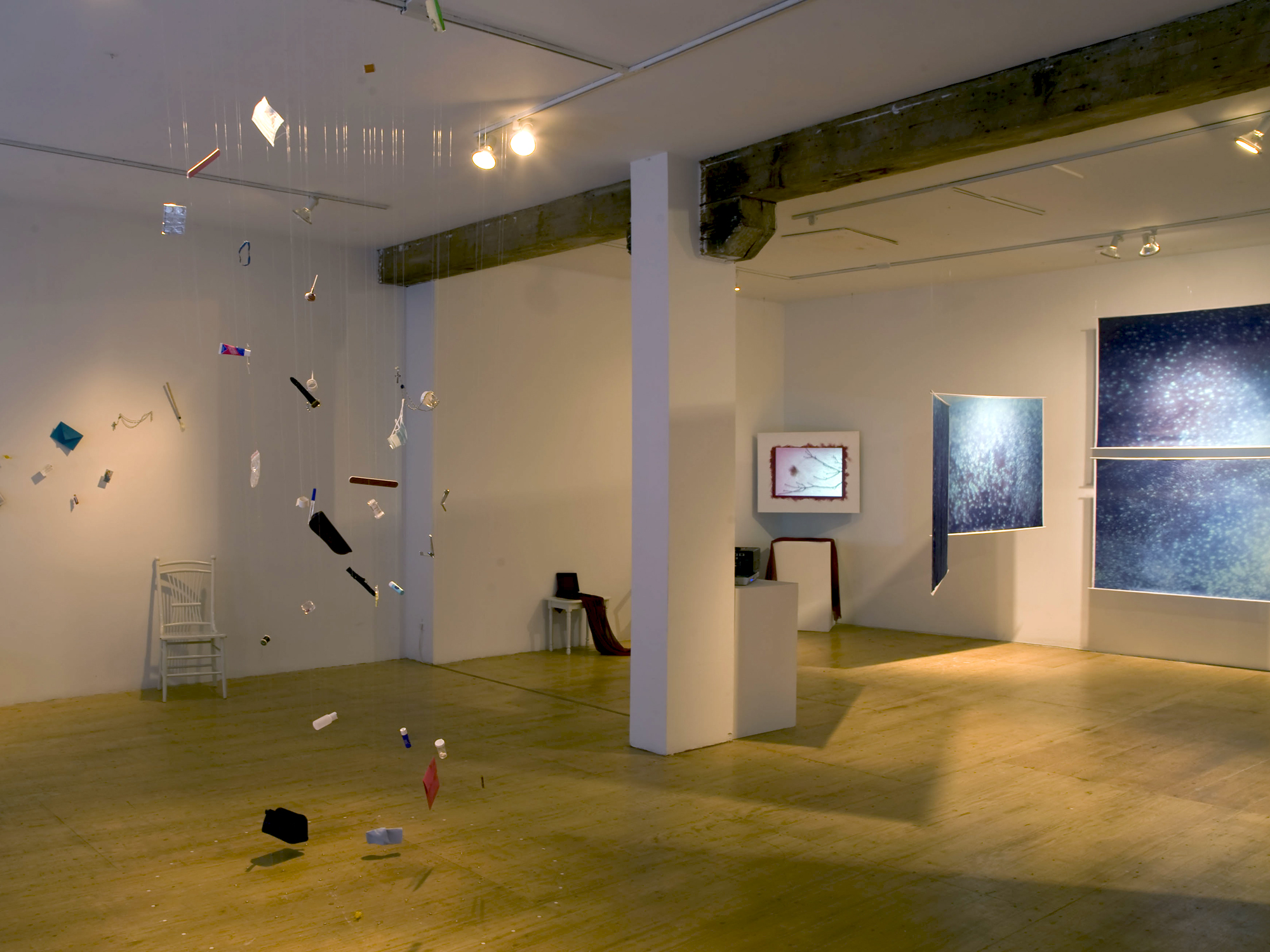
Placed at an angle with the wall, a small white bedside table, with an open drawer, evoked the table depicted in the video. On the adjacent wall, a series of heterogenous objects were arranged as though they had spurted out of the draw and flown across the space. As with the other items in the space, these objects evoked the life of her father and different aspects of his personality, and spoke of the relationship between the past and the contents of memory. Objects suspended in the center of the space – which seemed to move as a whole towards the ceiling – symbolized flight. This movement was accentuated by the use of translucent cord, creating the effect of luminous rays.

On the main wall, Garcia-Luna had transformed four window spaces into luminous alcoves. A birdcage was positioned within each of these recesses, illustrating the duality of presence and absence. In many traditions, the soul’s departure from the body is symbolized by a bird. In an interview at LA CHAMBRE BLANCHE6 the artist added that her father adored birds.

The installation was accompanied by two soundscapes. The first was created specially for the exhibition by the Mexican artist Diana Andueza. The second, created by Garcia-Luna herself, played in the four corners of the space, and featured the sound of drops of blood as they fell, symbolically, to the floor. The combination of these two soundscapes evoked the body and the soul of now-departed father.

In an interview broadcast on the CKRL radio station7 in Quebec City, Gabriela Garcia-Luna explained that she had worked with the public for the first time during this project. The artist drew up a list of 57 objects, with items ranging from a case for spectacles and a Bic biro, to a set of rosary beads and a caramel sweet. From there, the artist called on ten or so people with whom she formed friendships during her residency to participate in a ritual of sharing and exchange.

The final journey

It is often said that death is the final journey. Gabriela Garcia-Luna’s installation echoed this saying. The notion of the journey was present in the three areas of exhibition space: from the blue of traveling stars, to the red of the chest and the travel letters, to the white of the concluding space, and a video based on the artist’s car journeys with her father. It was as though, carried off by poetry, the human journey is never ending.

Poetry inspires poetry. That of Roland Giguère evokes the memory of Universos Relativos, an installation by Gabriela Garcia-Luna that so eloquently expressed the universality and fragility of life.

“I also know a bleeding star
in its blue vice
whose painful reflection dazzles me
with the dying of each day”8

  1. Beausoleil, Claude, ″Le Grand Hôtel des Étrangers″ in Graveline, Pierre. 2007, ″Les cents plus beaux poèmes québécois″. Montreal: Fides editions, p.24.
  2. Klimov, Alexis. 1985, ″De l’abîme″. Quebec: Du Beffroi editions, p. 42.
  3. Gabriela Garcia-Luna, ″Constellations/ blue″, project dossier accompanying ″Universos relativos″, Mexico, 2005.
  4. Lévesque, Maude. 2007, ″Universos relativos″, Press release, Québec: LA CHAMBRE BLANCHE.
  5. Debenham, Frank. 1964, ″L’Atlas de notre temps: Du centre de la Terre aux limites lointaines de l’espace″. Spanish edition prepared by Francisco Vázquez Maure, Madrid: Sélection Reader’s Digest editions, p.118.
  6. LA CHAMBRE BLANCHE [online]. http://www.chambreblanche.qc.ca/EN/event_detail.asp?cleLangue=2&cleProgType=1&cleProg=1734051703&CurrentPer=File (consulted on december 16, 2007).
  7. CKRL, Interview at Aérospatial with Jean-Pierre Guay and Richard Ste-Marie [online].
    http://www.richardstemarie.net/radiomemoire.org/artsvisuels/Gabriella_Garcia_Luna.html (broadcast on december 5, 2007).
  8. Giguère, Roland. 1988, ″Forêt vierge folle″. Montréal: Typo Poésie editions, p. 118.

Against the grain

crédit photo: Ivan Binet

crédit photo: Ivan Binet

″Come, enter the circle, we will all squeeze up to make room. We have been waiting for you. If we retain only one fact relating to him, it would be a thought that was so familiar, so necessary to him, speaking of his most intimate conviction: that one must always ″make space for the other.″1

Virginia de Medeiros was born in Feira de Santana in 1973. The Brazilian artist’s exhibition at LA CHAMBRE BLANCHE consisted of video works, produced during her stay and site-specific work in Quebec City. Following the completion of her Masters in Visual Arts, de Medeiros decided to pursue her own artistic experimentation. Before focusing on the medium of video, her work centered on painting, followed by photography, resulting in a series entitled Femmes pré-moulées (1995). This series marked out the terrain of future enquiries, notably attitudes to the body and relations with the other, and the social position of women. The work that she undertook during her residency in Quebec focused on the notion of the ‘fault’. The word ″fault″ is (nowadays) part of everyday speech, and defines disruptive elements that do not fit within conventional forms of order. That said, the artist sought to stay as close as possible to the etymology of the word. In geological terms, ″a fault is a planar fracture or discontinuity in a volume of rock, across which there has been significant displacement. Active faults are the cause of most earthquakes.″2

This geological definition was born out fully in the artist’s work, in terms of her analysis of the differences and similarities between the city of Quebec and that of Salvador in Brazil. Like Salvador, Quebec is constructed on two levels, possessing a downtown and uptown area. This separation in the urban landscape is revelatory of the social inequality and prejudices that have set in over time. These two distant cities, both in terms of geography and culture, found themselves juxtaposed through an approach that did not seek to simply critique; it was not a matter of noting that the richer part of the population live uptown whilst those less well off live downtown. Rather, the project sought to infiltrate the two cities through the heart of the fault that lies within them.

According to Virginia de Medeiros and her collaborator, the urbanist Silvana Oliviéri, initially speaking, a ″fault″ is a term describing the marginal, those who are excluded by society because they have chosen to live outside of the system. In Salvador, the artist recounts the story of the transvestite Simone and that of Mae Preta. In Quebec, Virginia decided to follow itinerants in the Saint-Roch downtown area. Despite the differences between the two worlds, the artist adopted the same methods, doggedly pursuing individuals able to introduce spectators to other realities.

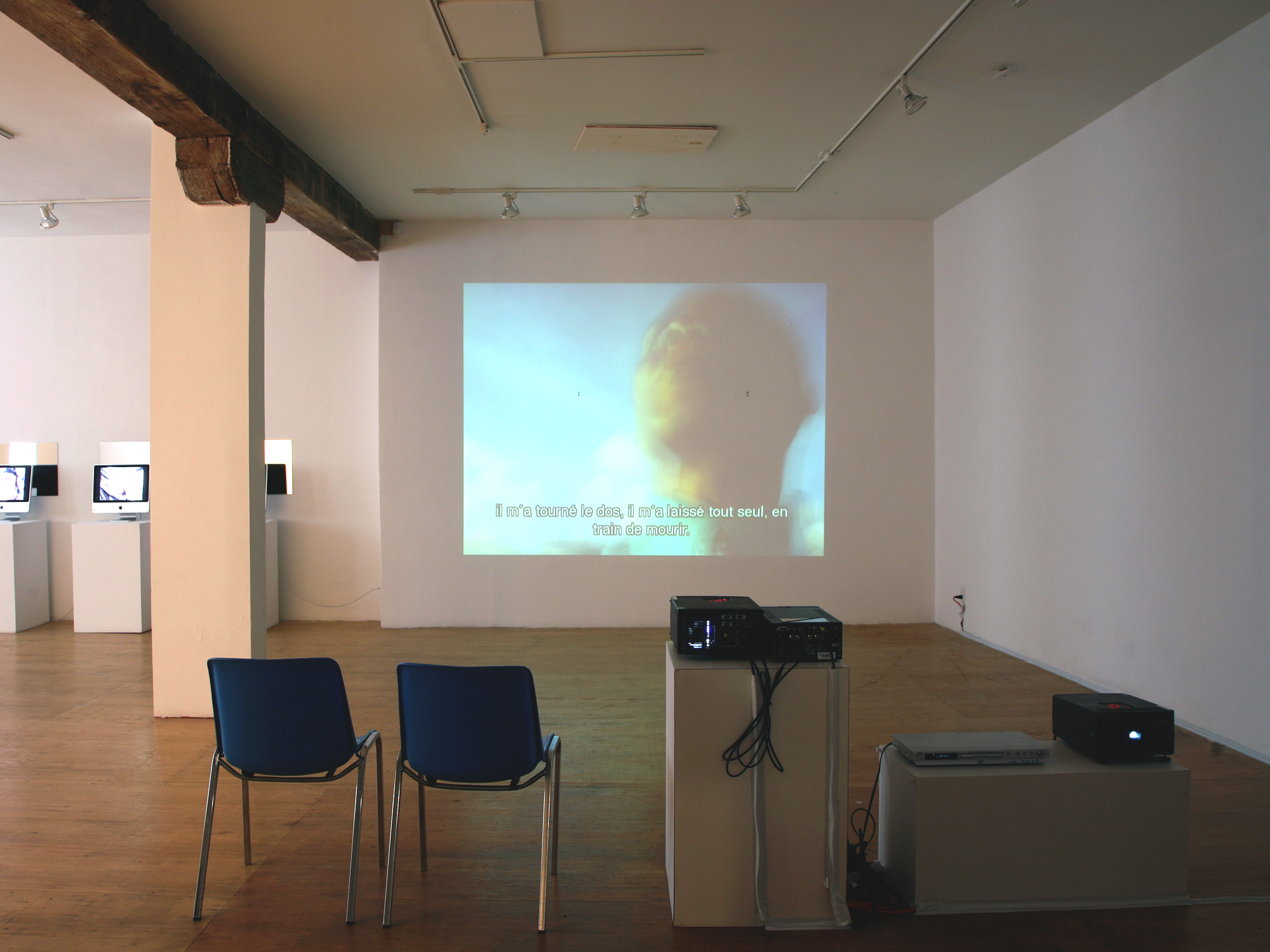
The public entering LA CHAMBRE BLANCHE’s exhibition space were immediately drawn towards a projection of the film Gardienne de la fontaine, produced in 2007. The images show a young Brazilian transvestite, Simone, avidly explaining her ″reconversion″ thanks to God’s love. He tells Virginia how, following a crack overdose, he changed from being a transvestite to a man of faith, preaching to all who will listen of his expiation and his new life. In a kind of mystic delirium, that the artist notably shares in, Virginia follows Simone both as a woman and in the subject’s new state as a man. We quickly understand that Simone is a loner, rejected by those around her. This solitude is underlined by the filmic effects that the artist employs, often placing herself behind the subject and only rarely appearing on camera. Similar to an anthropologist, the artist seeks to keep an objective distance from the object of her research. At the same time, it is this very sense of distance that enables the spectator to understand that what he/she is witnessing via the camera is above all a gaze. This is a vision that, ultimately, marks a form of questioning that is far from deterministic in nature.

How to be a woman? Is Simone a broken mirror of ″womanhood?″ By treating the body as a form of representation, the artist is able to draw the spectator into a deep reflexion on his/her own position in the social fabric and relationship with otherness. Virginia de Medeiros’s work with Silvana Oliviéri aims to be transgressive. It shows the appropriation of social codes by an individual, and how this appropriation becomes itself problematic. The ″unstable″ gender of the transvestite continually blurs the characteristics associated with femininity and masculinity. Numerous authors have insisted that femininity and masculinity are not concepts with a grounding in nature. Rather, femininity is a genre, a psychological and physical construct.

According to Judith Butler, a key figure in Queer and Gender Studies, ″To say that gender stems from a form of doing, is merely to state that it is not fixed in time, not a given; it also points to the fact that it is constantly unfolding, even if the form that it takes creates the appearance of something natural, preordained and determined by a structural law. If gender is made, constructed, through certain norms, these same norms are the form that it takes, that which renders it socially intelligible.″3

Moreover, Virginia de Medeiros and Silvana Oliviéri perceive identity not as something that is fixed, but as something that perpetually encounters forms of tension. It is through the prism of these differences that an individual can question his/her essence. The Brazilian artist ″sublimates″ these differences, which, ultimately, become a form of artist material. In this artist’s eyes, accepting alterity means each of us embracing the idea of inner upheaval. According to de Medeiros, difference is, “an agent of transformation.”

crédit photo: Ivan Binet

crédit photo: Ivan Binet

La gardienne de la fontaine does not recount the story of Simone, it also deals with Mae Preta, an elderly lady who tells us of the difficulty of her life in Salvador. After her home burned down, she was forced to look for new accommodation, despite having few means. Like Simone, Mae Preta was forced to leave behind and redefine her makeup as an individual. Whether it is in terms of identity issues or localizing oneself in the urban context, the characters in the video reinvent their relationship with the city. For example, every day Simone takes care of an abandoned fountain, gathering and burning rubbish, and cleaning the structure in what almost amounts to a pagan rite. The videos shown in the exhibition in Quebec City also showed how itinerants in Saint-Roch appropriate certain sites.

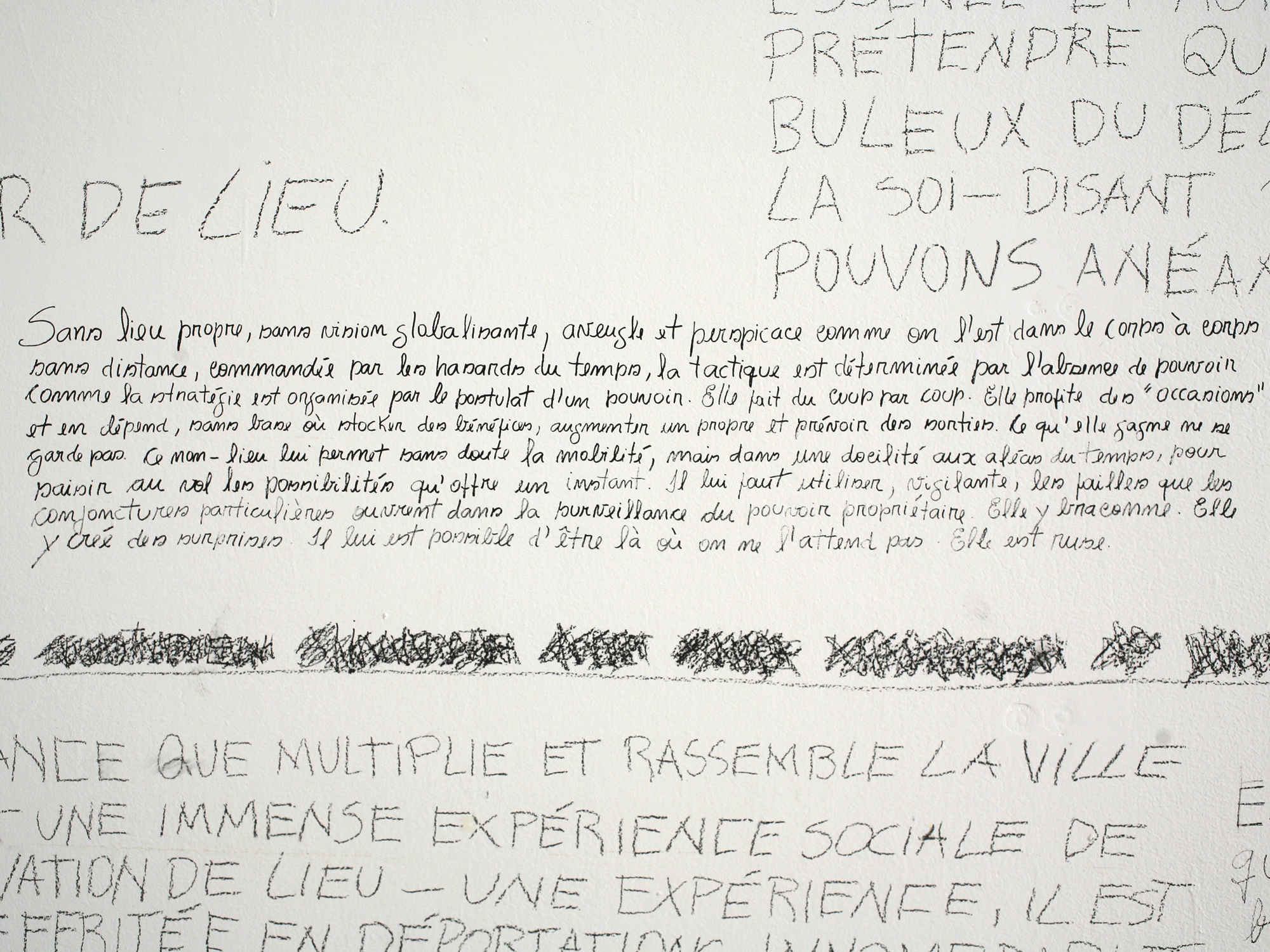
One influence makes itself consistently felt in Virginia’s art practice, that of Michel de Certeau and his book The Practice of Everyday Life4. The artist’s exploration is nurtured by two notable concepts from this seminal work, first published in French in 1980. In defining our relationship with the city and areas within it, Michel de Certeau spoke of strategies and tactics. Strategies involve an approach to power that seeks to locate the subject within subject/object relations. Strategies seek to accumulate a significant amount of goods in order to transform these into profit. Meanwhile, tactics represent ways of life for inhabitants of a given space, for example, going to the market, or drinking a coffee every day in the same cafe. Thanks to an understanding of tactics, the subject/inhabitant is able to create a more poetic relationship with his/her immediate environment, reinventing the everyday, from day to day. Tactics become, “the art of doing” that makes use of faults in the dominant system in order to reinvent itself. However, tactics do not enable one to entirely free of the system. Above all, they introduce the possibility of implementing a distance between oneself and systems. Tactics may also take the form of margins, wherein forms of otherness breath other ways of being in the city. The fact remains that observing these subtle shifts required a committed involvement on the part of artist in working with the people filmed.

Virginia de Medeiros set out to research the everyday experiences of those living in the Saint-Roch area, and their view of the process of revitalization that the area is undergoing. The moments of life that the artist shares with the participants represent these experienes, and constitute emotional encounters that move the artist as deeply as her subjects. A ″fault″ can produce creative energy. The position of the artist becomes fragile, as the encounter with the other is transformed into a necessity. Ultimately, the video works presented at LA CHAMBRE BLANCHE embody the possibility of envisaging our environment in ways other than through the grid of identity that at times may seem insurmountable.

  1. Giard, Luce and Michel de Certeau.1980, The Practice of Everyday Life: The art of making-do tI. Paris: UGE editions, pp. 33-34.
  2. Wikipedia [online]. http://en.wikipedia.org/wiki/Fault_%28geology%29 (consulted on November 11, 2007).
  3. Extract from the paper ″Faire et defaire le genre″ (Undoing gender) , by Judith Butler, Professor at the University of California in Berkeley, given on the 25 May 2004 at l’Université de Paris X-Nanterre, in the context of CREART (Centre de Recherche sur l’Art) and the doctoral program ″Connaissance et Culture″
  4. Certeau, Michel de, Luce Giard and Pierre Mayol. 1980, The Practice of Everyday Life: The art of making-do tI et Living and Cooking tIII. Paris: Gallimard editions. 416 p.

Living on the Badlands

A discreet vapour emanates from the asphalt, although the cars are barely moving, the noise of their running motors and the smoke from their mufflers continues unceasingly. In spite of the fact that the highway counts numerous lanes, the imperceptible movement of the motor vehicles combines itself with the expressions of resignation and impatience of their drivers. Under the robust structure of the highway a lost stare contemplates the impossible task of traversing the thoroughfare, ironically isolated, he glances in front into a useless leftover space produced by the colossal highways’ structure. We are in any city, going to any place, a familiar landscape that forms part of our everyday as urban dwellers and that repeats itself in almost every city, like a silent echo that we frequently ignore.

crédit photo: Ivan Binet

crédit photo: Ivan Binet

Have we ever asked ourselves how did this come to be? How is it that this situation forms part of my everyday?

Have we ever stepped out of the comfort capsules that our cars represent and analyzed this phenomenon from another perspective, a pedestrian point of view? n environment that doesn’t seem conceive by human beings, where there is no sense of ergonomics or proportion, where, inhabiting, the most essential of human activities, seems an impossible challenge.

Even though the city is filled with contradictions and complexities, it continues to be a strong magnet that attracts a great majority of people. The greater part of the world population lives within an urban centre and migratory tendencies indicate that this number will continue to increase due to the strong pull of economic, political and social interest that attracts people to cities. This fact has transformed cities into fast moving and changing spaces that suffer abrupt continuous transformations in their form and shape. Therefore, leading cities to compromise their identities, their principles and their essence while their poles of interest move and disperse their limits.

What we refer to, as urban centres in reality are a series of different “cities” united by transitory leftover spaces that we have learned to accept and domesticate. These spaces are a new challenge to our understanding of the concept of what a city is. They are ever changing spaces with no personal identity that repeat themselves in most large urban centres around the world, like an “island” that repeats itself in the collective memory of our societies. This all constitutes transitory spaces that we mainly utilise to move from one “city” to another in our extremely polarized urban centres.

These transitory spaces that pretend to link our urban centres in reality divide and separate them, creating frontiers within the urban tissue of our cities, splitting neighbourhoods and creating useless leftover spaces. These spaces are mainly the leftovers of a huge automobile infrastructure that leaves on its way huge useless spaces that have no specific use or intention hence no particular identity.

Thanks to its nature, we have associated these spaces with the post-modern notion of “non-space”, an ideological posture that denies a well-known and accepted concept, questioning its essence and revelling its particular complexity.
Our cities contain hundreds of these “non-spaces” which interrelate with one another creating huge conglomerations that occupy great extensions of our urban surface. The conglomeration of these “non-spaces” creates consequently what we can refer to as a “non-city”, the denial of the concept of city. Following this same train of thought we can argue that by producing and inhabiting the “non-city” we become “non-humans” and our thoughts, words and actions are governed by a “non-understanding”.

These conditions manifest themselves in the fact that while we concentrate ourselves in making our cities more comfortable and functional places, paradoxically we are also doing exactly the contrary. We are creating space with no particular use, intention or identity, spaces that divide and disintegrate our cities and dehumanize the life of its dwellers.

It is this inherent complexity, this apparent particularity that nourishes the artistic discourse of Eduardo Valderrey. This spatial phenomenon of our urban centres influences the creative reflections of the artist, nourishing his project Malpais. Malpais is a particular notion with which Valderrey makes reference to the visible geographic hostility of these areas of our cities.1

Contemporary badlands, territories created and provoked ironically by ourselves while pursuing a more comfortable and efficient lifestyle, making these spaces a part of our everyday. Aside from the aesthetic and formal stimulation that these spaces may instigate, the “non-city” proposes new challenges in the way in which we conceive, inhabit and understand the city, questioning its essence.

How many times have we stopped for an instant to admire this discreet herb that has apparently sprouted from the heart of a sidewalk’s concrete? A fragile little plant that has found its way to grow in the middle of a paved street and that grows slowly, smiling, knowing itself a winner of a silent battle. Maybe with time, this tiny plant grows into a big fruitful shady tree, filling us, without knowing why, with a fresh scent of hope.

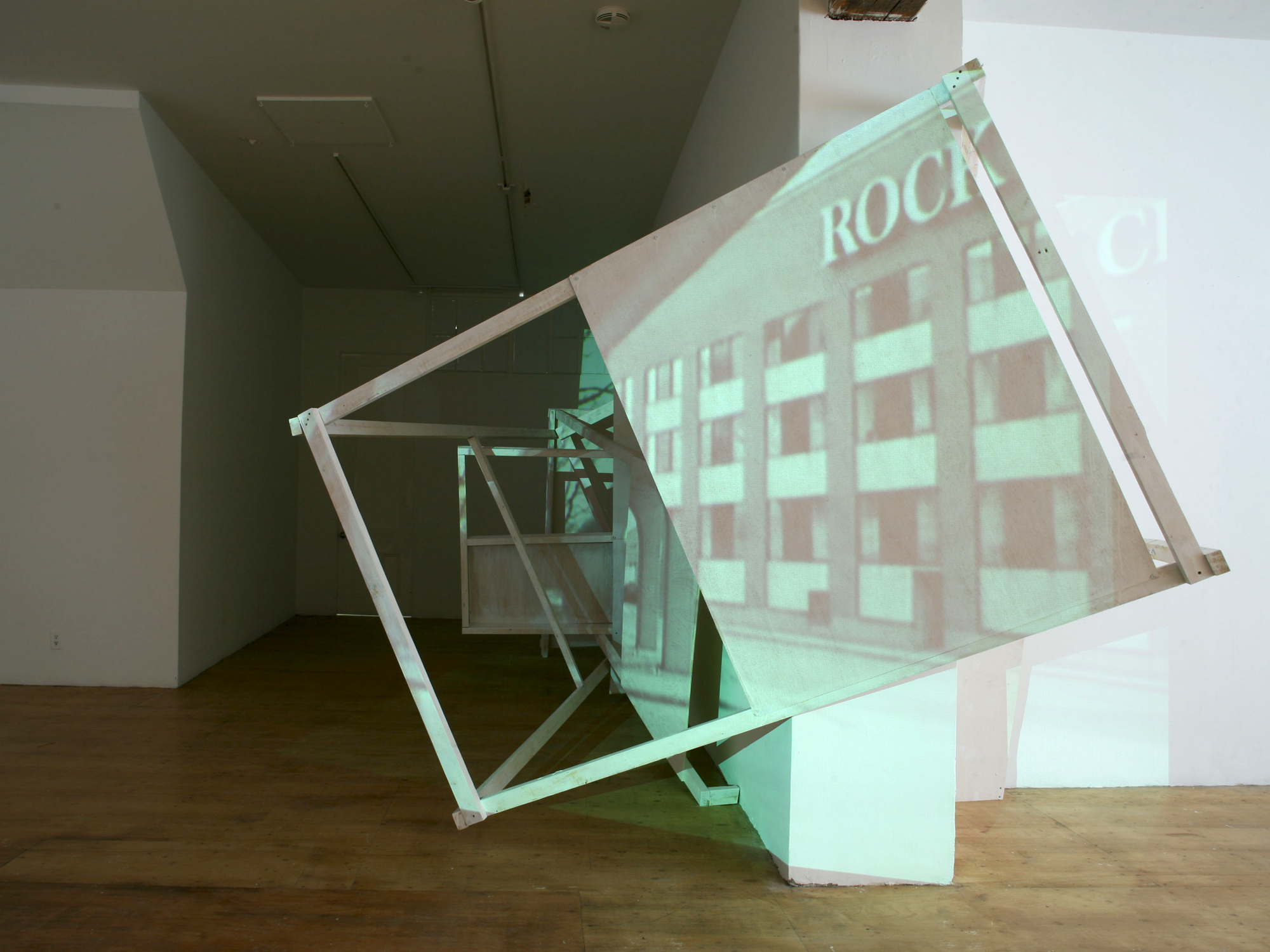
In this same manner, Eduardo Valderrey’s work, sprouts like this herb in the middle of a paved street, naturally perturbing its surroundings. Creating a new architecture inside an existing one, installing structures that perturb the existing architecture and using them as screens to project video images that describe the contemporary urban badlands accompanied with rhythmic percussive sounds, Vaderrey deconstructs our notions of the articulate city. His work encourages the questioning of our preconceived notions of the city, making us reflect upon the kind of spaces that we inhabit. In this way, Valderrey’s Malpais is filled with stimulations that lead us to ponder about the cities we live in and the form in which we would like to inhabit them, thus blooming a yearning to change them.

The idea and possibility of altering our cities in the name of common well being is not new. To the contrary, it has been an unfulfilled wish that has accompanied us since the last century. This social desire for transformation has remained a utopia and has been treated by sociologist, philosophers, urbanists, architects and artists alike. In his essay Quotidien et Quotidienneté2, Henri Lefebvre reminds us that in order to change life we have to change society, space, architecture and the city. In this way, the discourse to change the city is a well-known one. One will have to insist then on the fact that in order to be able to change the city one has to change its relating concepts. While discussing his notion of concept-city in his book L’invention du quotidien3 (The invention of the everyday), Michel de Certeau reminds us of the intrinsic symbiosis that exists between the city and its concept. The first step in changing the city is redefining its concept, thus redefining our concepts of urbanism and architecture.

The way in which we understand the concept of living is the heart of this conceptual question about the city. Caught up in the inertia of modernism, which we have not fully analysed and questioned, we continue to live under the premise that gives the automobile unmeasured importance, considering it an essential part of the well being associated with living in a city. It is not until we profoundly question this principle and ponder about its benefits and harmful aspects for our cities, that we are going to be able to start rebuilding our concept of the city and break with our polarizing inert tendencies to disarticulate our urban centres pushing us to inhabit hostile spaces willingly in the heart of the urban badlands that we nourish everyday.

crédit photo: Ivan Binet

crédit photo: Ivan Binet

Paradoxically, like Dr. Frankenstein, we have created a creature that has become an uncontrollable monster. The so-called metropolitan area is made up of both cities and non-cities and seems to grow by itself, like it has a life of its own. Trapped and paralyzed by its inert movement we witness how our urban centres, far from re-creating its spaces, offer us hostile environments lacking real intention. It is said that these spaces reflect the absence of personal, social and collective identities and repeat themselves in any place at any given number. Lets keep in mind that this “loss” of identity is reminding us of a profound collective amnesia that prevents us from remembering the basic fact that we create ourselves the spaces and environments that we inhabit and it is ourselves who create that which we refer to as city.

If at certain instances, it seems like we have created an urban frankenstein, it is our duty to nourish it or destroy it. For the most important part of recovering our identity is acknowledging our capability and responsibility to transform the place in which we live in.

  1. Through out the history of exploration, human beings have encountered all kinds of territories. They founded both abundant fertile lands that fitted their needs and promoted their well being, and hostile inhospitable lands that did not served their purposes and where often avoided and respected. It was this second kind of territories that English explorers called badlands, concept that has been translated into Spanish as malpais to describe this kind of hostile environments of practically no use for human beings.
  2. Lefebvre, Henri. 1972 “Everyday and Everydaylife”, Encyclopaedia Universalis, vol. 13, Paris: Claude Grégory editions. p. 152
  3. Certeau, Michel de. 1970, The invention of the everyday. Paris: Gallimard editions. 416 p.

I’ve felt this before, but…

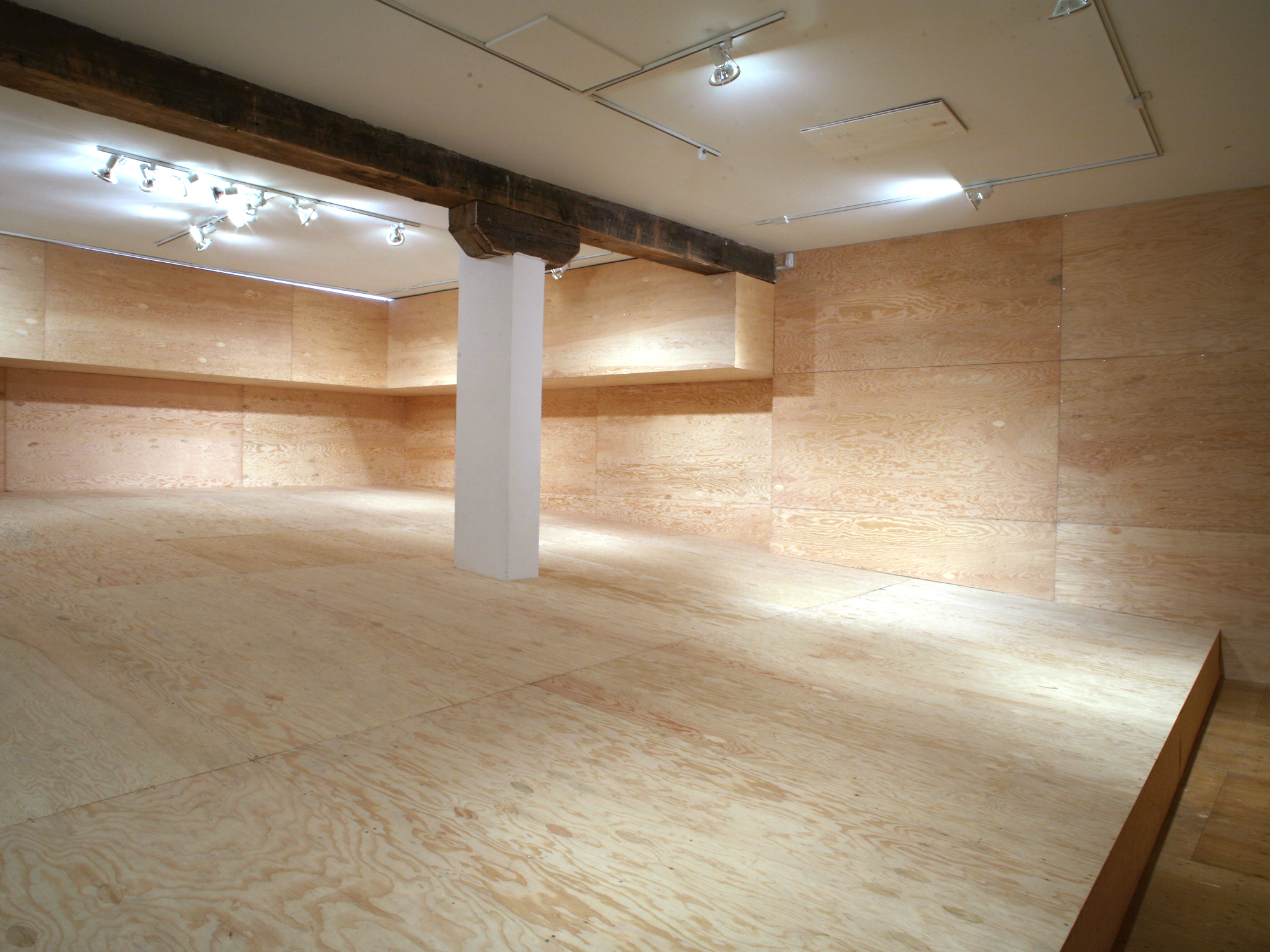
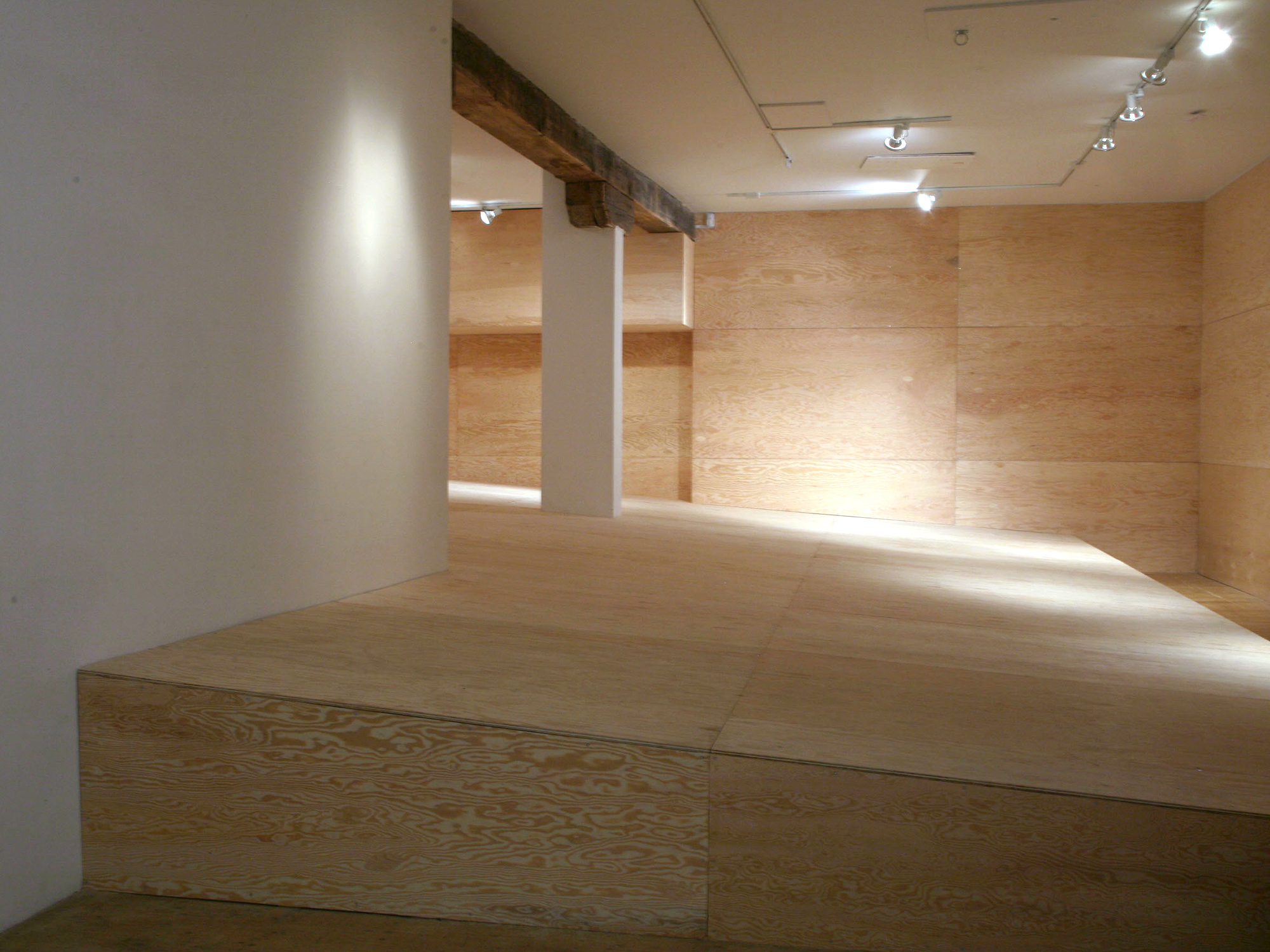
Although Alexandre David detests disciplinary categorizations, he considers himself a maker of sculpture. Whilst he works in a number of diverse practices, which he regards as secondary, his preference is for sculptural installation. David’s objects are also spaces; his work deals with our understanding of space and objects, and the complementary relationships that exist between them.

Over a period of five weeks, David transformed LA CHAMBRE BLANCHE’s exhibition space into a joinery workshop; wood is a very enjoyable material to handle, the artist tells us, and is something that can be recuperated. The doors opening out onto the street carried with them a fine dust and the perfumes of the forest.

crédit photo: Ivan Binet

crédit photo: Ivan Binet

The first week of David’s residency involved the hanging of threads in the space, forming a three-dimensional sketch. The artist is a perfectionist, which led him to rework his idea over twenty times during the process. For example, in order to avoid juxtaposing an impeccable cut of wood with the irregular, and potentially disruptive line, of the ceiling he decided to leave a slight space between the two. Initially, the final form of the work was to have been an L-shape, allowing movement around the work. This plan was abandoned. Boxes built at ceiling level were also demolished halfway through, after a week of consideration:

“I took them down. I had the impression that I was simply reproducing a traditional cloistered form, with a roof and an empty center. It was too loaded. It interrupted the tone of the work, turning the space into a single entity, when I wanted to create a number of very different spaces. If I had another six weeks, I’d do it, build and fill the space with them. Just to see. But it’s always a question of choices.”

crédit photo: Ivan Binet

crédit photo: Ivan Binet

“When I arrived at LA CHAMBRE BLANCHE I saw two systems: one, parallel to the street, consists of two walls with columns in the center; the other is autonomous, and independent of the street. So I wanted to explore these two directionalities in the space: to emphasize the columns and the experience of separation, and the distinction between two halves.”

Alexandre David’s installation demanded an effort on the part of the viewer for it to be properly appreciated. This was not because the work was hermetic in nature – the artist stresses that his work is not intended to be conceptual – rather it is experiential. In order to grasp the intentionality behind the work, one must therefore scale it. Here I attempt to retrace the journey that he proposed, with the help of the artist’s words.

“Being up high on the work gives us a sense of direction, because when we see its surface, we see that there is no access into the space at any point. We can come back down or go higher. If we go higher, something happens: we realize that there is a curve near the base of the work that is barely noticeable. It is not a visual curve, but a curve in the base of the structure that we feel when we are walking on it. Why is the curve there? I wanted to create an architectural environment, not in terms of design, or creating an interior in which my installation would become a type of loft. I was more interested in exploring the relationships between different types of sensation to create something singular, something new.”

“The sensations that I am referring to – such as walking on the ground or climbing a slope – are sensations that are associated with exterior architectures. When we climb a hill there comes a point at which we slow down: the angle of the slope becomes less steep, as it levels out at the top before descending. So we stop, turn around and look at the other side. My curve recreates the exterior sensation that prompts people to turn around and look at the other side of space. This is a good example of how I work. I use ordinary things from everyday life to create events.”

“We also feel that the slope is rounded in two directions, which pushes us to the corners, always in a kind of slowed down motion. I didn’t want the work to be aggressive; I didn’t want people to climb straight up the structure and run into the box forms. Instead, viewers can come and sit on the structure, under the boxes, as in a cave or when sheltering under trees or a roof. A range of architectural sensations are in the mix. It’s as though we are protecting ourselves from the sun, from bad weather, this is how the elements of exterior architecture work in my installation. At the same time, the way that the walls are layered with plywood and forms overlap in space, each one positioned in relation to the previous, evokes the feeling of an interior architecture.”

crédit photo: Ivan Binet

crédit photo: Ivan Binet

“In addition to these sensations, I play on the familiarity of architectural features such as the height of a step or a bench. For example, the point at which one climbs up on the installation, the step, is much higher than normal. But on the other side, nearer the wall, the step looks more like something found in a park, perhaps a bench. The space marked out by this step (or bench) forms a corridor. The environment is therefore composed of elements that are reminiscent of known architectural features, except that my intention is not to evoke a structure that is already familiar. Rather, this approach allows me to propose something that – given its uniqueness spatially – is not really architecture at all.”

“Ultimately, the particularity of my approach lies in the way that I create objects that, quietly, become spaces in their own right. This transition takes place slowly, and from two directions. Beneath us, the platform does not make contact with the wall, it acts and functions as an object. The structure then continues forward, joining back up with the wall, meeting the wall in a way that transforms the object into a site. This accentuates the feeling of turning a corner, prompting us to turn a corner: the title of my residency refers to this sensation.”

“My work has no symbolic value, it says nothing about the world. We discover nothing in it other than what we experience. On the contrary, such symbolism lies on the other side of the work, it forms the foundations from which we are able to experience space. Once the experience has taken place, it has no further significance for me. It can however be related to the everyday, to our knowledge of architecture, prompting us to reflect on space, and perhaps to acquire a critical perspective, as is the case with all art that reconnects us with life. But there nothing to decode in the work.”

“One could, stretching it, speak of a formal experience, but I don’t really like this term, because it often refers to experiences that are separate from everyday reality. I’d speak of perceptual, sensorial or event-based experience, but certainly not of intellectual experience, even if I am able to intellectualize it after the event.”

“One last thing is important, the installation is not a solely visual experience. It involves a meeting between the visual realm and use value. The work does not involve simply looking, or conversely simply sitting. It involves a meeting of the two. One must no longer be able to separate the two, except in terms of language. The work is not merely a functional object. We have to use the space that we see, and for that we have to draw on our basic knowledge of architecture: for example, our everyday experience, when we are young, of hoisting ourselves onto chairs, or of climbing a ladder. Of course, there are more visual moments, images, in the work. Climbing up at this point creates a frontal, visual experience that is supplanted by the sensation of the curve in the floor. I modified a slope during the making of the structure, precisely so that it was not too visually apparent.”

Personally, I am more intrigued by the formal nature of David’s work. My body no longer senses the subtle variations that the artist has introduced into the work, based on his extremely rigorous handling of materials and calculations. I am more attracted to the logical impossibility, the improbable and nevertheless visible fusion of two uneven surfaces juxtaposed with the ground. I am more attracted to the fact that the slope leads nowhere. At the same time, I am tempted by the corridor in the work, which offers a means of moving around amongst other viewers that seems more convivial.

David specifies that he, “wanted to create a form of symmetry, of equivalence between the two spaces. At the base of the structure there is a hollow in which people can walk, and up top there is a hollow in which people can sit. If you stand up, you hit your head, or else you have to walk hunched over. The spaces are, therefore, static (points at which to observe an empty center) as opposed to spaces for walking around (in which you can observe something as it transforms into an image). The voids are a form of punctuation in the object. At the top and the bottom of the slope there is an inversion of volumes. I like this notion of inversion, of negative volume.”

On entering his installation at la chambre blanche, Alexandre David saw a form of public space, an empty center (a city center perhaps?) surrounded by walls and encircled with boxes. The project is an extension of an approach that he has been developing in his practice as a whole, whereby the object becomes a site. He is increasingly interested in architecture and less and less in the creation of defined objects. His next project/space, planned for Montreal, will consist of a mobile public space on wheels, with plastic cases that can be opened.

David has always been interested in the architecture of public space, without knowing why. Gradually, he began to perceive public spaces as a form of knot, a focal point from which collective decisions are made. Collective, public space is extremely important to the artist; the physical and material agora inflects the ways in which we work together, and construct community. Architecture, he says, plays a part in a holistic vision of the world. It draws together all aspects of life. It’s a question of ethics, of generosity in the world, of going beyond individualism by creating or collaborating on the creation of forms of critical reflection on collective space. This seems to be shrinking, according to the artist, “We are sold collective space on spectacular terms. Here is a new train station, a new airport, a new museum…”

David prefers working in something different, something unique: “My work is ephemeral because I have no desire for my projects to be installed permanently in space.” The artist wishes to work on small-scale projects that reflect on architecture that influence experience and contribute to the sharing of ideas and the senses. Therefore, although he claims that his work is neither political nor symbolic, he is conscious that it is situated in political space.

He concludes that, “art making draws us into the collective sphere because it involves addressing the other. This is even more the case when the work takes place in public space, at a site that interests the public.” In sum, David wishes to prompt us to reflect on this subject, which does not exclude the rural experience, whilst his preference is for urban settings.

Study of a phenomenon or the invention of a memory

From the 26 January to the 25 February 2007, Julie Andrée T. undertook a site-specific residency at LA CHAMBRE BLANCHE. The artist has produced a considerable body of work, and her installations and performances have brought her international recognition. She has been a member of Black Market International since 2002, and regularly collaborates with other artists, including Dominic Gagnon and Benoît Lachambre. From time to time, she co-directs works by the PONI collective and has also been a member of the experimental theatre group PME, directed by Jacob Wren.

crédit photo: Ivan Binet

crédit photo: Ivan Binet

The relationship between the body and space is a fundamental area of exploration in the work of Julie-Andrée T. Étude d’un phénomène ou l’invention d’un souvenir forms part of a body of work that has been ongoing for some time, centering on the relationship between the human and nature. The project is inspired by current interest in climate change, and particularly the natural disasters that it produces, in a context where the media often serves to distort the perception of the population.

Julie Andrée T. presented an installation at LA CHAMBRE BLANCHE that sought to construct the fragmented memory of a natural disaster. Her interpretation of climate was based on a range of references and media, developing an aesthetic of disaster in which it is difficult to gain access to information.

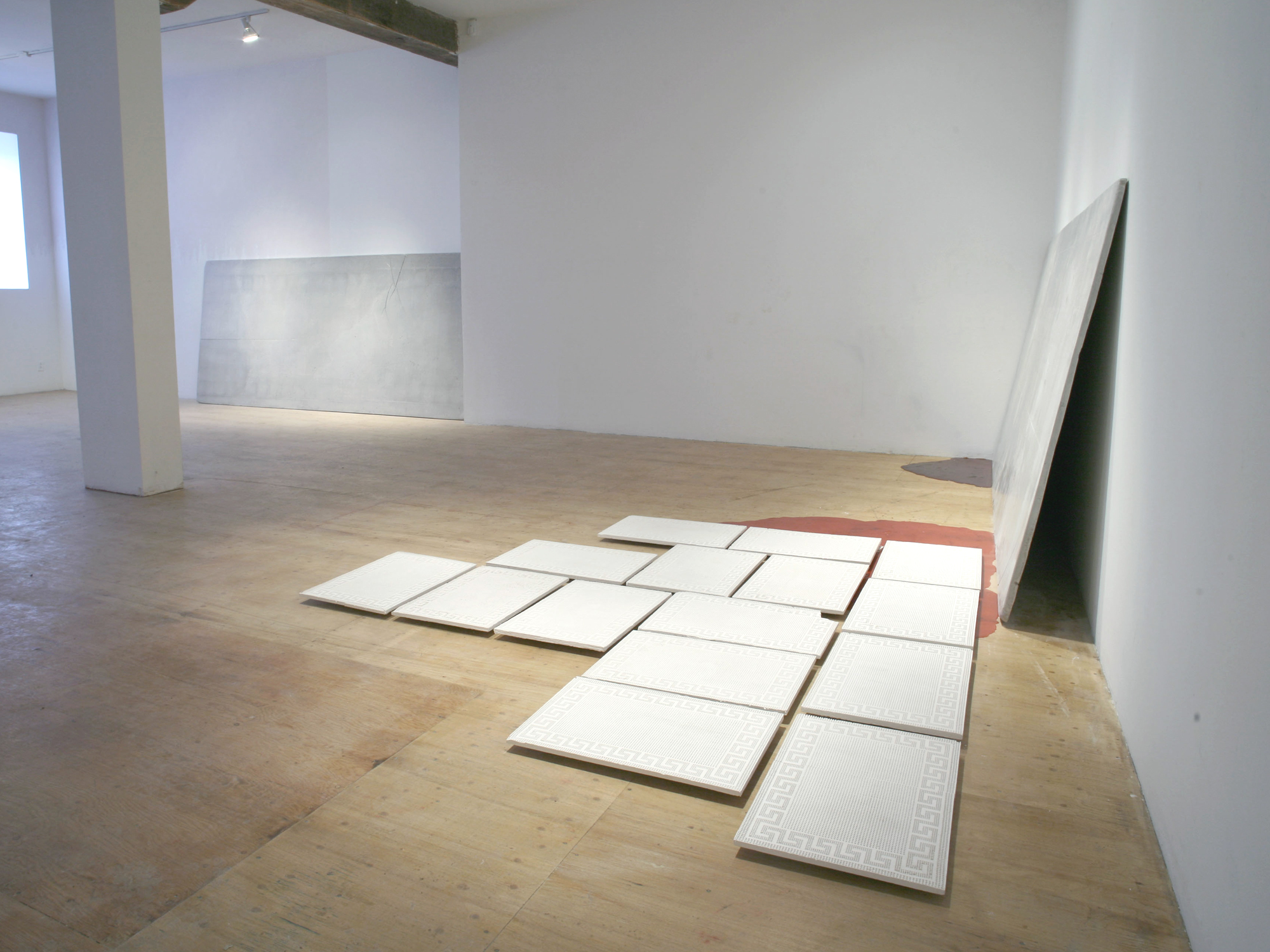
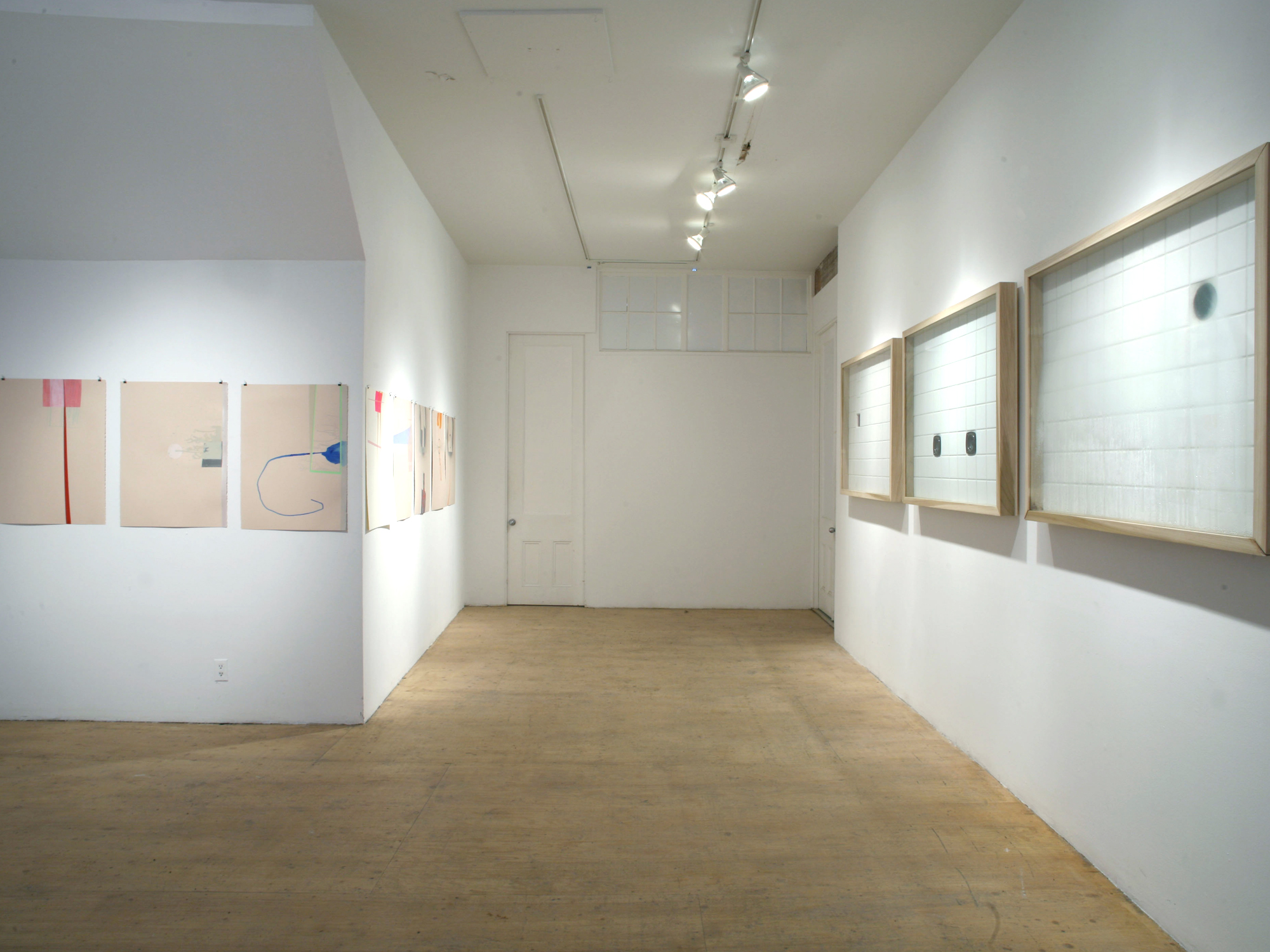
The installation was divided into four sections that interacted to create a strange habitat. The first section consisted of three pictures made of squares of white ceramic. In the first picture, one of the white squares was replaced by a small screen displaying images of an erupting volcano. In the second picture, two small speakers took the place of white squares, and played recordings of disturbing sounds and stories of disaster. Smoke came from the third picture, by means of a similar device. A glass screen placed in front of each picture prevented us from coming directly into contact with the works. As a whole, the triptych conveyed the impression of a natural disaster by means of three different senses: sight, sound and smell. The ensemble evoked the feeling of segmented memory.

crédit photo: Ivan Binet

crédit photo: Ivan Binet

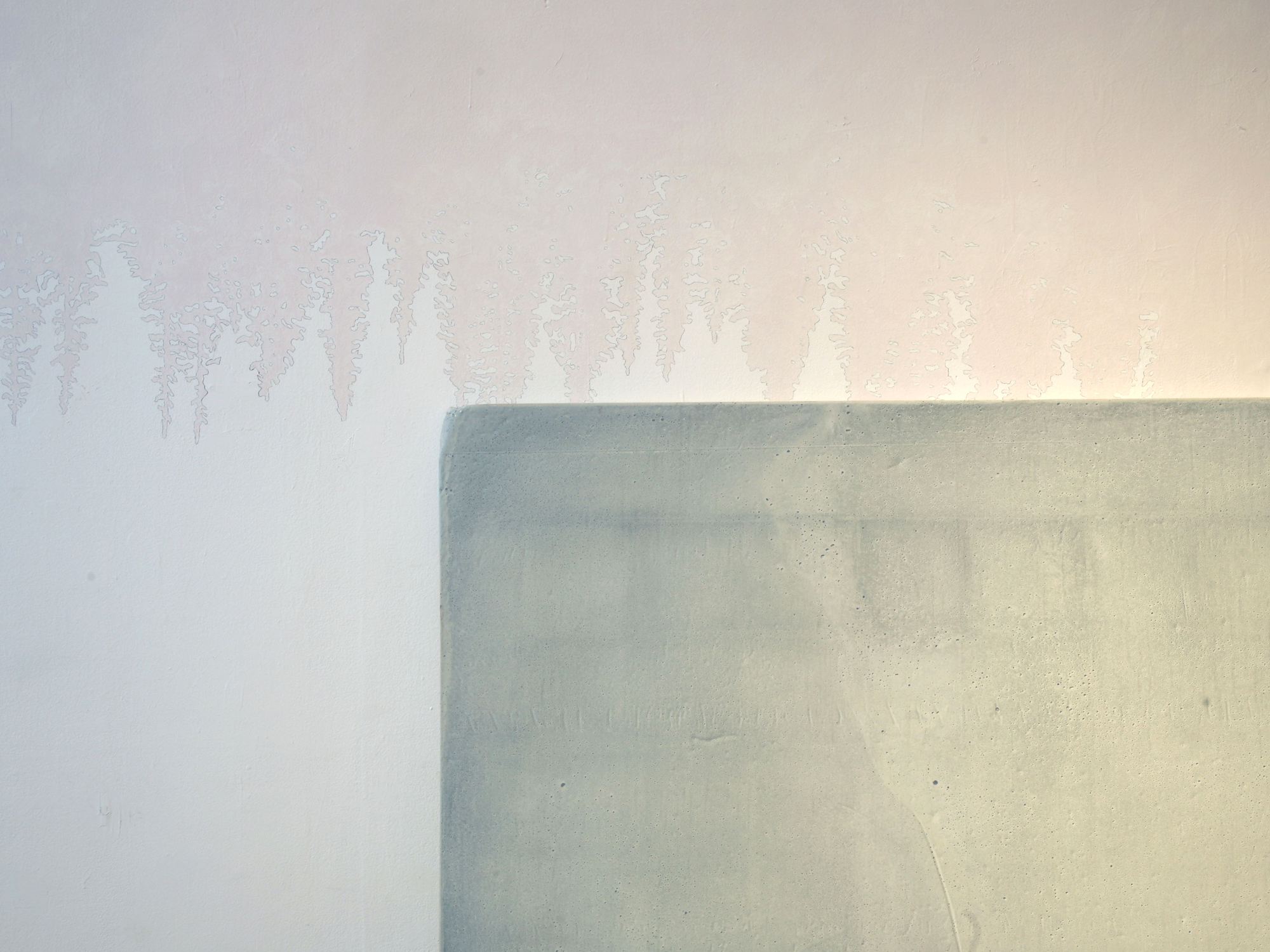
At the far side of the exhibition space, a concrete block leant on a wall that bore the outline of a forest in red and off-white. Drawn upside down, the heads of the trees seemed to flow like blood from the ceiling. On the wall perpendicular to this, another forest, on its side, seemed to fall to the floor. This flood of red, which seemed a response to the block of concrete, signaled another natural catastrophe, laying bare the tension that exists between man and nature.

The third section of the installation consisted of another piece of concrete leaning against the wall. To the right, rectangular plaster moulds burst up from the floor. They seemed to float above the ground, as though time stood still. This created the feeling of being witness to a meeting that had been interrupted. The fixed feeling of the scene was accentuated by the weightiness of the materials used. A mysterious substance that resembled blood emerged from the left and right side of the concrete, as though an accident had taken place. Given that the trace on the right was more marked, one surmised that the second accident was more recent. These traces of ‘blood’ gave a pictorial feeling to the space, harmonizing with the drawings that the artist had chosen to include.

Before entering the space, there was a sense that the elements were moving, communicating amongst themselves, and the feeling that they had suddenly frozen to preserve the secret of their story. This effect contrasted with the three pictures, which seemed instead to be communicating something that cannot directly be perceived.

The viewer felt obliged to keep a distance from the elements on show, a distance that marked out this residency from other projects by Julie Andrée T on the theme of climate. For her project Prudence Volontaire, presented at Le Lobe in 2004, the artist created parloirs-isoloirs (self-contained spaces) featuring a series of micro-climates designed as situations that would provoke meeting with viewers. The artist worked again with the reality of climate in Weather Report/Potentiels évoqués, presented at SKOL in 2005. On this occasion, she developed structures in which viewers could enter directly into contact with different artificial climates. The spectator’s senses were thus called to react to conditions of heat, fog and wind…

By contrast, at LA CHAMBRE BLANCHE the artist presented the audience with sealed elements, something like a bottle that it is impossible to open. Instead, viewers had to fix the fragments of the work together, enabling them to re-transcribe, in their own way, the memory of the natural disaster that had taken place.

Julie Andrée T. likes to work outdoors with elements taken directly from nature. On occasions, she creates shelters as with La Salle Commune, which featured in the Espace Blanc event held in Rimouski in 2005. So it was that during her residency at LA CHAMBRE BLANCHE, Julie Andrée T. staged a performance, working along the shores of the Saint-Charles river for the day. This site has born the brunt of pollution and symbolizes natural disaster for the artist.

For the performance, Julie Andrée T. collaborated with Francis Arguin in attempting to create links between the two banks of the frozen river. This action underlined the ephemeral nature of the river and the various conflicts to which it has been subjected in a succession of redevelopments.

The performers began on either side of the river, each tied to their respective riverbank by a cord knotted around the waist that limited their movements. A series of actions followed in which the two protagonists interacted, creating a dialogue between the two riverbanks. With the help of shovels, they exchanged snow. Other actions took place independently, such as the use of traffic cones to call out to moose. The repetition of their movements gradually formed a pathway of water linking the sides of the river. A conversation had been established.

The site gradually changed shaped. Road signs marked the pathway, displaying arrows or circles, always pointing in opposite directions, along with cords that created obstacles to direct contact between the riverbanks. A red liquid appeared in the center of the river, evoking blood: a distress signal. The tensions generated by these communication problems between the human and his environment echoed those in the LA CHAMBRE BLANCHE’s exhibition space.

Further to this series of actions, the performers’ bodies also featured in the aesthetic of the work as a whole. In different sections of the performance they adorned themselves with self-adhesive strips. Those worn by Julie Andrée T. were blue, whilst Francis Arguin wore red strips. As with the road signs, these features further added to the marking out of the space.

After a while, the performers changed positions, each completing the semi-circle on the ground that the other had begun, also exchanging self-adhesive strips. Gradually the differences between them gave way, revealing two bodies linked by the same colors. Although they never met each other directly, through their actions they ended up resembling, merging with and understanding one another.

In devising a new set of markings for the river, Julie Andrée T. gave the river a voice. At the end of the conversation, the site had changed meaning by way of the set of references hat unfolded form the use of natural materials and road traffic objects. This redefining of the relationship and connotations that exist between place, bodies and objects prompted spectators to reflect on their own identity and environment.

crédit photo: Ivan Binet

crédit photo: Ivan Binet

This intervention at the Saint-Charles river can be read as a fragment of the installation presented at LA CHAMBRE BLANCHE. In the case of both works, nature calls out to a humanity that understands little of its distress. In devising a poetry of the unfamiliar by means of everyday references, Julie Andrée T. created the paradoxical feeling of taking the viewer closed to a beyond that is as unknown as it is familiar.

DIY inventors, or Les Patenteux, of Quebec: La Collection sound performance evenings

“A patenteux is someone who does things that others have never done and who has imagination within.” 1 – Mathilde Laliberté

It is no accident that for a number of years LA CHAMBRE BLANCHE has held audio performance evenings. Such events have a strong link with the art center’s mandate, which focuses on the promotion of site-specific and installative art practices, whether in terms of their dissemination, production or documentation. 2

The La Collection series of events took place from January to March of 2001 and involved the furthering of links in the field of contemporary visual arts practice, by way of the involvement of the Musée national des beaux-arts du Québec, (MNBA), and their Prêt d’œuvres d’art (CPOA) collection. The principle was simple and yet at the same time extremely interesting, to use art works loaned from the collection as the basis for the creation of sound works, presented in front of a live audience. The artists invited by LA CHAMBRE BLANCHE to participate in the events each chose a work from the collection and used it as the inspiration for an audio performance, which also featured the original visual art work.

The link between sound art and the visual arts can be superficial: how many times have you witnessed performances involving audio and video in which there is nothing linking the elements, and the relationship between visual and auditory experience, other than artifice and gadgets ?! That said, LA CHAMBRE BLANCHE’s choice of sound artists resulted in a complete osmosis between creativity and inspiration in works presented across five evenings. The series included one event that took place at the MNBA, in an exhibition space dedicated to the colossal Hommage à Rosa Luxemburg by Jean-Paul Riopelle, an artist who has been omnipresent in Quebecois culture since the sixties.

The sound artists invited to participate in the project had one thing in common : the ability to work with new instruments or better still to create a new array of stringed instruments – instruments of their own that acted as forms of audio sculpture – revealing a further link between the visual and audio arts.

Martin Ouellet, January 25, 2007

Selected work: Lointain indéterminé no 3 and no 4, by Jean Lantier, 1998-1999, acrylic on wood.

For this work, the creator presented a discrete, almost unobtrusive form of instrumentation. The audience found themselves asking just how Ouellet – who was seated with them – had managed to produce his sounds, which all traveled in the same direction, as Lantier’s strange and blurred diptych looked on.

A system of rigid plastic tubes and cylinders made its way to the artist’s chair. We soon understood that the buzzing in our ears was being produced by the orchestrator and stringed instrument maker that is Martin Ouellet, as he sat, concentrating and moving his fingers at the extremities of his “pneumatic” system. An air compressor secreted in the entrails of LA CHAMBRE BLANCHE provided the necessary ammunition to produce the sounds. This was a contemplative work that combined high and low frequencies. The resulting audio effect was perfectly concordant with Lantier’s work.

With striking simplicity, Martin Ouellet performed a short minimalist work, which followed the slow auditory experience with which he began the evening. A pierced beer can attached to a long piece of string turned above his head, gradually making its way over the heads of the audience. The subtle variations in acousmatic sound were captivating, with the auditory experience varying for each listener according to their position in space and the speed and height of the object.

Maxime Rioux,February 8, 2007

Selected work: Assemblée phosphorescente, Proposition no 1, by Pierre Bruneau, 1995-1998, phosphorescent pigment and acrylic on canvas.

Since 1996, Rioux’s audio work has focused on his “Ki robots”, a system that he has invented that enables him to animate acoustic instruments with the help of inaudible base frequencies. The artist used several of these robots in his creation of a soundtrack for Pierre Bruneau’s multi-panel work consisting of several canvases of varying sizes that, to the naked eye, appear blank. The space was bathed in a near-total darkness, as projectors lit up the robots from beneath or above so fragments of phosphorescent images (profiles of Gainsbourg, a portrait of Lenin) were revealed by a person shining a bright lamp on Bruneau’s work.

The movement of the robots – primitive sculptures composed of string, metal wire, steel blades, familiar forms of container, wooden drumsticks, cymbals, etc. – created a strange sound track that was both percussive and tribal, plunging the audience into two layers of observation: the movement of the sculptures and that of the fragmentary characters that appeared on the wall.

Raôul Duguay, February 21, 2007

Selected work: Hommage à Rosa Luxemburg, by Jean-Paul Riopelle, 1993, mixed media.

As a poetic homage to the life and work of the immense figure that is Riopelle, Duguay’s contribution to the series was singular. Accompanied by a multiflutist and a taped soundtrack, this omni-creator (sic) accompanied himself from time to time, playing trumpet, delivering a work that evoked the thirty panels of the fresco by Riopelle, who passed away in 2002. The instrument invented by Duguay – his phonetic poetry – explored Riopelle’s imagery with skill and sincerity in a resolutely beat and jazz work.

Frédéric Lebrasseur, Lyne Goulet and Marco Dubé, February 22, 2007

Selected work: Dragons et dragonnes, by Fabienne Lasserre, 1998, acrylic on paper.

For this performance, the selected work was literally integrated into the creative process. Frédéric Lebrasseur, a percussionist and patenteux, and Lyne Goulet, a multiflutist, asked the video maker and VJ Marco Dubé to create a real-time mix of images of works by Fabienne Lasserre. This videographic work, projected onto the wall, served as the inspiration for the duo’s improvisation, in an approach that evoked the era of silent cinema when live musicians accompanied film screenings. Thus, various vignettes of Dragons et dragonnes functioned as an inspiration on two levels.

Following the purist traditions of contemporary experimental music and improvization, the duo structured a performance that began from “point a” and made its way to “point b” without the slightest stasis. The work involved a great deal of movement, echoing the movement and expressions of the characters in the chosen work. Using voice, cymbals, African percussion, saxophone and flutes, the duo staged an effective and at times fantasy and image-laden recreation of the narrative in Dubé’s video score, and its mix of colorful personalities from Lasserre’s work.

Sabin Hudon and Catherine Béchard, March 1st, 2007

Selected work: Fascination no 6 and no 7 (dissolution), by Patrick Bernatchez, 2002, acrylic and resin on mirror and wood.

The first live performance by this multidisciplinary artist duo featured sculptures that generated sounds, but in a different register from those found in the work of Maxime Rioux, as much in terms of their sonority as their aesthetic.

Hudon and Béchard’s work featured a universe of “micro-sounds” – forms of friction, buzzing, random melodies and slow movements – along with fragile-looking sculptural elements controlled by two computers. The performance was acoustic, as the generative elements remained un-amplified. The sounds produced by the various elements of the work, spread out here and there, travelled subtly thanks to the natural reverberative qualities of the space.

The soundtrack created by the duo was in perfect synergy with the inherently minimal quality of the art work that they had chosen. The performance was both visually and aurally captivating and arresting.

  1. Grosbois, Louise de, Raymonde Lamothe and Lise Nantel. 1978, Les patenteux du Québec. Montréal: Parti pris editions, p. VIII.
  2. As part of its artistic mandate, LA CHAMBRE BLANCHE offered the Quebec public a series of exciting contemporary performances centered on the chosen thematic. These moments of creation demonstrated once agin that visual art is a creative and inspirational vector for the conception and devising of audio art and new music forms, even more so when the makers in question have the heart of a patenteux…

Jetables

Mariana Gullco’s site-specific work, entitled Jetables, featured sculptural, pictorial, functional as well as decorative elements. In the work, Gullco combined a wide range of objects that, as a whole, suggested both vastness and lightness. The artist travelled from Mexico to LA CHAMBRE BLANCHE in order to participate in an artistic exchange inspired, amongst other things, by her experience of integrating into a new milieu and her observation of the domestic and cultural habits of the Quebecois. These observations gave rise to her art works, which she created using everyday materials, such as waxed cardboard containers and coffee filters.

crédit photo: Ivan Binet

crédit photo: Ivan Binet

At the far end of the exhibition space, unused white coffee cups were spread out on the floor, in an arrangement that climbed the wall, extending up to the ceiling. The small domes, stuck one to the other, formed a series of seemingly endless piles, creating the feeling of perpetual movement. The form engendered by this assemblage evoked numerous organic shapes: molecules clumped together; moss sprawling in the undergrowth; an avalanche of snowballs; a cloudy sky; glaciers adrift; or pristine summits… The impressive quantity of paper cups conjured up the idea of surplus and disposability.

On another of the walls of the exhibition space, used coffee filters, made of unbleached paper, marked with stains of a slightly darker colored brown, were stitched together in small groups. A very discrete fine line in turquoise, embroidered in thread on each filter, separated the two tones of brown. The finesse of this microscopic trace, added like a signature to each filter, spoke of the high degree of attention to detail that Mariana Gullco brought to the poeticization of the objects in her work. The contrast between the elegance and delicacy of her approach and the raw nature of the waste materials with which she worked instantly gave rise to a feeling of paradox.

crédit photo: Ivan Binet

crédit photo: Ivan Binet

The low-relief sculpture of Gullco’s essentially monochrome and organic-like compositions brought to mind the image of a mass a mushrooms clustered on the bark of a tree trunk. In choosing to work with simple artifacts, which bore the trace of their use through her addition of a magnificent swarm of colored fibers, the artist simulated nature as much through her signaling of the plant origins of the material as by her echo of a widespread and daily ritual, the preparing of coffee.

Photographic enlargements of a number of the filters used by the artist were presented on the wall adjacent to the sculpture. These detailed and large-format views recreated the map of imaginary landscapes, tracing the winding movement of a stream through the sands of a desert, or the path of a fissure in an erg.

So it was that the groupings of coffee cups mushrooming like moss in the forest, along with the mass of used filters, whose function was altered and form embellished, gave rise to the physical sensation of being invaded. The mass of disposable objects collected by the artist in the space of only a few days was suffocating as, faced with their abundance, their lightness of form gave way to a weighty feeling. A choking feeling invaded the viewer, echoing the earth’s own breathlessness. The accumulation and piling up of these simple artifacts, derivatives of petroleum, almost inevitably redirected our attention to thoughts of expansion and invasion. Thus, the astonishingly fine blue line, moving amongst the mass of homogenous objects arranged on almost all of the gallery surfaces became a brilliant thread of hope, the sign of an opening, of a clearing. This blue line traced the limits, symbolized the passage of the daily life of the other, the consumer, the coffee drinker. It stood as a sign of humanity, a luminous feature amidst monotony, the expression of subjectivity within the repetition of the series.

Through her use of needlework, Mariana Gullco combined the methods of the artist and artisan, emphasizing the value and potential of mixity on all levels. By uniting different approaches, and integrating industrial materials into aesthetic wholes, she heightened, transformed and returned a sense of pleasure to the standard decorative motifs used in commercial products. Thus, at the entrance to LA CHAMBRE BLANCHE’s exhibition space, the artist had fixed four white plastic support structures. On each, she placed a roll of paper towel, bearing floral and maritime motifs embroidered by the artist, revealing another highly refined and elaborate aspect of her practice. The same blue thread used on the coffee filters appeared in the stitching of minute spiral and flower-like forms, superimposed on the decorative print produced by the paper’s manufacturer, adding subtle bursts of color.

It is not unusual to find textile materials in the studio of an artist. However, the specificity of Mariana Gullco’s work likes in the astonishing way in which she recuperates forms of paper disposed of so readily everyday, rendering them unique through her addition of decoration. Through this metamorphosis, they become rare. She creates a permanent tension, a game of ongoing slippage, between the common and the precious, the ordinary and the fantastic, the essential and the futile.

Like many artisans, Gullco’s approach to using materials seems to emphasize know-how, related to means of fabrication. Her work evokes popular art forms in Mexico and shows the influence of a long tradition of indigenous craft, which has nowadays been appropriated by the tourist market and industry. For her previous exhibition, the artist worked with used sachets of medicinal herbs and tea leaves, collecting them in their thousands with the help of friends and family. She used them to create new functional objects, including an immense cover, once again employing craft-based techniques such as sewing. In another work inspired by the Taoist concept of yin and yang, the artist turned to crochet.

Mariana Gullco’s ‘jetables’ (disposables) re-actualize techniques that are rooted in centuries of customs of the peoples of tropical America. She transforms waste materials into souvenirs and relics, whether by presenting the objects in their original form, which enables the public to immediately recognize them, or by embellishing them. Faced with these common objects that form an almost living universe, the artist invites us to see, to grasp things differently, drawing our attention to notions such as the minute and the infinite. The approach involved in looking at the works constructed by Gullco is not strictly intellectual, rather it is physical and conscious in a relationship that reminds us of the incredible force of attraction and interdependence that exists between the individual and matter.

This Mexican artist often involves those around her in the devising of her exhibitions, inviting them to participate in the creative process, notably by collecting everyday items, and then giving them a second breath of life. Her very real interest in humanity is there for all to see. The waste materials that she uses bear in them a sense of the universal; they test the sense of humanity in each of us. Whilst her works may not always arouse debate, they prompt the viewer to reconsider the notions of responsibility and freedom, and to reexamine their relationship with the material world and daily life. Gullco’s art opens a space in which to reflect on infinity, on man’s presence in space, on what Alain Cotta referred to as “our intentionality with regard to the world.” By restoring the poetic force of objects, her work inevitably confronts us with the problem of the erosion of the beauty of the world.

crédit photo: Ivan Binet

crédit photo: Ivan Binet

What is remarkable in the work of Mariana Gullco is its dazzling sense of integrity and immanent human sensitivity. In choosing to work with everyday materials, and reappropriating the ceremonial nature of needlework, Gullco has created her own language, a “language with which to speak directly to the viewer,” as the artist describes it. Her concerns drive her creative practice, and a sense of urgency that is inseparable from the importance of “doing”. An encounter with Mariana Gullco is perhaps a moment in which to recall one’s own passage in the universe, which is marked by the traces that one leaves, traces that proliferate. Art works, along with the world and conscience itself, are always a matter of remaking.