Category Archives: article

chacun des articles indiduels publiés dans un numéro du bulletin

Through diverse techniques, a bridge is created between disembodied individuality and social compromise

“Shit! This armchair at the entrance to the studio disturbs me!”

In today’s contemporary art world, Paolo Angelosanto’s work is a genuine encounter between individual and social realities. For several years, his research has been centred on a radical analysis of himself. This process, inherent in his work, is in tune with the outside world.

crédit photo: Ivan Binet

crédit photo: Ivan Binet

A protagonist in performances that he calls “movements of painting,” Angelosanto plays, divides in two, changes, manipulates and restructures various scenographic proposals, becoming the subject of the represented events.

His interventions concern photography, performance, drawing, painting, interactive sculpture, photocopying, video and other mixed disciplines.

Looking retrospectively at both his present and past memories, Angelosanto draws a chart, a kind of contemporary postcard. In the performance Welcome (June 2001), for example, during the inauguration of the 49th Venice Biennale, the artist set himself up among the visitors with a machine to produce cotton candy. The idea was to make a gift to the public of a biodegradable sculpture, a kind edible energy before they faced the long trip through the biennale. A welcoming gesture in which the viewer, by the mere fact of arriving, entering and observing, would thus create a work using his or her childhood memories.

Some of Angelosanto other works are directed at contemporary globalisation’s sensitive spot: incommunicability. There is the video the artist made during his sojourn at UNIDEE Citadellarte-Fondazione Pistoletto in Biella (Italy) in 2003: Ten words for Love Difference. Ten artists at the residency were invited to recite ten words in the language of the host country in front of a camera. Likewise, in M’ama non m’ama (Love me, Love me not), in which several people of different nationalities close to the artist play she-loves, she-loves-me-not to the rhythm of the cantilena.

crédit photo: Ivan Binet

crédit photo: Ivan Binet

While historically the artist’s profession has been a rather solitary one in which the artwork was transported from the studio to the exhibition space, and only then did it receive acknowledgement, which according to many, contributed to the work’s completion, for Paolo Angelosanto, this process is a transit between the studio and the museum and a form of reflection on the subjectivities confronted in this context. In accordance with these criteria, Angelosanto conceived of Interno 12 in 2004, offering a number of artists a place to elaborate a collective project, motivating them to produce a work. For one day a month, they would make the role of the protagonist public at an exhibition-encounter in a private space.

“I was carrying out work centred on my own image. I needed to exchange with other artists. I believe that art doesn’t have meaning unless it is seen, unless it has a social aspect or that the public can identify with it. I am not a gallery director, curator or critic, I only was thinking of work that would make me open up and communicate with others. My studio was twelve square metres, I looked for twelve artist from studios and collectives, I gave myself twelve months of work and there were twelve encounters with the public.”
crédit photo: Ivan Binet

crédit photo: Ivan Binet

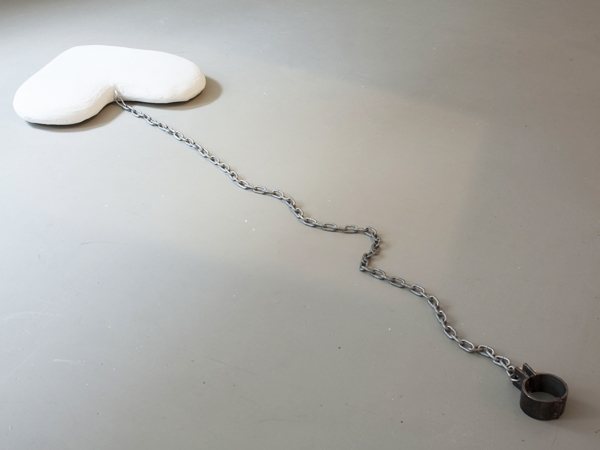
This is not new in Angelosanto’s career. There was another in situ work presented in Canada titled Je me souviens. The project consisted in a performance presented in the Saint Roch neighbourhood of Quebec City. Exhibited there were a cement sculpture, two mural works and a video of a trumpeter player dressed in a uniform of the Louis XV era. This event was part of the residency that the artist had at LA CHAMBRE BLANCHE in Quebec City in August 2010. The forms used and resulting from the cut out of a cement heart were converted into sculptural elements making up an exhibition in the gallery. This also included two paper murals of 150cm x 150cm. They both represented the flag of Italy, having on one, the text Je me souviens and on the other Qui a tué Pasolini (I remember and Who killed Pasolini). The local population was invited to meditate or to say the first word that comes to mind when one thinks of Italy.

“If all object is, in a some way, immanent to the cognitive subject, inevitable limit of knowledge at the same time as the unique possibility of knowing, what to say about language?” wrote Octavio Paz. “The boundaries between object and subject seem blurred. The word is man himself. We are made of words. They are our unique reality or at least, the unique testimony of our reality.”

crédit photo: Ivan Binet

crédit photo: Ivan Binet

Words thus are transformed into symbols of differences between peoples and cultures, between experiences and representations of the world.

“My main objective is to develop new ideas and evolve as an artist, continuing my research both in the field of performance and in the visual arts. I believe it is possible to make public interventions, using various forms of communication.”

In his project, Je me souviens, Angelosanto tried to establish a relationship, a meeting point, a link between an aspect of his identity as an Italian artist who finds himself in an unfamiliar country and the work that he produced in Italy before leaving. Je me souviens contains all that he needed to elaborate his thoughts and concepts that have arisen since the first day of his residency in Canada.

“But on leaving Italy, one realizes that no matter where one goes, one carries everything within.” Memory, love, solitude, nostalgia for one’s home, for one’s country, the beauty of one’s cultural heritage: “Through this experience, I would like to be able to make a connection between my art and the place, establish relationships with the milieu, and create a synergetic collaboration here with critics, artists, organisations and institutions.”

Thus Angelosanto’s artistic production is an amazing interpretation of the intermediary spaces between things, colours and objects. He refuses the general description: the narration of a story is of secondary importance in his work.

The exhibition turned out to be a choreography of forms. A series of projects, ideas and concepts carried out in full at the last stage, acquiring a new presence.

The cut out of a heart leans against a wall: this is the heart that was pulled around in the streets of Quebec City. The form of this heart was modelled in cement, presenting the weight of this heart, the fragility of this love. Thus the wall sculpture became merged with painting. The artist, who exposed his body to bad weather, dragging this weight, attained a sculptural body language and expanded the work’s narrative. These works are distinguished from the two-dimensional nature of his work on the paper mural. The project concluded with another performance, a work stemming from the other: Je me souviens ends with Angelosanto sitting on a strange armchair, where he weaves a flag, intertwining the colours red, white and green. These colours give a maximum, meaningful tension to the gestures of the hands, producing mental landscapes that we carry along towards a romantic fantasizing. The work is a materialisation of ephemeral poetry, flesh and spirituality, fertile ground conducive to illusion.

In Italy, one calls Garibaldinos those who embark on a business without having infrastructures. Leaving Italy and bound for Canada, Paolo Angelosanto had wanted to represent someone having this type of character. The idea came from the need to play a character who could represent Italy, who as well would be know in North America, and who would coincide with his way of being or who would be able to establish a reference to his way of working. “I think regularly of my way of acting and proceeding,” he says, “I’m an artist who will do the impossible in order to produce my work.”

He arrived in Canada and looked for ideas and inspiration. He found himself in Parc de l’Amèrique Latine dedicated to Simon Bolivar, where there are numerous statues and flags in tribute to the liberation of the Americas. In this square, there were two pedestals without sculptures. He took over the place for a day with the intention of transforming it, in situ, into a genuine living monument, putting into play his own “I” to convert it ultimately into his alter ego, as part of a new social and cultural subjectivity, rebelling against language. He went out looking, searching until he found a place that had nothing to do with his concept of place, a virgin site set up with monuments and statues in which flags waved. But in his Italian way of seeing things, this place had nothing to do with a site that is commonly used to welcome people rather than aesthetic symbols. He succeeded then in reformulating a hypothesis, a process, a vision of the world and for this he “mimicked” himself. He added himself to where there were only the pedestals, placing himself in the foreground where there was an empty spot, where something was missing as a result of restoration or theft. It is a predicate without subject because he poses as a Garibaldino who is superposed on the issue of this solitude, from this perspective, in a site in Quebec City, thousands of kilometres from his city (Cassino? Roma?). Similar to Garibaldi in Montevideo one hundred and fifty years ago, saying to the world that there is a place without place that is nowhere and everywhere, because contemporaneity has been able to reformulate this start and this end as well, which is a new beginning, the concept of “here,” where everyone finds his or her origins.

“Precisely because the work of art and the adventure are confronted in life, they are the one and the other similar to the whole of life itself, such as it is presented in the short encyclopaedia and the condensed existence of dreams.”1

crédit photo: Ivan Binet

crédit photo: Ivan Binet

This is the artist’s real and imaginary trip across the city and at the same time, an invitation to be confronted with social contradictions: a way of revealing the codes that efface meanings, accentuating the destabilizing effect.

I will chance a last thought: in his work, Angelosanto goes beyond the boundary between personal and collective space, reconfiguring a reality that in contemporary art appears definitely organized, thus inverting the nature of this quest for his own language. So his challenge is transformed into a defiance of art. As well, I say that the fact of going and producing cotton candy at the Venice Biennale is a gentle and perfect provocation. This has to do with love, in the most profound sense of the word.

  1. Heidegger, Martin. 2014, De l’origine de l’œuvre d’art. Paris: Rivage editions, 120 p.
The Lightning Bug’s Doubt: on Fireflies

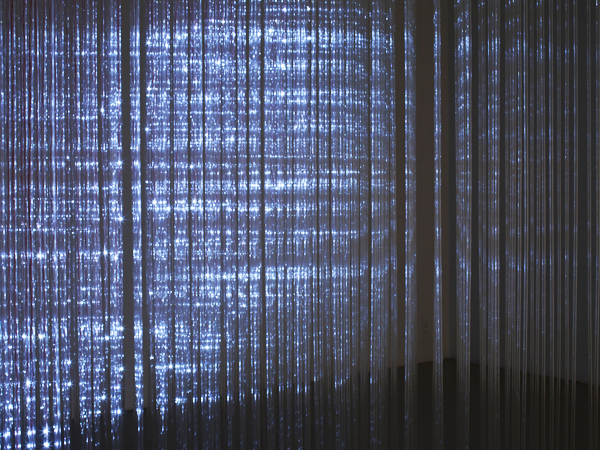
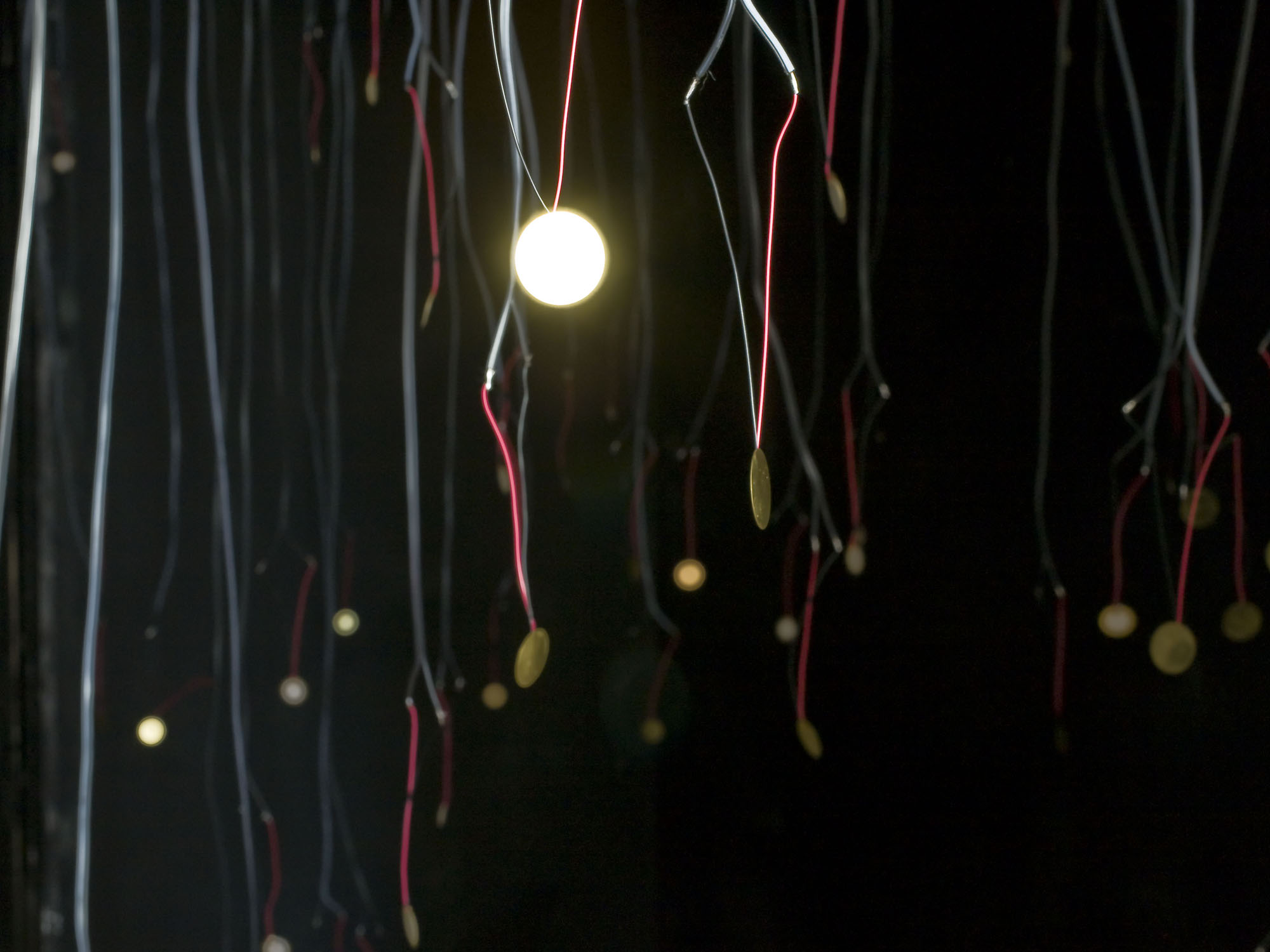
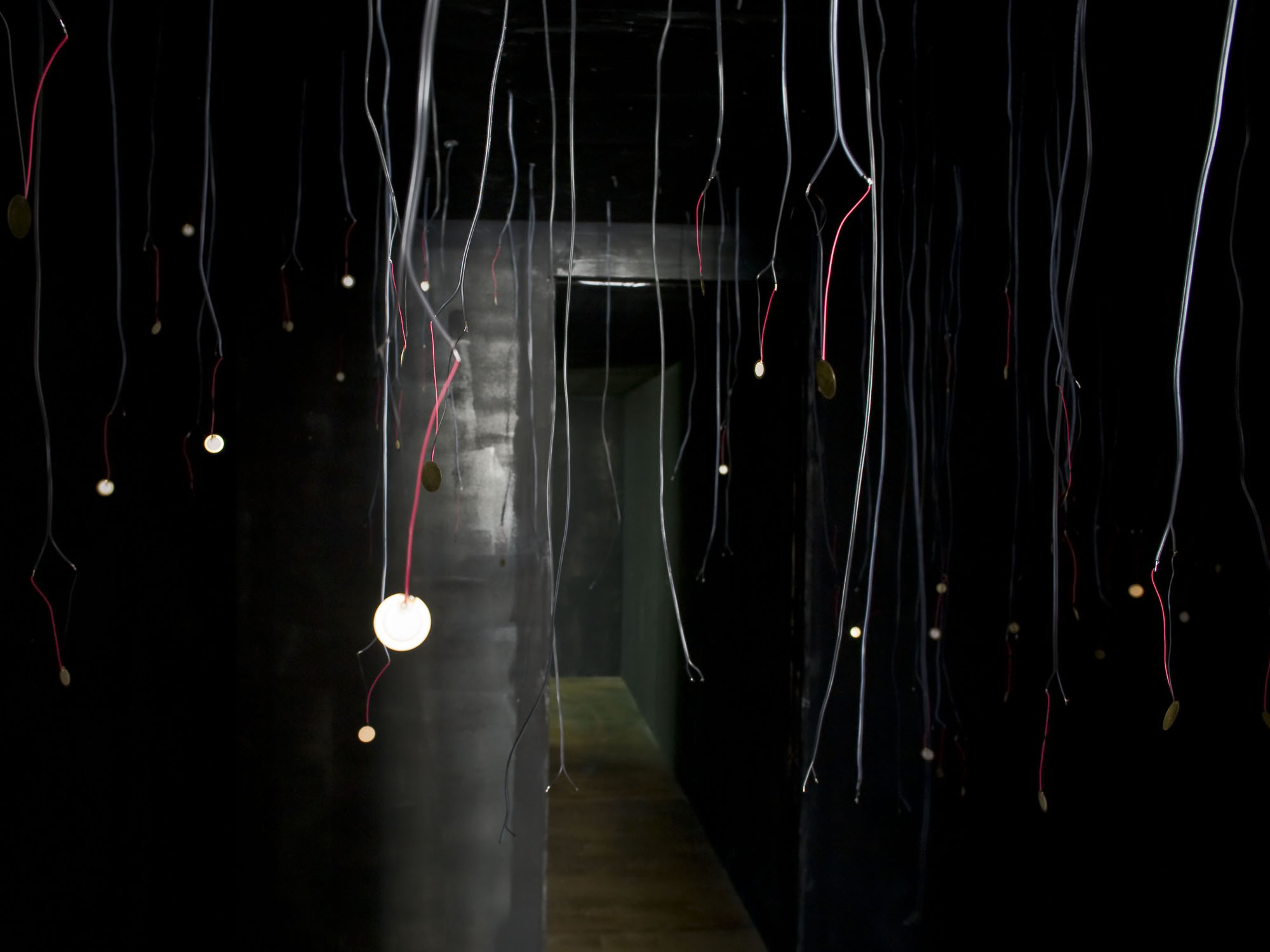
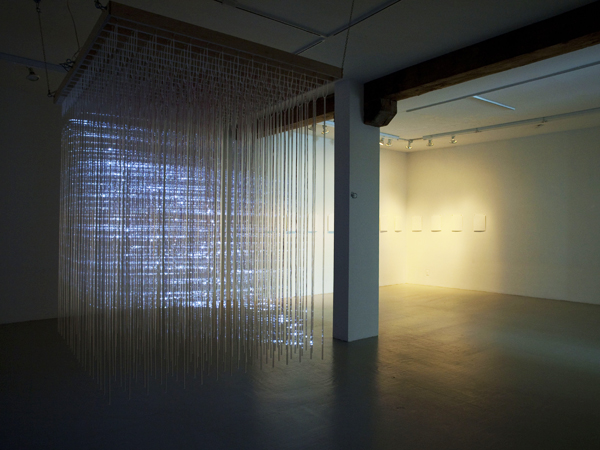
Stéfane Perraud’s work Maia (2009) featured a human skull displayed under a light whose intensity was so extreme that spectators had no choice but to avert their eyes, and seek an alternative means of engaging with the work. In Fireflies (2010), Perraud made use of light emitting diodes (LEDs) that created such a low level of light – a light that was barely there at all – that it immediately brought to mind that particular cool light produced by fireflies in their natural setting.

crédit photo: Ivan Binet

crédit photo: Ivan Binet

The 350 LEDs, suspended in transparent plexiglas tubes, invited viewers to come closer and observe the detail of the diffraction of light within the grid of cylinders, or else to locate the point of origin of a burst of light around which there was an uncertainty: was this the beginning or the end of something; was it ON or OFF; did it mean flight or fall; was it referring to the present or the past? Stéfane Perraud’s lightning bugs evoked the fragility of meaning, the same fragility lay in what was on view.

Perraud’s Fireflies did more than hesitate: they swung between two movements, created by the same fixed force, in contrast to many of the artist’s recent works, which evolved over time (Lueurs, Amoebe, and the series Simulte and Maia). In this way, Fireflies was more aligned with Modifié#03-BI2 (2009) in which Jean-François Millet’s painting Des Glaneuses reappeared, transcoded in digital form. Whereas Modifié#03-BI2 created an interplay of distance and proximity, as we attempted to recover the memory of the painting signaled within it, Fireflies evoked a circular movement, which was the only means by which to take in the three-dimensionality of the swarm, and to grasp its dynamic in space.

crédit photo: Ivan Binet

crédit photo: Ivan Binet

The moving eye of the viewer was an indispensable component of the work, given that it alone brought the swarm to life, removing it from petrification. If the viewer froze in front of the lightning bugs, they too became fixed in their strait jacket plexiglass containers. When the viewer moved, their élan gave the bugs flight. Élan, or rather desire, was very much at stake in the work. Fireflies was concerned with the desire to see, the desire to imagine movement emerging in space – a movement that reveals the object – the desire to avoid being snared in a form of despair from which there is no return: that of the immobilized and fossilized lightning bugs.

The low light of the lightning bugs, in contrast to the bright light of death that featured in Maia, evoked two contrasting themes: disappearance1 and survival2. Beyond the political overtones that these terms have, and perhaps beyond the field of the artist’s own interest, Fireflies underlines a trait that appeared in Maia and which speaks of a working method and a position that is typical of this visual artist.

To unpack this, Fireflies was born during Stéfane Perraud’s residency at LA CHAMBRE BLANCHE in February and March of 2010. It began with a series of white on white gouache paintings, in which certain key threads of the work appeared: the swarm, and attempts to create forms of movement that draw the viewer in. The conception of the work manifested and gestated here, in this first phase of inquiry, centered on the artist’s gesture.

crédit photo: Ivan Binet

crédit photo: Ivan Binet

Parallel to this, the process of creating the work was organized and planned to the minutest detail, before the production phase proper got underway. The work itself is fabricated, or assembled, in a process based essentially on repetition, in the course of which the artist – to use his own words – “no longer thinks or decides.” He has only to reproduce the movements that he himself has set in motion beforehand, and which are conceived in such a way as to inevitably include errors in their fabric that will upset the finely-calculated light of the LEDs in the plexiglass tubes.

The lightning bugs laughed in the face, resisted, troubled and perturbed all attempts at an almost-industrial level of exactitude, bringing with them a sense of imperfection and the fragility of the human hand.

  1. Pasolini, Pier Paolo. “L’articolo delle lucciole”. 1975, dans Scritti corsari, 2 p.
  2. Didi-Huberman, Georges. 2009, Survivance des lucioles. Paris: Les Éditions de Minuit, 144 p.

The fragile architecture of a home base

The question of taking up a position in space is as much a matter of geography as it is of history. The act of creating a glass city sacrifices intimacy, in favor of the limpidity that characterizes transparency. The act of recreating a memory-city generates a means of positioning oneself that is determined precisely by site and the past. The capacity to see through buildings implies a fragile form of localization. So it was that, in her desire to retrace the city, Sarla Voyer developed an architecture of ‘anti-intimacy’. With private space entirely exposed, so landscape and the horizon remain visible, despite the act of construction. And so the apparent void created by Voyer emphasized the act of laying bare.

The home base; the home town

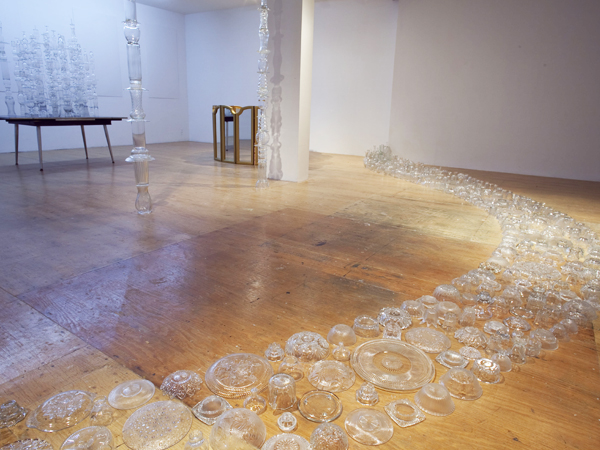
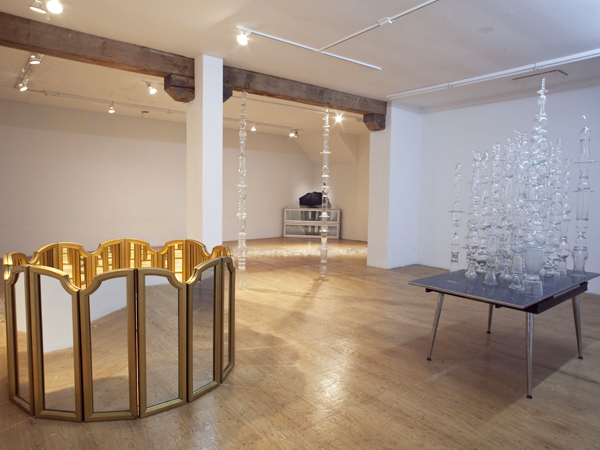
Voyer’s installation was constructed from objects that are commonly found in everyday domestic settings. From personal items to souvenirs, the objects reconstructed the architectural identity of the artist’s home town. The accumulated glass objects had the effect of holding strangers at a distance from the urban landscape so personal and so precious to Voyer. In effect, she created a ghost city. The audience was able to see through, as well as around, the space, which created the impression that the city was deserted, with only its maker able to truly feel at home; this was an architecture of the infinite.

crédit photo: Ivan Binet

crédit photo: Ivan Binet

The artist’s home base was a fragile construction composed of multiple pieces of glass, a mass of souvenirs and secrets containing a world of rediscovery. The act of reconstituting an intimate relationship, of retracing a city, also explored the acts of merging and understanding, creating a dialogue with the mother figure. The various structures within the installation spoke of the numerous possibilities of returning to the cradle, of revisiting the memory of the mother.

crédit photo: Ivan Binet

crédit photo: Ivan Binet

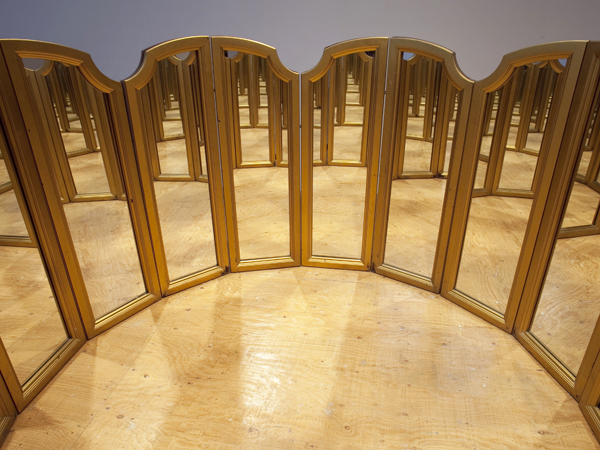
In the 20th Century, Walter Benjamin analyzed the relationship between transparency and an absence of habitat, stating that, “habitat must first be understood as a reflection of the period spent at the mother’s breast.”1 On the subject of mobile glass homes designed by Loos and Le Corbusier, Benjamin asserted that, “It is no accident that glass is a hard, smooth material to which nothing can be fixed. A cold and sober material into the bargain. Objects made of glass have no “aura”. Glass is, in general, the enemy of secrets. It is also the enemy of possession.”2 Thus, in Sarla Voyer’s installation we rediscovered the connection between the artist and her mother, between architecture and the maternal breast. In her choice of glass as a material, Voyer opted for a structure that revealed its own interior.

The assemblage of transparent and reflexive objects shaped the lines – or rather the curves – of the architectural and urban elements in Voyer’s labyrinthian city. Her placing of the collection of vases, ashtrays, carafes and glasses mimicked the vocabulary of urban settings. Whether placed horizontally or vertically, representing a pathway or a castle, the usual function of the objects was altered, as the physical characteristics of the items determined their transformation into construction materials. Despite the fact that the objects that Voyer had chosen were transparent, fragile and brittle, the glass forms created a solid exterior that spoke of protection. And so it was that the artist confronted us with an immaterial urban landscape.

A brittle no man’s land

The uninhabitable city that Sarla Voyer created was an unreal space, composed of real elements with connotations of both an intensely affective and practical nature, which spoke of the impossibility of creating an identical reconstruction of souvenirs and of memory. The space of cleanliness and purity in the work took on an identity only through the presence of the audience. The place created by Voyer had neither color nor scent, and offered no means of interaction. The audience were able to look but not touch, to observe without really knowing. We were offered access to a fictional representation of an intimate site. As Gaston Bachelard commented, “To give an object its own poetic space is to give it more space than it has objectively […], it is to follow the expansion of its intimate space.” 3

crédit photo: Ivan Binet

crédit photo: Ivan Binet

Voyer’s no man’s land was precarious. It created a tension between stability and collapse. Although the space was described as a city, the work presented an “in-between” zone, somewhere between the artist and the mother figure, intimacy and shared space, the void and an overflow, between the space of the city and that of identity. What we saw before us was both an uninhabited and uninhabitable place. The act of retracing involves following one’s own footsteps, redefining a place by leaving one’s mark, or creating a new trace of oneself. Sarla Voyer’s efforts to retrace the city, her home town, traced the contours of this no mans land, thereby protecting its secret, its silence and its transparency.

Voyer’s city was an invisible city, perceptible only by means of a few curves and contours that alluded to a melee of memories and stories. Her city offered both noise and silence as, in making us of a wealth of found objects, the artist created a true collector’s item.

  1. Benjamin, Walter. 1986, Paris, capitale du XIXe siècle: Le livre des passages. Paris: Du Cerf editions, 972 p.
  2. Heyne, Hilde. “Habiter dans une maison de verre”. 2003, in Exposé n.3, Volume 1. Orélans: HYX editions, 280 p.
  3. Bachelard, Gaston. 1957, La poétique de l’espace. Paris: Les Presses universitaires de France, 215 p.

John Cornu

“I’ll never look into your eyes again”
– The Doors, This is the End.

In 2010, John Cornu was awarded the Prix Découverte des Amis du Palais de Tokyo and was given an exhibition in one of the modules of this same institution. Born in France in 1976, he seems not to show any partiality for one medium in particular. Declaring himself “on the look out for cultural techniques, forms or niches that are open to aesthetic experiences,”1 the artist works just as readily with reinforced concrete––at the moment Melencolia at Cneai de Chatou––as with video, photography, performance, woodworking, neon lights or even and above all creative works in context. Although his practice may seem heterogeneous, the fact remains that his works borrow an ensemble of common guide lines, implying some recurrences such as the strong, at times inextricable, relationship to the presentation site2 (Plan Libre, La function oblique, Wash art); an interest in historical, political and current ecological subjects (Laisse venir, Erratum, Cut up); a predilection for “materiological” games and simulacra that lead us to see beyond the immediately visible, disturbing our perception of the real world (Beauty shots, Sibylline); and most recently, reformulating the idea of romanticism by exploring certain codes of art from the 1960s-1970s (materials, forms, presentation displays, production protocol) and some modernist utopias from the viewpoint of fiction, ruin and destruction (Assis sur l’obstacle, Sonatine ((Mélodie mortelle), Macula).

crédit photo: Ivan Binet

crédit photo: Ivan Binet

This last focus was moreover what was chosen for his residency at LA CHAMBRE BLANCHE in the fall of 2009. Titled Tant que les heures passent, Part II, this project was the second part of a trilogy that began in Lyon in the context of the Biennale d’art contemporain (Attrape-couleurs, France), and concluded in Brussels (Galerie Sébastien Ricou, Belgium).

During the five weeks of work in residence in Quebec City, John Cornu concentrated all his energy on producing two sculptural projects: one of monumental carpentry (Je tuerai la pianiste); and a conceptual production in which the work was delegated to Pierre Paquin, a cabinetmaker who became blind following a degenerative illness (Tirésias paintings). Two very different carpentry projects; however, both proceed from an aesthetic of disappearance and of blindness.

crédit photo: Ivan Binet

crédit photo: Ivan Binet

Although the Lyon exhibition (Tant que les heures passent, Part I) already included a work of eroded carpentry (Macula), it really is at LA CHAMBRE BLANCHE that the artist initiated his research on falsely charred ruins, which would generate the series Sans titres (verticales) and sculpture pieces such as Laisse le vent du soir decider.

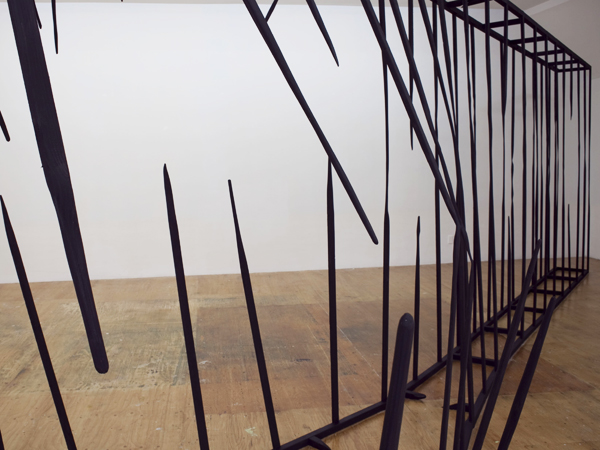
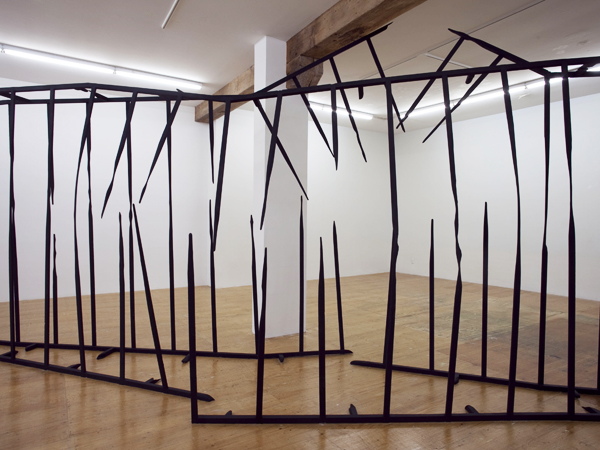
Je tuerai la pianiste thus was a structure both authoritarian and delicate that ran right across the space of LA CHAMBRE BLANCHE. A real architectural fiction on the scale of the exhibition place, the work proposed the enactment of a damaged wall partition sketched out with about sixty lengths of wood.

Note that this aesthetic of the accident, of crash was already present in Lyon in the installation Corps flottant – the name of these more or less dark and defined filaments that, fluttering next to the vitreous body of the eye, intervene between the subject and the visible world. As if working against himself, the artist has attempted to crumple the geometric schema governing some of his compositions in kit form such as Rosanna, Rosanna, Arcélor tubuline or even Urbicande, showing at the moment at BF15 in Lyon and in Morlaix Bay in Brittany. Corps flottant was an assemblage of painted aluminum tubes, curving in the air. The initial structure, formally close to those that form the rails for plasterboard on construction sites, seems to have been roughly handled, thrown into the architecture of the place so that it has become embedded in one of the corners. Although showing signs of violence, it nevertheless displays no other apparent mark of distortion. It was exhibited as new, absolutely impeccable contrary to Je tuerai la pianiste, which appears much more damaged. Carbonized, like the victim of a poetic fire, the work is exhibited broken, eroded and blackened.

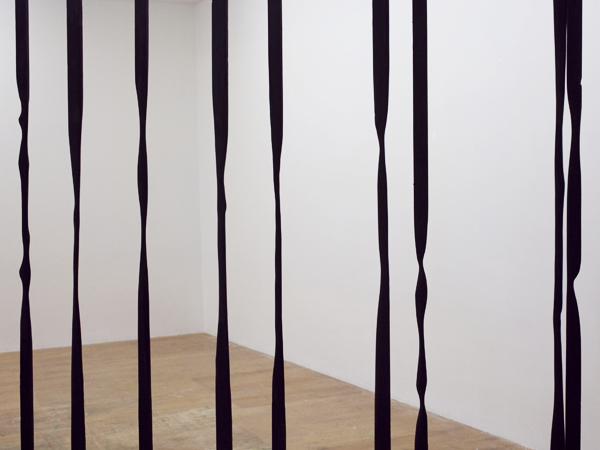
Each of the verticals forming this latter work, in fact, has been carefully sanded down until the knots of wood protrude, and then are painted black. Between difference and repetition, the artist thus lets the material dictate the final form of the pieces of wood. Fluctuating, wavering, Je tuerai la pianiste was a representation, a pure simulacrum made of sculpted and painted wood. Melancholic, it evoked an apocalyptic narrative, having an aesthetic of ruins.

A broken skeletal work, Je tuerai la pianiste proposes a mentally ambiguous scenario: the end of a story in which the cause has been eliminated. We, the visitors, arrive after the accident to note the damage and the weakened ensemble without knowing why this has happened. We have been placed in front of a residue, the ruins of a world without any explanation. However, this burned carcass could appear painfully familiar. Kind of in the manner of a memorial or a monument, Je tuerai la pianiste evokes our collective memory. This is only the fragment of a vaster and more universal story, a “dynamic” fragment in sum embellished with images of all the other catastrophes, all the other devastated areas and all the other stories.

And what if the fragmented nature of this narrative in the end is only an expression of the present, a response to reality, a document-evidence forming a part of this society of spectacle, an indexed structure specific to our era?

This dark and melancholic vision of a dislocated modern world is in fact increasingly evoked in John Cornu’s work along side defence apparatus and other paranoiac device. Examples are his productions such as Par la meurtrière, Fleurs (flash-ball fired on wired glass) or even Assis sur l’obstacle presented last February at Palais de Tokyo. Inspired by the expression “Sitting on the Fence,” this latter work lies between “documentary sculpture”––if one considers that they are Czech hedgehogs or anti-tank obstacles like those that were positioned on the beaches of Normandy––, inverted Holy Crosses and certain artworks of the 1960s-1970s. Indecisive and ambiguous3, this installation brilliantly synthesizes a radical and serial aesthetic, and a more anguished “expressionist” narrative. A strange mixing that was found as well in the artist’s second Quebec production that combined conceptual work and a minimal facture in a highly poetic project.

Unlike that of Je tuerai la pianist, the production of the Tirésias paintings4 was delegated entirely to a craftsperson. Well before he came to Quebec, John Cornu, in fact, had planned to entrust the making of a symbolic object to a person who has no visual referent. And it was by a fortunate combination of circumstances that the artist, while surfing the Internet in July 2009, discovered a human-interest report on Pierre Paquin5, a non-seeing cabinetmaker at work. This cabinetmaker was able to learn how to adapt his skills before he went completely blind so that he could continue to carry on his professional activities from memory. Having exchanged several emails with the cabinetmaker and presented his drawings, John Cornu asked Paquin to fabricate four stretchers, normally used to present paintings. “I have thought about this and I would like you to make painting stretchers (the wood structure that holds the canvas). I think four stretchers of 100 cm by 81 cm. The idea is to make them as close as possible to the stretchers sold in the stores. […] The best thing would be to buy a standard model (I will pay the expenses) and try to reproduce it with your skills.”6 Presented on the ground or hung on the wall, the four frames of plain wood were then displayed, exhibited for what they are, without their customary canvas.

crédit photo: Ivan Binet

crédit photo: Ivan Binet

In response to this and to recount this poetic human adventure, the Tirésias paintings in the Brussels exhibition (Tant que les heures passent, Part III) were accompanied by a short publication, relating the correspondence exchanged between the artist and the cabinetmaker, which furthermore, seems to be continuing…

As for the large barricade, this has been vandalized for the last time. Demolished and plundered, only about fifteen lengths of wood remained. And these were placed at regular intervals, as if to form a single work (Sans titre (verticals)), against one wall of Galerie Sébastien Ricou.

  1. Ardenne, Paul, Daria de Beauvais, John Cornu and Christian Alandete, «Principe d’incertitude/Uncertainty Principle». 2011, in John Cornu, Arles: Analogues editions, p. 83.
  2. John Cornu holds a PhD in Arts et sciences de l’art from Université Paris I Panthéon-Sorbonne. His doctoral thesis being “Art contextual et création.”
  3. According to the artist, “One is in what Wittgenstein described as ‘seeing in this way’ that is to say, the fact that a same signifier is potentially the object of a plurality of signifieds.” in Ardenne, Paul, Daria de Beauvais, John Cornu and Christian Alandete, «Principe d’incertitude/Uncertainty Principle». 2011, in John Cornu, Arles: Analogues editions, p. 84.
  4. The title of the work is taken from the hero of Greek mythology, who on loosing his sight obtained the gift of divination, this being the capacity of “seeing” beyond the visible.
  5. Pierre Paquin’s Website [online]: www.ebenisterieleschutes.com (consulted on November 2, 2011).
  6. From emails exchanged between the artist and the cabinetmaker.

A continuous flow

“The deepest thing about man is his skin.”1

Enter and follow. Choose an anchoring point, knowing that it will be lost. Circle, from one wall to another, following an irregular line, somewhere between a curve and a straight line. The movement seems to take on the shape of life itself, if we weren’t stopped in our path by a sense of destabilization.

crédit photo: Guy L'Heureux

crédit photo: Guy L’Heureux

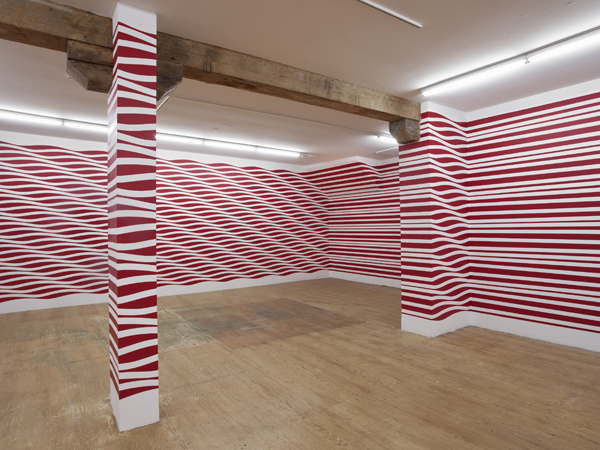
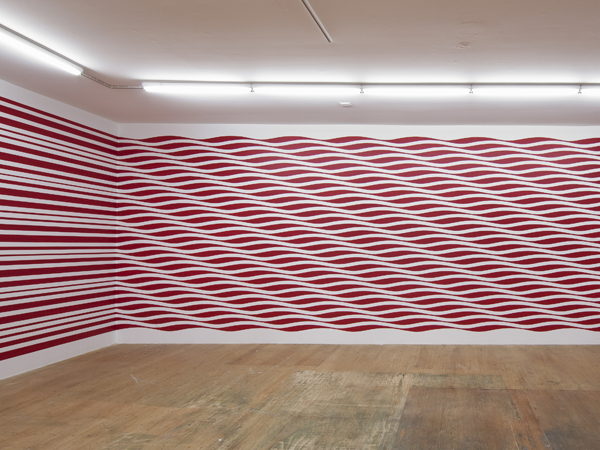
Initially, Robbin Deyo’s installation is experienced on the surface, as a series of lines spread out evenly across the walls of LA CHAMBRE BLANCHE, one after another, one over the other, like a pavilion, as Michaux would say. The lines of varying density unfold along the length of the walls, forming an impressive flow that is only broken by ‘breaches’ in the architecture at particular points: a door, a window, a pause for breath.2

And so the line extends outwards, and it is for the eye to reconnect its interrupted movement, for the eye to join one side of the thread to the other. In the center of the space stands a column. This separation in the space, similarly to the walls that surround it, is covered in stripes, horizontal bands running from east to west, as well as undulating lines running from north to south.

crédit photo: Guy L'Heureux

crédit photo: Guy L’Heureux

And so the eye begins to see beyond the surface, or more precisely within the surface. A loss occurs, causing us to forget the referent ; drifting through the architectural details of the space, the lines appear to be painted (and indeed Robbin hand-painted this system of dual openings). They unfold into their own depth, as though uncovering their own internal structure, rather than covering the walls ; as though during her residency at LA CHAMBRE BLANCHE Robbin Deyo had not so much painted as excavated the building, revealing its structure, bringing its strata to the now-exposed surface.

crédit photo: Guy L'Heureux

crédit photo: Guy L’Heureux

In the landscape of the windows we see a crucible of light. A crucible of matter also, as another dimension is revealed: in the horizontal openings, the motif of the line is broken, making way for long, red-tinted slats. The window has become a cliff-like form, a living, solid surface emerging, like an outcrop; an entranceway, into the building’s strata.

If the term site-specific means to integrate oneself into a given context, say a building and its history, so this work reverses the equation, in taking hold of the architecture as a means of locating the body.

In the work that Robbin Deyo presented at LA CHAMBRE BLANCHE, the artist took a risk in working on a scale little-explored up to that point. In a previous exhibition by Deyo (Plein Sud, Longueuil, November 2008), there had been a sense of overflow, a sketching of lines. It was as though the art work could no longer be contained by distinct media, frames, moulds ; as though some of the art had slipped out, imperceptibly, and made its way onto the wall. The limits of space demanded that bodies and instruments twist, at least in the process of making the work ; numerous instruments were deployed, including a spirograph, creating forms beyond the limits of the colorful world of childhood. In Robbin Deyo’s hands, this highly-structured game, which invites the sensible application of the rules of symmetry, became a fascinating means for destabilizing space.

Propulsion and pulsion were evident in the work, in both its sudden bursts of movement and its sense of regular motion. These spoke of the heart, of its emotions and its biology, of its repetition and, ordinarily, its regularity of pulsion/pulsation.

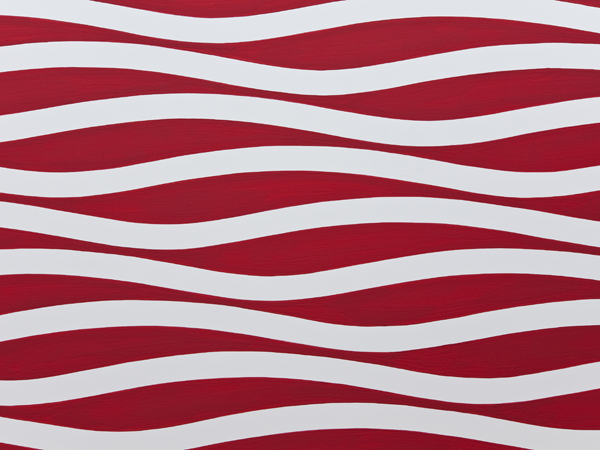
Ordinarily regular. The undulations of the lines, whose curves became more pronounced as they climbed upwards, became then finer as they plunged downwards, only to swell and rise again. And so to the possibility of prolonging this movement through the imagination. From here also arose the possibility of rules breaking down; the exception proves the rule, and isn’t t the case that still waters run deep? Something unexpected could happen whereby…

Robbin does not reinvent the use of the spirograph in order to retell the story of childhood, nor is the story of life to be found between her lines. Perhaps here lies the strongest link between her work and the 1960s Op Art movement, born of the desire to re-transcribe the dynamics that structure landscapes rather than portray their literal form. According to Bridget Riley, a key figure in the movement, Op Art reveals forces that are “liberated of all functional and descriptive roles”. Form and color are treated as the ultimate expression of the visual realm, in a mode of painting that re-transcribes form, purged of the gaze, in a space where technique has no bearing. These are works without signatures, or œuvres-paysages to employ a term used by Deleuze to describe an ensemble of structural traits for which the artist merely acts as a medium, or vector.3

As we move along a line and then the wave that follows it, one possible effect of the work is that it causes our gaze to lose its way. There is a sustained sense of destabilization, amidst the successive focal points that we encounter, moving from the line into the space as a whole, from the singular to the common, back and forth. This tension between the part and the whole, the uniqueness of the motif and the ensemble to which it belongs, is a defining characteristic of Robbin Deyo’s work. Further to her consideration of scale, Deyo’s work explores negation, upsetting attempts to identify, or fix the gaze on, a clear referent. The question is: in or out, or how to clearly discern what belongs to the interior and what remains exterior?

This confusion seems to leave no doubt as to the exteriority of the work that we are penetrating. Boundaries could become blurred however, and the space seems to speak of “I” The presence of a dense shade of red is impressed upon us: “Red appears as a color without limits, that speaks of warmth, and acts internally, reflecting a sense of the ardor and agitation of life. It contrasts with the dissipated character of yellow, which spreads out and expends its energy on all fronts. With its energy and intensity, the color red speaks of an immense and irresistible power, that is almost conscious of its own strength. A form of male maturity, essentially turned inwards, with little regard for the exterior, emerges from this ardor and effervescence.”4

The words that Kandinsky uses to describe color escape the field of geometry into the field of coloration. Rather than employing pictorial language, he speaks of energy, maturity, ardor and agitation. Color is a vibration, an organ within the composition, a driving force. The painter enters into an almost organic exploration of the grammar of red: from the red that, “sounds a fanfare, resonating the strong, indignant and irksome tones of the trumpet”5 the red that “burns with regularity”6, charged with a power, “a color that is sure of itself, that resists being covered over”7 and the red that possesses “the vehemence of passion, resonating the middling to deep tones of the cello.”8 Such are Kandinksy’s descriptions of the impact of color on the body.

crédit photo: Guy L'Heureux

crédit photo: Guy L’Heureux

Whilst I have focused here on Kandinsky’s comments on the relationship between sound and color, this is not the sole means used by the artist to describe the bodiliness of color, though it occupies a central space in her approach. As we enter LA CHAMBRE BLANCHE, a space that is normally painted white, we clearly feel a sense of vibration, equivalent to something like the feeling of sound; as we cross the space, our entire body vibrates Amidst the lines that run from east to west, how can we fail to see a musical stave, where the melody rather than being inscribed between the lines, is carried between the north and south walls, producing long undulations in which the eye easily loses itself? Here is a musical score, of the texture of sound, in waves that are both seismic and radiophonic, according to the way that we apprehend space, and that space apprehends us.

  1. Valéry, Paul. 1966, L’idée fixe ou Deux hommes à la mer. Paris: Gallimard editions, 178 p.
  2. Michaux, Henri, “Un tout petit cheval”. 1935, in Minotaure, Revue no. 7. Paris, p. 11.
  3. Müller, Heiner. 1987, La bataille et les autres textes. Paris: Éditions de Minuit, 111 p.
  4. Kandinsky, Wassily. 2004, Du spirituel dans l’art et dans la peinture en particulier. Paris: Denoël editions, 2004. p. 157-158.
  5. Ibid., p.160.
  6. Ibid.
  7. Ibid.
  8. Ibid.

À hauteur du regard

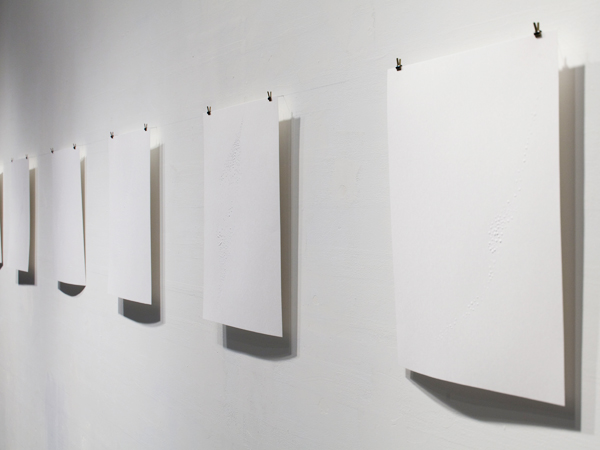
For centuries, theories on the nature of painting have sought to explain Man’s experience of color, and yet phenomenological aspects of this question remain unanswered. Cézanne was right when he stated that painting is above all an optical event.1 Painting is a material phenomenon, that has a precise intention, based on a form of visual expression (involving color, line, touch, sign, rhythm, surface, bursts of light, opacity and transparency) whose only goal is to reveal an image, a complete and singular image of the world.

crédit photo: Ivan Binet

crédit photo: Ivan Binet

It is precisely this logic of the whole, the force of this absolute constructed through the at once simple and complex relationship between modular painting, architecture and space that is so remarkable in the work of Antonello Curcio. This Italian artist’s residency at LA CHAMBRE BLANCHE culminated in a sober and powerful installation entitled À hauteur du regard.

crédit photo: Ivan Binet

crédit photo: Ivan Binet

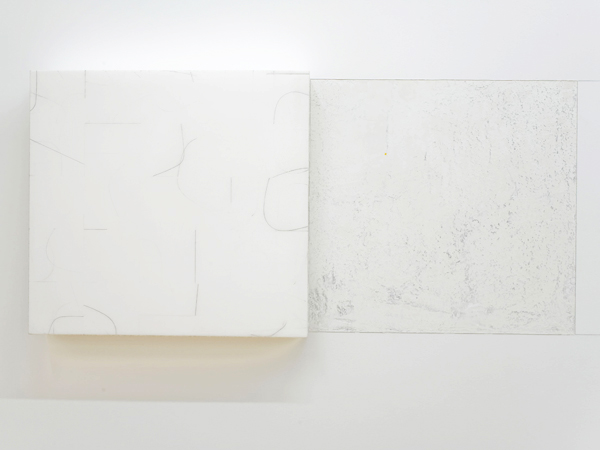
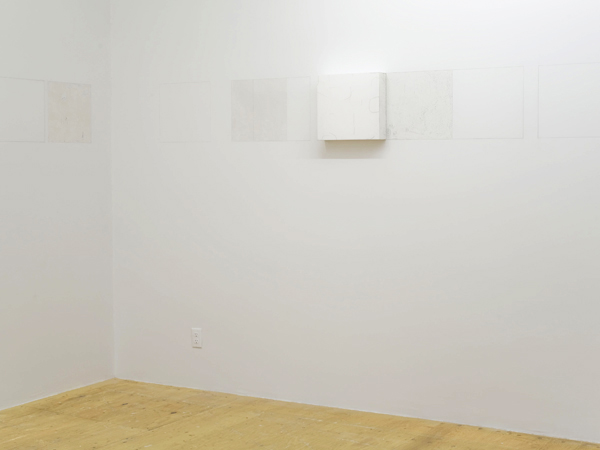
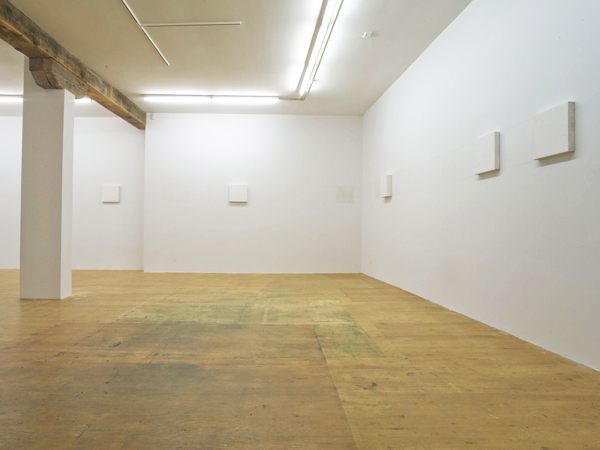
This site-specific work consisted of inscriptions on the gallery walls, where each mark seemed to be underlined by a sense of its own absence. This was immediately clear in the most striking aspect of the installation work (aside from evidence of the artist’s exploration of the pictorial problematic of the relationship between sign and surface): the absence of color. The entire work reposed on subtle variations in the use of a single color, an absorbent, matt, delicate and yet also intense white. On closer inspection, it was clear that the overlapping, and transposition, of presence and absence was a key feature of the visual composition of the work.

The work featured various volumes and geometric drawings – all similarly sized – along with pencil lines visible through fine layering in the work, as well as traces created with an exacto, which were perfectly integrated into the architectural surfaces. However, all of these features seemed to manifest a sense of absence, linked to an unexplainable void in materiality itself; an incomplete materiality, that did not correspond to any sense of origin so much as to a conjunction of phenomena, including vibration, transparency and the trace of silence, as contemplated in time.

It was only a matter of observing the luminosity of volumes produced by the strange dynamic between a dimly-lit white and a vibrant grey, or the sense of absence in the shadows created by the depth of the paintings protruding from the walls, in order to comprehend the extent to which Curcio’s work opened up a horizon of reflection that was purely phenomenological in nature, beyond all reference points. It was only a matter of looking, in order to comprehend the extent to which, above all, his work examined the potential and limits of plasticity and the medium of painting itself, in a complex and intimate process that was revealed to the viewer with finesse and determination.

Pierre Fédida wrote that, “the only thing that can be said of images is that they are neither true nor false, they simply are, or else they are through what they produce.”2 Antonello Curcio’s work confronted us with precisely this observation. Faced with his work, the viewer felt sheltered from all verbal preoccupations and thematic confusions; sheltered from all obvious forms of seduction and spectacular excitement, the viewer experienced a great and mute sense of satisfaction. A sense of otherness emerged somewhere between the immediacy of our being and our awareness of the deep, slow and limpid breath of life, a breath that explains nothing, that recounts nothing, but which simply is.

As viewers, we felt both astonished and moved; we felt that we had no choice other than to ask ourselves: are images ultimately a form of correspondence that is mute and solitary? Are images a form of reality that can never be entirely comprehended, which exists only by means of repetition and endless difference? Can images be measured in any way other than through the gaze of the other? How may images defend themselves, if not through the emergence of a phenomenological fragility?

In this way, Curcio’s work offered neither an affirmation nor a proposition. Above all, it brought forth the moment of meeting that opens up a space sui generis; a space in which all that is offered us is the ultimate aspiration of becoming that which we are given to be, of being elevated to the height of our own gaze. Art is always a possibility and never an observation, offering inspiration as much for the creator as the public. An art work offers a form of continuity, a circuit of experience that simultaneously and paradoxically cannot exist outside of its own history, that can only be savored by way of a form of subjectivity that enables the perpetual transformation of the senses.

crédit photo: Ivan Binet

crédit photo: Ivan Binet

Offered to the other, through a contiguous articulation of the image, presented as both an image and object that visually evokes several layers of reality. Antonio Curcio’s work undoubtedly asks a range of such questions, obliging us to rethink the nature of imagery and its ontological dimension of trace within the overall existence of space. Moreover, Curcio’s work obliges us to rethink space as an element that functions poetically and physically as a form of organic link between two experiences: the human and the artistic. Essentially, this space is a fusion of distinct situations and experiences into a single instant in which there is a superposition, of the point and the whole, the original and the new, the possible and the necessary.

  1. Cézanne, Paul et John Rewald. 1978, Correspondance. Paris: B. Grasset editions, 346 p.
  2. Fédida, Pierre. 2009, Le site de l’étranger: La situation psychanalytique. Paris: Presses Universitaires de France editions, p. 213.

Gabriela Vainsencher’s Lifelines

In the shock of freezing cold January in Quebec City and hardly bothering to plan her wanderings, Gabriela Vainsencher elaborated her project The Unfinished Tour Quebec City from notions of translation and displacement. The wording of her artist’s statement tells us that biographical facts account for her choices and are important in her career as an artist. Well defined as both operating concepts and actions, they have directed the workings of this adventure, that is to say, the ways in which the multiple relationships have become integrated as the days went by and have come to life through the processing of two favourite subjects, the art of others and objects from her everyday life.

crédit photo: Ivan Binet

crédit photo: Ivan Binet

To grasp what is at stake in this project, it is important to consider the abundant nature of the ensemble as well as the sum and diversity of materials and gestures that have composed it, including the artist’s intentions. Also one must continuously pay attention to the various stages as well as to the objects created during the residency process. A first visit to Gabriela Vainsencher’s installation at the beginning, and reading the press releases made me think of Rosalind Krauss’ essay Line as Language: Six Artists Draw1, and I have chosen to refer it in order to go deeper into this reflection.

crédit photo: Ivan Binet

crédit photo: Ivan Binet

In this text, Rosalind Krauss presents pertinent concepts for thinking about drawing, a practice that the artist Gabriela Vainsencher sets out as basic; moreover, both as a process for understanding things and as a reference for when she experiments with other mediums from time to time.

“I make mostly drawings on paper. When I work with different media, it is usually based of the drawings, fulfilling a function which the drawings cannot.”2

The main notions that Krauss favours on this subject are space and expression and here she analyses the drawings of a group of artists that include Sol Lewitt, Donald Judd and Frank Stella, comparing them to works by artists from the American abstract expressionist movement. For me, the idea is not to take time comparing these works with the ones that concern me now. Rather, I am focusing my attention on notions in the text that appear appropriate and open enough to be transferred to a different context, in which the artist’s position counts as much as the place, the installation process and the constructed objects. And what was presented here were Gabriela Vainsencher’s press releases, the very first developments for the gallery at LA CHAMBRE BLANCHE, her drawing and painting interventions, her photographs, videos and all her manoeuvres, showed the obvious, the profound implication of reality that these concepts cover in her work process, just like the dominating role of drawing. In other respects, not only do these works show compatibility with notions that she has favoured, but also they may include them.

crédit photo: Ivan Binet

crédit photo: Ivan Binet

However, although they are pertinent in their overall meaning, they concern so many artists’ practices of all disciplines that they still do not introduce us to a more astute reading of the project. It is really in resorting to the ideas that Rosalind Krauss proposes in her essay, of an opposition between internal space (the space of a private language) and exterior space (the outside world), and the notion of expression that she associates with them, which opens a way to examine this work without regard for its conformity to one aesthetic category or another. And, more precisely still, the consequence that this idea entails: two quite distinct visions of drawing, one as illusionist projection, also integral to the work of the abstract expressionists, and the other, drawing as a kind of showing this world, the exterior world, a contemporary vision of it. Two visions that define the distinction between artists dedicated to expressing a private myth, let us say, and those such as Johns, Stella and others, who dissociate strongly from it, asserting themselves according to their terms, not in relation to a projected world but in tune with the pulse of this world.

crédit photo: Ivan Binet

crédit photo: Ivan Binet

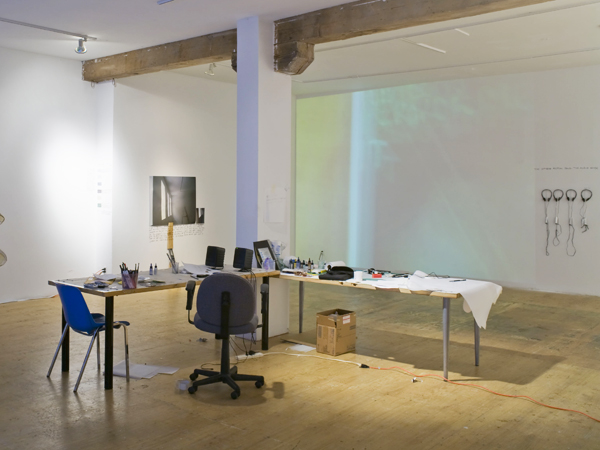
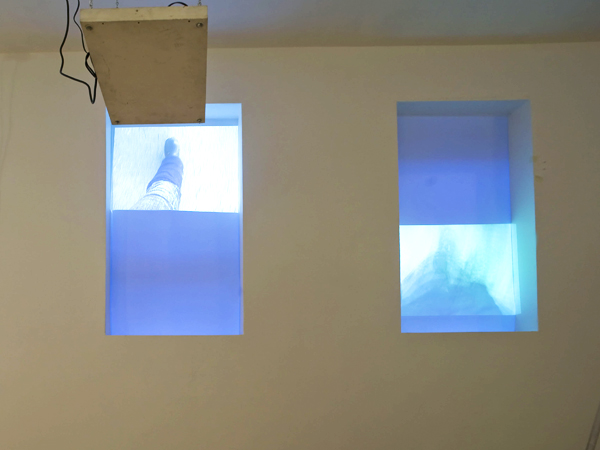
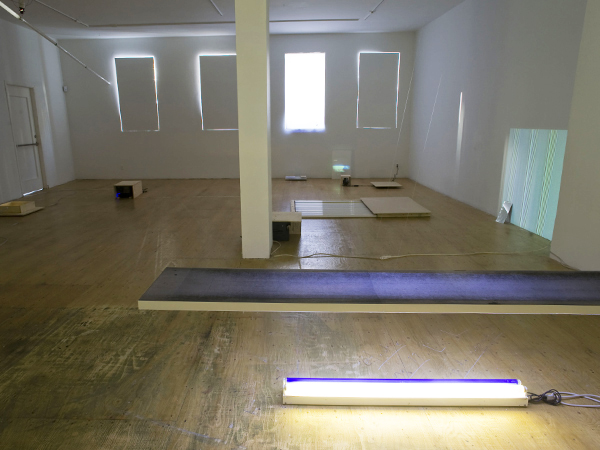
Going from here, it seems interesting to me to see what the elements of the evoked duality require us to consider in Gabriela Vainsencher’s installation, all these concrete visual and sound works that she tells us are constructed from translation and displacement actions produced in the gallery, thinking about the space and the surface areas. For example, this angled worktable in the centre of the gallery is placed in relation to the disposition of the walls configuring the space. A gesture that can be understood as establishing the artist’s position as the centre of the action, a point of departure for comings and goings and also showing the significance given to the place in terms of geography because the direction of the viewer’s gaze depends on the artist, as well as the movement in the gallery. Therefore, the walls are partitioned into several related groupings, each time marked out by the dominant presence of one of the numerous mediums used. By establishing spaces conducive to diverse interventions, the artist thus defines an opportune way of presenting a remarkable feature, the multiplied representation of her designated image, from what one knows to be her image from what she has said, through visual strategies such as framing and point of view, and not by identification. These are visual signs, sounds and representations in one form or another, literally or as evocations coming from plays on language. And finally, introducing an aspect of another nature, but just as significant, the artist shares private moments from her everyday life, stratifying the course of experiencing another temporality, this morning ritual of drawing everyday. Thus it resurfaces that the significance of the artist’s space in the actual framework of the installation is in reality established at the beginning of the Gabriela Vainsencher experience. Since the start, the artist has informed the space, but, and this must be emphasized, she has always integrated the space of the other into it, especially in constantly enhancing the architectural space, as one could observe, and that of the city to which some of the videos refer.

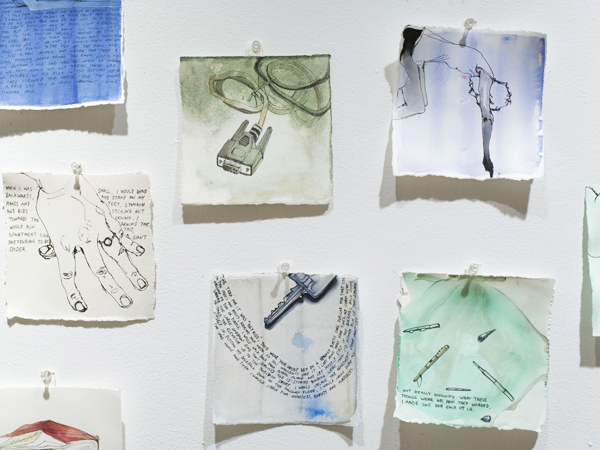
This being so and in remembering my first surveying of the place where the artist was working, I recall my keen attraction to this grouping of work on the walls forming the west-north-west angle of the room. From afar, one first saw a multitude of small drawings pinned to the wall at varying heights and in which the shadow of the lower raised corners often were added with drawn and painted marks. Covered with glazed touches, this produced a kind of quivering effect. One had to get closer to grasp image by image what they were, discovering right away what made them relate, same light-weight paper, similar format, method of presentation, medium and treatment, the same. Then my identifying gaze was activated, looking for relationships in the images, multiple close-ups producing fragments, feet and legs viewed from above indicating the artist, rarely the face however, neither here nor in other groupings, part of a refrigerator, outside views, writing, television set, plants, a pot, a key, a very blue projector, a cable, all everyday things of a socially aware person and artist. And again, this private view introduced us to this new space of openness that presented a great number of these images, space for commentary in which the content really belongs most often to that of a diary both by the variety of the subjects and the freedom of expression. The treatment of all these elements, image and handwriting, revealed knowledge of the effects of paintbrush and water and here a freedom in the drawing, but a facture remaining simple and appearing without the wish to be expressive. Expression without the aim of expressiveness, one could say.

The artist attributes great significance to the actual process, both the ritual nature and certain procedures that she has decided to follow, that for example, of letting all the mistakes show through in the drawings that have been changed. On this subject, she evoked the matter of integrity. This could very well be linked to a very old historical vision of the image as an element of illusion, the false image. One does not know to which time to associate this rule, but the fact is that it introduces an aesthetic aspect that also refers to another side of psychic space, a private space if there is one.

Continuing on the course progressively reveals that this grouping of small drawings makes up an image bank from which Gabriela Vainsencher will draw to present work on the other wall areas. In fact, few of these works will be retained and the result will be to show the few recurring figures, those that especially concern her, designating her as a subject but which, as a result of being multiplied, will end up objectivizing her, an object among the everyday objects. Thus when being a model for herself, the artist produced feet and hands, legs and necks, one after the other, these figures then became motifs and thus thwarted any possible perception of their image status as a portrait of an insistent ego. From then on, she worked increasingly to distance herself as a referent, preventing her identity from becoming important and hence the subject.

crédit photo: Ivan Binet

crédit photo: Ivan Binet

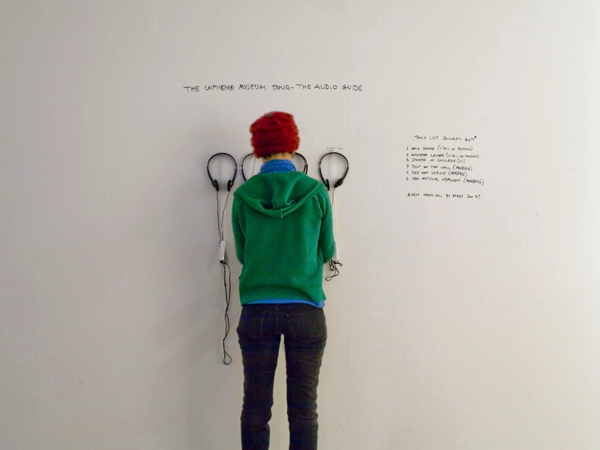
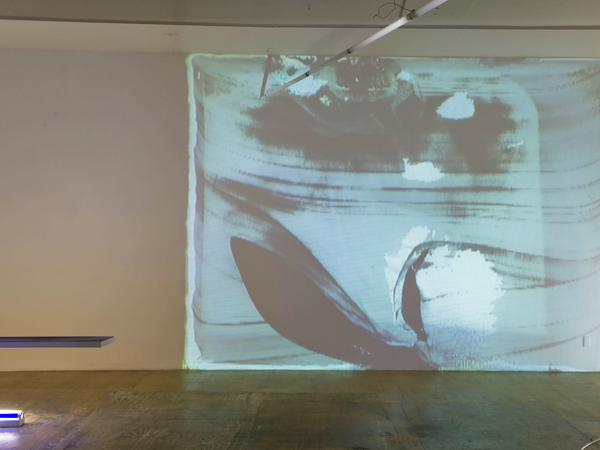
Finally, here it is necessary to recognize the major role of images in relation to the overall residency experience. It must be said that when a figure is presented in one medium, and then in turn, this figure is represented in another medium to produce a translation, another image is created through this transfer. And more than just considering the facture and treatment of the one and the other of these mediums taken separately, it is in their difference that a new meaning occurs. These relations create a force from “the interval,” from “the spacing,” one could say. Strangely, the difference opens another world, describing the specific mode each figure inhabits. Thus, for example, one of them is this hand that one saw as a very small drawing, now painted in large scale, architecturally occupying an area of wall. From this also, from memory, the same hand, but that the video presents in another way, in its action of writing words that appear jerkily as green handwriting, commenting on the work of another artist. Green commentaries that one will recognize in the linked photographs a little further along, right near the hand-drawn plan made directly on the wall of a museum space where the artist intervened. Then again, windows on the windows of the gallery, among other videos, those that capture the feet and legs already drawn, similar to those viewed from above, but moving this time, here in the snow and there on dry ground. And not to forget the auditory component, the words waiting in their iPods, hanging on the wall, vocal thoughts on the visual experiences of other artists’ work in other places. Interventions that also recall this aspect of a diary already observed.

I am constantly calling this residency an adventure. One that is built up through lines, journeys, stories that have taken place, that develop, are close by, are linked, branch out, and weave a network of spaces, objects, figures, sounds, lines and of course time always, at various rhythms. One perceives, among many other things, the structural complexity that could justify many metaphors, from a mille feuilles layered arrangement to a woven “cloth” design or an abyss, often coexisting, none of this being quite right, but even so we always understand that something is continually silent in the coming and going space that Gabriela Vainsencher occupies, which will remain distinctive to her, unsaid, through time.

Private space, exterior space, private myth, real world, all these notions might be pertinent, but we have noticed that in this residency they have not led to the question of duality. Neither have the vast number of expressive gestures about the artist’s personal time and space, constructing network relations of all kinds, been referred to as an end. Actually, perhaps it is the dialogue between images and spaces shown in concrete terms in this work that involves a constantly evolving form in this remarkable combination of worlds…

  1. Krauss, Rosalind, “Dossier: Le dessin”. 1990, in La Part de l’OEil, Annual magazine n. 6. Brussels, p. 208
  2. Vainsencher, Gabriela. 2007, Artist Statement. Brooklyn.

Beyond interpretation and judgement, writing the story of art

There are many ways to dance the dance that is the invitation to write on art. In this text, which is orchestrated around the work of the Australian artist James Geurts at LA CHAMBRE BLANCHE artist-run centre in Québec City, I do not wish so much to interpret or account for his specific endeavours in the residency that he undertook at the centre.1 Nor do I intend to evaluate or judge his practice at large, for worse or for better, whether that concerns his research methods, skills with materials or his overall artistic vision. I am not playing the role of accountant or judge, on this occasion. Rather I wish to take this opportunity to tell some stories. In case this seems errant, I can assure the reader that my stories are connected intimately to the artist’s work, for the journeys involved in these excerpts from my experience with Geurts – journeys that are always combinations of shadowy recollection, lucid encounter and day-dreaming – are inspired by his own journeying, as conveyed through the aesthetics and atmosphere of his work, and the stories that he himself charts.

In this way, I am proposing that writing on art becomes a way of thinking through the particular space that artistic research and art exhibitions offer. Writing then extends artistic spaces, by moving through the original art work, yes, but towards the ultimate goal of spurring the further making, and use, of critical, creative spaces: in the mindseye, in the city, and beyond. I imagine this to be the greatest goal of art: an offering that leads to more concerted doing ; an intimacy by way of the public.

And so…

Once upon a time a woman was sitting at a desk in an attic, at the top of a three-storey terrace house, on a small island, not so far away from here, over an ocean known as the Atlantic, named, in passing, after a mysterious and lost underwater civilisation. The woman is working late into the night as is her disposition, poring over journals which she receives from around the world, under the modern light of an angle-poise lamp. The magazines holding her attention discuss the work of men and women engaged in the ancient ritual pursuit of making art, in which, incidentally, our female nightworker is herself involved. Her task in this work scene is to take the mass of these magazine contents and from it compose abridged versions of the myriad tales, to add to an encyclopaedia of art produced by a company whose business is the buying and selling of knowledge. Every once in a while, amidst the cascade of gloss and black that she efficiently channels into synthesis, the woman comes across something that, suddenly, captivates her above the rest, and which therefore she studies not with workman-like thoroughness but with natural curiosity. And so it is that she is interrupted by one such moment, this evening, as her eyes fall on the story of a man, who had made it his mission, she reads eagerly, to circumnavigate the world’s equator, all the while carrying with him a sculptural device, a totem, of his craft. At four points on the imaginary latitude that is known as 0, he duly photographs his right-angle sculpture, and with these four cardinal images he assembles a mandala, an optical poem, on psychogeometry. His story is presented in diary form to her, and the journey in question is called: 90 Degrees Equatorial Project by James Geurts.2

crédit photo: Ivan Binet

crédit photo: Ivan Binet

Storytelling is a primordial function of art. Art becomes potent because of the space it offers for this experience of power over lives: le déroulement de notre histoirexperiences, over the primordial state of our existence, which Sigmund Freud, after Homer, called the ‘oceanic’. Science, including psychoanalysis, is also, in passing, a means of epic storytelling. It, like art, falls back on the mythic: from the Greek ‘mythos’, that which involves representation: words, images, and all demonstrations of symbolic consciousness. These combine with action to form that human-animal way of engaging with the world that enacts the fact that, as Ludwig Wittgenstein clarified, we are not in the world but of it.3 That human-animal engagement with the world is known as ritual. Geurts performs many rituals, through which he tells many stories, involving water and journeying, incorporating them in temporary arrangements of light and 3D structures. These are accompanied by less ephemeral marks on man-made surfaces, notably drawings and photographic prints. Fluidity, or mutability, is his leit-motif.

crédit photo: Ivan Binet

crédit photo: Ivan Binet

Stories in, on and through lines and channels, of (human) landscape and bodies of water. The fluidity of representation. In relation to Geurts’ work, we come to the question of figuration and abstraction. These are distinctions that, as with the distinction between poetry and philosophy, only take us so far. Still, one must leave the house by some means, whether through the front door, or an attic skylight. To consider how things function through their opposites, how extremes in fact meet, and so how distinctions give way to a greater whole – as a dymanic of nature at large and Geurts’ practice in particular – one might look to Friedrich Nietzsche’s discussion of the way that intense experiences in life collapse each into the other, to finish in that fundamental and trans-historical place that comes forth as a manifestation of will, of life-force. Thus a process of distillation, as in Geurts’ channelling of water from his artist’s apartment upstairs at LA CHAMBRE BLANCHE, through clear tubes that he ran down to the gallery below, becomes an epic story. Epic encounters always at once both distill down and transport away. The epic and the simple in stories and phenomena are kindred.4

To go beyond the first step of categorising things in terms of opposites, following Nietzsche’s example, one might also look to the magical principle of sympathetic semblance. One thing becomes another, through playing on that quality that is common in both. Thus, for example, a figurative representation – an effigy – may stand for a person in certain rituals. Finally, where the limits of taxonomy are concerned, I am reminded of the understanding that things are connected by their kind, rather than simply their external form: thus a stolid horse resembles a stolid woman more than she does a faint-hearted horse, a spiralling man ressembles a spiralling constellation more than he does an explosive man, a waterfall in transformation resembles lovers in transformation more than it does lovers in stasis.5

The work of Geurts lends itself, if one is so disposed – and I am – to the fabulous. What lies in fables? Something fundamental about experience. Should we name it becoming? What is at the heart of the epic and what simply is life? This becoming, that is the source of power. Geurts passage at la chamber blanche was called Drawing Field, implying the opening up of a mission field, “spurring the further making, and use, of critical, creative spaces: in the mindseye, in the city, and beyond,” which I suggested at the outset of the text remains the ultimate goal of art. To name what I have until now endeavoured to demonstrate: I think journeying is required, of the kind the artist shows us he has undertaken, to get to a space beyond, through that of the exhibition. One can say that this work, generously, points to the great decision to simply undertake a journey.

All good stories feature some heartfelt confession. And so… Art per se does not interest me. Rather art is a means for the creation of a space, for movement, with purpose: transformation. To reiterate Nietzsche’s insight, the character of the purpose is less important than its quality: things meet through the conditions that they offer for intensity. Like a cathedral and a library. An airport lounge and the stage of a Samuel Beckett play. A shopping mall and a cemetery. An art gallery and a river, to return to the content of Geurts’s work at LA CHAMBRE BLANCHE. Galleries can make the city their own, that is be a point of departure, in this way. Through an alliance of their intention, the intention of artists that work in them, and naturally the intention of visitors to use them in this way.

I have sought to convey something of the essence of the intention in Geurts’ passage at LA CHAMBRE BLANCHE, and that is its instigation of the fundamental. What does fundamental art look like, what is it? The answer cannot be spoken. Because transcendance – or “movement beyond” – has no one face. And therein lie the limits of the mask of judge or accountant, and the limitless of the ritual of enacting stories.

I have sought, in other words, to conjure the story of spaces that have the purpose of creating movement, that is a story of the collapse of differences of form into fundamental intensities in kind: the power of water, the power of dreams, the circulating dream structure that we know as the human body: back to Geurts.

The act of will on the part of the artist to create a space for movement invites the visitor’s enactment, and story, of transformation. In a cavernous space in a former women’s prison, which has now become an art museum, I asked James Geurts how possible he felt it was for the visitor to take up this invitation. My motive in asking something so hypothetical was this: LA CHAMBRE BLANCHE supports artistic endeavours, but what is its relationship with the public through what it offers? Here I want to state the obvious, which is the fact that artist-run centres do more than nurture arts communities, and support artists’ practices. And so whilst artists do what they have to do, the larger social and personal conditions of visitors to arts centres cannot be abstracted. How to enter into the space of the art work from the street, from psychic and social, including work, spaces that consistently level stories and regulate ritual: that teach and tame? After all, as Jean-Luc Godard reminds us “Policing is to society what dreams are to the individual”6

The question of how possible it is for the visitor to enter into this act of will can and can’t be answered, as at the beginning of the day each man and woman decides for themself. However a key aspect of artistic spaces that offer movement, that is which open up the ritual enactment of being of the world, leads to one response to my question: artists can favour this possibility through the atmosphere of initiation in their work.

crédit photo: Ivan Binet

crédit photo: Ivan Binet

An essential characteristic of powerful art is its initiatory aspect, because when stories unfold through us, we move through this aspect of initiation. Atmosphere is crucial for this to happen. I have written elsewhere7 that art that is powerful in atmosphere by its very nature invites us to leave the art work behind, as we move through it to a space that is at once born of it and beyond it. All art that offers this movement meets in an experience that lies above, and so below, the grounds of historical time or a contingent present.

And so I return to the captivation of our nightworking woman in her attic that evening with the atmosphere of Geurts’ equatorial journey. And I return to my initiation with Geurts’ space of water and light, at LA CHAMBRE BLANCHE. To atmospheres that inspire not the account or verdict of art but its story.

  1. The residency of James Geurts took place from November 10 to December 21, 2008.
  2. For further informations [online]: http://www.jamesgeurts.com/index.html (consulted on December 21, 2008).
  3. Wittgenstein, Ludwig. 2001, Tractatus logico-philosophicus. Paris: Gallimard editions, 121 p.
  4. Twilight of the Idols or How to Philosophise with a Hammer, from Friedrich Nietzsche, first published in 1889. One commentator of this text explains Nietzsche’s argument as follows: “For art to exist, or for any form of aesthetic activity to exist, there must be a condition inspired from the part of the artist or the viewer. The inspired condition is described as “Apollonian” or “Dionysian”. The Apollonian state is an intensity state in which a creative vision of the form is fully realized. The Apollonian impulse is order, form, rationality and control. The Dionysian state, on the other hand, is characterized by a dissolution of form, and a release of energy. The Dionysian force is an impulse towards disorder, irrationality and spontaneity. The Dionysian state is characterized by an ability to respond to any stimulus and is a state of emotional intensity. Art is the result of the interaction or conflict between the Apollonian and the Dionysian. The Apollonian and the Dionysian transform one and the other, so that the control of the irrationality is obtained, and the Dionysian state becomes the creator of the “living will” to assert itself.” [online] http://www.angelfire.com/md2/timewarp/nietzsche.html (consulted on December 21, 2008).
  5. This elucidation is inspired by “Parlour Games” from om lekha publish in In Place of Passing, Julie Bacon Ed., Belfast: Interface/Bbeyond, 2007.
  6. Godard, Jean-Luc. 1984, Prénom Carmen. France: Sara Films, JLG Films, Films A2 productions, 85 minutes.
  7. For exemple in the essay “Silence, Failure and Non-Participation: Art Beyond the Manifest” in In Place of Passing, Julie Bacon Ed., Belfast: Interface, 2007.

Étude

when two things meet
they vibrate the air

and

they make sound
attack – decay – sustain – release

As I visit the city and the people
Let me vibrate your ears

I will leave as the sound disappear
Sound – a trace of existence –
– a sign of visitation –

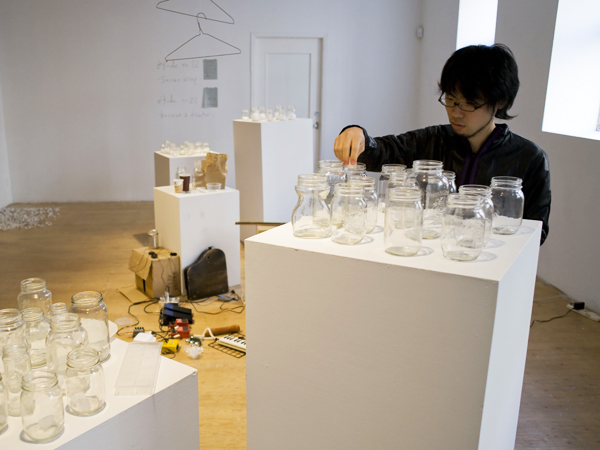
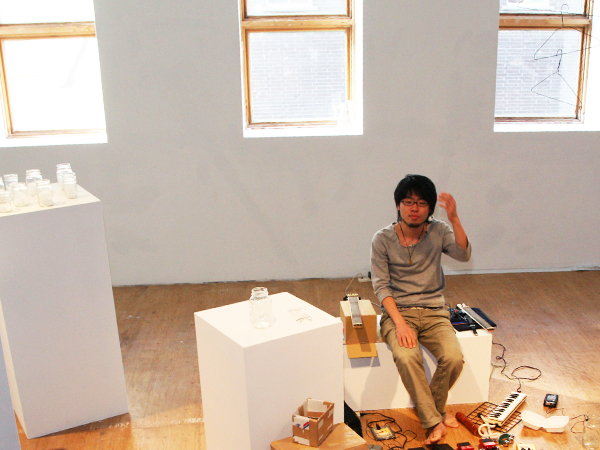
The series of works entitled Étude, by the Japanese artist Mamoru Okuno, explored the musical and sonorous properties of everyday objects. The artist’s unusual approach to working with ordinary items such as coat-hangers, glass jars and straws transformed them into surprising sources of sound. With their usual function set aside, the artist’s actions transformed the objects into sound works. In this sense, Étude was an exploration of the spectrum of sound that is obscured in everyday life, and a reflection on the notion of value. “What determines the value of something,” asks the artist. In Étude, this questioning focuses on the sublimation of the everyday, drawing the spectator in by inviting him/her to experiment with the works created by the artist, and to discover the poetry that exists beyond convention and norms.

Attack

During his residency at LA CHAMBRE BLANCHE, Okuno used the series Études as a means of meeting the public. Before coming to town, he proposed structuring his studio work around meetings with Quebec residents. His goal was to share ideas, and on occasions objects, in a spirit of exchange and complicity.

crédit photo: Ivan Binet

crédit photo: Ivan Binet

Without delay, the artist took to exploring the city, seeking out a public curious to discover this artist who had come from so far away. A simple process of establishing contact began, based on participation in the project, its values and its sense of difference, reflecting a shared desire for meeting. Okuno presented participants with Étude no 7 / plastic straw, a multiple that he had produced industrially, using a straw of the kind found in fast-food chains.

crédit photo: Ivan Binet

crédit photo: Ivan Binet

This modest and normally disposable object came wrapped in colorful packaging designed by the artist, and was signed “Okuno.” Recipients were both amused and seduced by the simplicity of the work; some readily, and others more hesitantly, played the game of blowing into the straw. The sounds produced by blowing in the plastic tubes ranged from the melodious to the shrill. The process was both novel and elementary, revealing a kind of poetry of the ordinary. The immediacy of the situation was complemented by non-verbal modes of communication, expressing a desire to experience essence and a need for collective encounters.

Participants also showed their readiness to engage with Étude no. 12 /plastic film, a work consisting of sections of plastic food wrapping carefully pushed into two small, transparent acrylic cubes. The size of the work invited interaction, which took the form of pushing bubbles of ‘Saran Wrap’ to the bottom of the cube, and holding the structure up to one’s ears to listen to the sound produced by this action. The two cubes were presented in an attractive walnut-colored wooden box, bearing the title of the work and the artist’s name, creating the effect of a precious object or expensive jewelery case.

crédit photo: Ivan Binet

crédit photo: Ivan Binet

The strategies used by the artist to transform everyday objects into works of art were reminiscent of the subtlety of Duchamp’s work, if not the scandal. In 1917, this French artist presented an upside-down urinal in New York’s Armory Show, dating and signing the object R. Mutt. A heresy in its time, this “ready-made” was rapidly recuperated by other artists (amongst them, the surrealists and later the minimalists) in a lineage that continues to this day in the work of Okuno. That said, the question of the value of the Études did not reside in their status as elevated objects of everyday life, but rather in their propositional nature relating to the experience that they offered participants in the residency project.

Decay

Visits to Okuno’s residency project were also an occasion for the artist to collect items for potential use in the work. With an assurance that the items would be returned, Okono borrowed metal coat-hangers and glass jars from visitors, and introduced them into the exhibition space where they became ‘sound stations’, adding to the series.

crédit photo: Ivan Binet

crédit photo: Ivan Binet

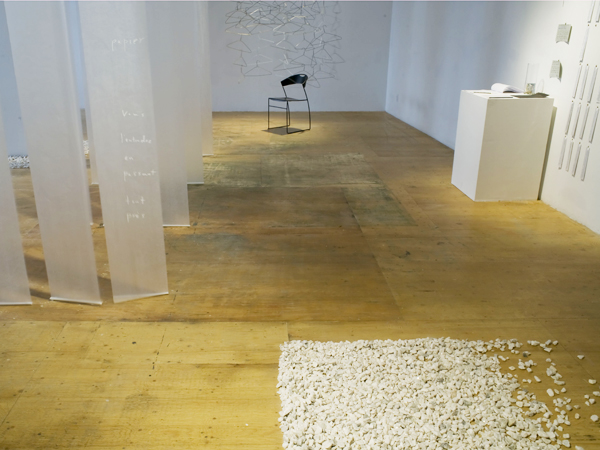
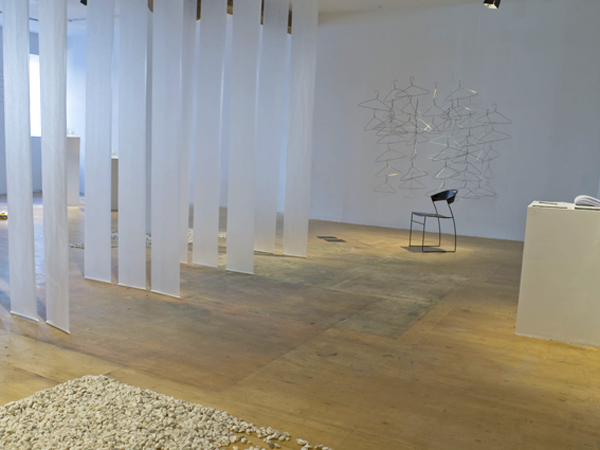
So it was that Étude no 11 / hangers invited visitors to the gallery to let themselves drift amidst an ensemble of coat-hangers, suspended with nylon thread in the air, and carefully arranged around a chair, offering a seating place from which to enjoy the subtle sounds of the hangers as they moved against one another. In Étude no 21 /wax paper, strips of waxed paper were hung in groups of three from the ceiling, rubbing up against each other to produce sounds similar to leaves rustling in the wind. Elsewhere in the space, in Étude no 9 / stones and shoes visitors were invited to step on small white stones placed on the floor, creating friction sounds.

The diverse elements in the installation evoked a Japanese garden, and were placed in the space in such a way as to create a rhythmic journey, of both movement and moments of pause. The work as a whole seemed to be speak of an unchanging order, but in fact each station drew visitors in, and was activated by their presence. The objects featured in Études seemed to lose their form and specificity against the white backdrop of the exhibition space, turning instead into fascinating musical boxes.

Sustain

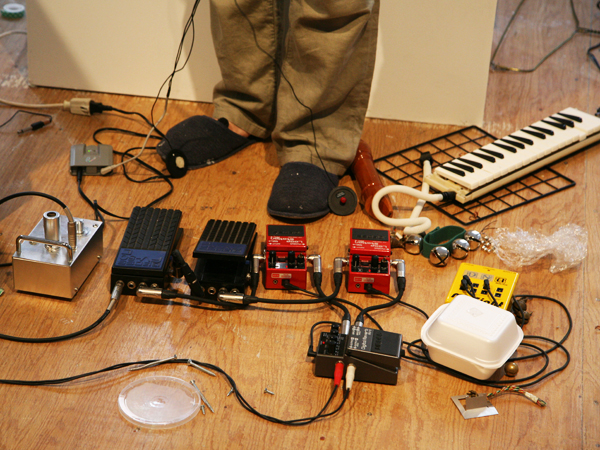
Okuno punctuated the timeframe of his residency with public sound performances using a range of transformer devices, further pursuing his exploration of sonorous forms. His sound performances were presented in the form of simple actions employing contemporary materials as, surrounded by objects, the artist improvised. Okuno allowed the sounds to flow and combine, using the transformers to amplify and loop the tones. Rather than seeking to create arrangements, he focused on the character and expressive potential of the sounds, individually and as an ensemble. The artist aimed for neither sophistication nor melody, preferring to focus on the raw qualities of the sounds produced. This resulted in a form of music that required a similar attentiveness to that of the actions of John Cage. This American composer was responsible for introducing a change of direction in the art world, creating a fracas similar to that caused by Duchamp several decades before. Cage’s 4’33, interpreted by David Tudor in 1952, consists of the background noises in the concert hall in which it is presented. The musician simply rests his or her hands on the piano keyboard, without playing a single note. In the case of Okuno’s work, the silence in the work related to the concentration required by visitors appreciate the music produced by everyday forms.

Release

In contrast to the artist’s use of improvisation, the final days of Okuno’s residency involved the orchestration of a closing signature work. The artist concluded his physical exchange at LA CHAMBRE BLANCHE by returning the objects that he had borrowed to their owners. In an event resembling a waterfall of sound, he invited participants to return to the space to witness a final sound work.

crédit photo: Ivan Binet

crédit photo: Ivan Binet

The artist had placed the glass jars on the floor of the space, arranging them in a way that corresponded to the distances that he had covered during his residency. One by one, visitors were invited to approach the jar representing their home. The artist proceeded to hand individuals an ice cube, in which a thread was partially enclosed, leading to a hook. Following the artist’s instructions, participants attached their ice cube to another thread that the artist had suspended over each of the jars. Once all the participants had completed the process of creating this delicate installation, Okuno invited them to approach the thread and listen closely. All were silent, listening out for the barely audible sound of drops of water falling from the ice cubes and into their respective jars. All that remained was to applaud!

Following the sounds produced by this arrangement of objects, Okuno began to dismantle his assemblage for the last time. Cutting the cords suspending the series of coat-hangers from the ceiling, he handed the items to participants with a discrete word and hand gesture of thanks. Echoing the conductor of an orchestra, Okuno concluded with the tap of a baton, before turning to thank the audience.

A journey to Orion

The electronic music and free jazz composer, radio animator, audio art curator and contemporary artist Érick d’Orion presented his work Forêt d’Ifs at LA CHAMBRE BLANCHE. His preceding work, the installation Solo de musique concrète pour 6 pianos sans pianiste was shown in Oboro gallery in 2007. In Forêt d’Ifs, the artist set aside his play with direct references to objects that was a feature of Solo de musique. Instead, d’Orion’s intervention at LA CHAMBRE BLANCHE employed a formal approach that evoked certain experiments by Servaas, or else the opening seconds of Vostell’s Sun in your head1, created in the 1960s. Through his exploration of movement and distortion, d’Orion demonstrated the influence, on his inspired work with sound, of certain forms found in Bruitist works and Russolo’s Arte dei Rumori (1913).2 Vostell worked with disorder, using structures and forms of narration influenced by the culture of 1960s America. Forêt d’Ifs foregrounded a more subject and individualist approach in which the artist employed the forms of abstract art, combined with an exploration of noise, which drew the audience into the vast interpretive space opened up by installation art. D’Orion’s hyperfluxus experimentation dealt as much with the instantaneity of, “liveness, revisited in recordings,” which is associated with site-specific performance (evoking the beyond of the forest), as it touched on the technique of the manœuvre. Notably, in Forêt d’Ifs interactivity reinvoked linearity, through the work’s looped video element. Whilst in Solo de musique the artist worked with familiar objects, juxtaposing associations, underpinned by the concrete referent of the piano object, the objects in Forêt d’Ifs were anchored in a beyond space offered up by d’Orion for our consideration. This conjured up the visual dimension of research that, in a manner of speaking, dealt with the ‘music’ of sounds. Thus a reading of the artist’s installation at LA CHAMBRE BLANCHE in terms of sound exploration offers a way into his incursion in the art of the image. Such a reading opens up the question, amongst others, of a Bruitist mathematics, as applied to the codes of video installation. The work required an additional and inverse effort, that of a return to the semi-abstract image, by way of sound become object, through its amplification and its intemperance A formal reading of the installation Forêt d’Ifs in terms of “sound vision” emphasizes abstraction and invites interpretive research in cyber history: we will all Google d’Orion.

crédit photo: Ivan Binet

crédit photo: Ivan Binet

Forêt d’Ifs consisted of two distinct sections: a dimly-lit vestibule area featuring a sound work comprised of miniature speakers suspended from the ceiling, which visitors were required to cross3 to reach a second space containing a three-screen video projection. In the first section, the miniature speakers (with the dual function of microphones) emitted barely-audible sounds, which were discernible only by listening attentively. These miniaturized sounds could only by heard during the rare moments of silence in the soundtrack of the adjoining work. This deafening soundtrack filled the entire space, its amplification spilling out onto the street. As soon as the door of the space was opened, the sound coming from the speakers was so strong as to cause the building’s walls to vibrate. In practical terms, the installation broke down boundaries, ran amok; as visitors crossed its threshold and enter the vestibule area, with its black-painted walls and cables hung from the ceiling, it became clear that the spirit of the work was that of confrontation, of silence speaking through noise.

Did the cables hanging from the ceiling represent a forest? Was a form of immersion offered up by the enclosed space of the vestibule area? The first feeling of confrontation experienced by the audience took place in the passage towards the projection. Once spectators had traversed the antechamber, they came face to face with three projections arranged in a triptych, allowing little space in which to stand back from the work. This conflicting and antinomical face-to-face alluded to the heart of the work, in that the sense of immersion felt was that experienced when seated in the front rows of the cinema, the immersion found in La Ciotat.4

D’Orion’s imagery imposed itself on our gaze, as the sound waves in his work flooded the space, seeming almost brutal. So it was that, pragmatically, the installation used impact to reconfigure our senses, as our immersion in the contemporary world was emptied out, to be replaced by conceptual formalism. The experience of immersion in the work was primary, and not that associated with media art; a form of immersion that speaks of alterity (we are immersed in this world that surrounds us). This basic immersion was brutal, taking hold of us, creating a form of promiscuous relationship between the eye and the image, through the impact of noise. The video imagery evoked a walk in a forest, with the depiction of movement in the walk flouting all cinematographic conventions. The filming process appeared of secondary importance to the artist, as the camera swung in all directions, as though hanging from a cable. D’Orion let this cable do the talking; as we watched it was the cable that spoke. The video conveyed disorder, as the images came in blocks, discernable only in fragments: a dog amongst leaves, the green of foliage. Where were the much-anticipated yew trees? They appeared suddenly, before the infernal circle recommenced, turning endlessly. How could we be sure it was them? In technical terms, the sliding movements of the camera defied the physical distance between the three screens, as the “cable” used in the filming made no acknowledgement of the space between capturing and projecting the images. Moreover, the resolution of the work created the impression that a single video had been spread across three screens, that its 720 pixels were divided between their surfaces. This impression was confirmed by the artist: the projection consisted of a single video shoot. The combination of the single shot and low image resolution, projected on a large scale, moving from one extremity of space to the other, caught us unawares and blurred all narrative structure. This neo-Fluxus-like approach is that of an art characterized by the instantaneity and ephemerality of a digital era in which “everything is possible.” The artist’s role is that of a re-director, who transports the audience into an experience that forces them to stop. The audience must pause to think, in a process that reflects the artist’s adherence to the mission of the gallery: to explore the site-specific nature of art.

crédit photo: Ivan Binet

crédit photo: Ivan Binet

Site-specific art can be approached in a variety of ways. In this case, as the artist’s text that accompanied the work explained, “the yew forest” to which the title alludes undoubtedly constitutes part of the interpretive framework of the installation, but a fuller reading requires further research. The artist provides a number of clues: the yew trees in question come from a forest on the Ile d’Orléans. Thus, the confrontation in question is that between the tranquility of the forest and its proximity to the noise of the city. Such clues are necessary and welcome. When we visit the artist’s website, a new avenue of interpretation opens up. The artist is self-taught, an experimenter therefore and, essentially, his methods are based on his exploration of sound. Further research on Google reveals that d’Orion draws on a range of references, that speak of immediate ecologies, of creating links between different environments – whether the nearby forest and the gallery premises or another –, of integrating the art work and the audience. However, the experience before us at LA CHAMBRE BLANCHE is “in progress”, not all the elements involved are present. A distance exists between what is presented and the background of the work. The confrontation in question in his work spoke of opposite forces, those of: nature and construction; site-specificity and the beyond; noise and silence; the within and the without; presence and absence. The aspect that most caught my attention related to the dialogue between nature and construction. A two-fold antimony is at stake, involving urban space and nature, representation and the void of sound space. It is difficult to locate the silence of the forest in d’Orion’s work. Moreover, the irregular movement of the camera challenges our capacity to follow the imagery, questioning the natural hyperactivity of the gaze. Cognitive scientists have proven that consciousness is modeled through a rapid succession of images. This incarnates action, action that seeks to understand and to construct, model and validate the world in which we are evolving. Such is the case in Forêt d’Ifs, where even tranquility must be understood in terms of speed. D’Orion manipulates the camera and seeks for us.

The installation spoke of image technology by demonstrating its opposite, in pointing to forms that immerse the viewer and invite them to choose. In contrast to imagery that synthesizes a viewpoint, guided by the handling of the camera, d’Orion’s work offered no choice but to allow the onslaught or leave. The audience was offered no means of stopping the cycle before them. Even if – as the artist desires – an integration takes place between art work and viewer, such an event occurs despite the viewer who, rather than exerting choice, is captured in the constraints of an interactive loop.

crédit photo: Ivan Binet

crédit photo: Ivan Binet

The installation signaled the capacity of autodidactic approaches to open doorways of inquiry to artists, doorways that lead to ever-larger spaces. Interest in self-taught methods is central to a number contemporary issues, including what is loosely defined as interdisciplinarity. The capacity to teach oneself is practically guaranteed in the Internet age, where a simple click enables the browser to become a geographer, an economist, a jurist, a video maker, a musician, and much more besides. D’Orion admits that his work is raw, it explores noise associated with what is referred to as “circuit bending”: Bruitist music that is produced by the intentional manipulation of electronic circuits in order to transform them into musical instruments. The forms of manipulation involved are generally random and subjective in nature. Reed Ghazala5 invented the term “circuit bending” when two sections of the same circuit accidentally produced a short-circuiting effect that diverted electrical pulses, producing a new sound form: the famous noise referred to in the 1950s Bruitist movement that signalled the end of modern thinking, and the onset of postmodern techniques of deconstruction. These interests remain current in a variety of contemporary art practices that focus on the role of error in opening up the abyss-like space of possibility. Is such an exploration still pertinent to the everyday life of individuals? This question is easily answered: all forms of exploration are necessary, all have a place in current debates, whether they result in works that are hyperrealist, situationist or deconstructionist.

Where do the unfamiliar forms and inaudible sounds encountered in d’Orion’s work come from? To answer this, we must “surf”, look elsewhere; we must read, search on the Internet and inform ourselves of prior works in this vein. So, we discover that Bruitism speaks of the subject of authorship, of instruments whose functionality has been altered. It contributes to a discourse that centers on the era of the void6 which speaks of purely formal relations and comprises many interests, stemming from those outlined by the Luddites.7 Dear Ned Ludd who placed stones in the machines that threatened the livelihoods of workers and their handmade labors. The ghost in the machine was threatening to such a degree that the alienation of production-line labor was preferred. This fear has died out: nowadays no-one is interested in doing production-line work. The first steps of childhood and the joy of overcoming oneself have won out over the fear of falling, to the extent that initial anxieties are long gone. We are witnessing the great march forwards, that offers no way back, despite postmodern doubts and returns. The footsteps are those of Man and his relentless quest, in which individualism is confronted with its own abyss, with an intergalactic moment of self-creation.

  1. Vostell, Wolf. 1963, Sun In Your Head. Germany: Fluxus, 07:08 minutes [online]. https://www.youtube.com/watch?v=z5krhw54oqs&gl=FR&hl=fr (consulted on September 28, 2008).
  2. Russolo, Luigi. 1913, L’art des bruits: Manifeste futuriste. Italy: French version [online]. http://luigi.russolo.free.fr/mani1.html (consulted on September 28, 2008).
  3. This is the classic trap, the interactive Indians’ favorite canyon, the viewer must necessarily interact in the obligatory passage point, under the flux of the sensors.
  4. Lumière, Louis. 1896, L’arrivée d’un train en gare de La Ciotat. France: Lumière Society, 50 seconds [online]. http://fr.wikipedia.org/wiki/L’Arriv%C3%A9e_d’un_train_en_gare_de_La_Ciotat (consulted on September 28, 2008).
  5. Ghazala, Reed [online]. http://www.anti-theory.com/ (consulted on September 28, 2008).
  6. Lipovetsky, Gilles. 1983, L’ère du vide : essais sur l’individualisme contemporain. Paris: Gallimard editions, 246 p.
  7. Fox, Nicols. 2002, Against The Machine: Hidden luddite tradition in literature, arts and individual lives. San Francisco: Island Press, 240 p.