Author Archives: Florence Le Blanc

Cabinet of Time

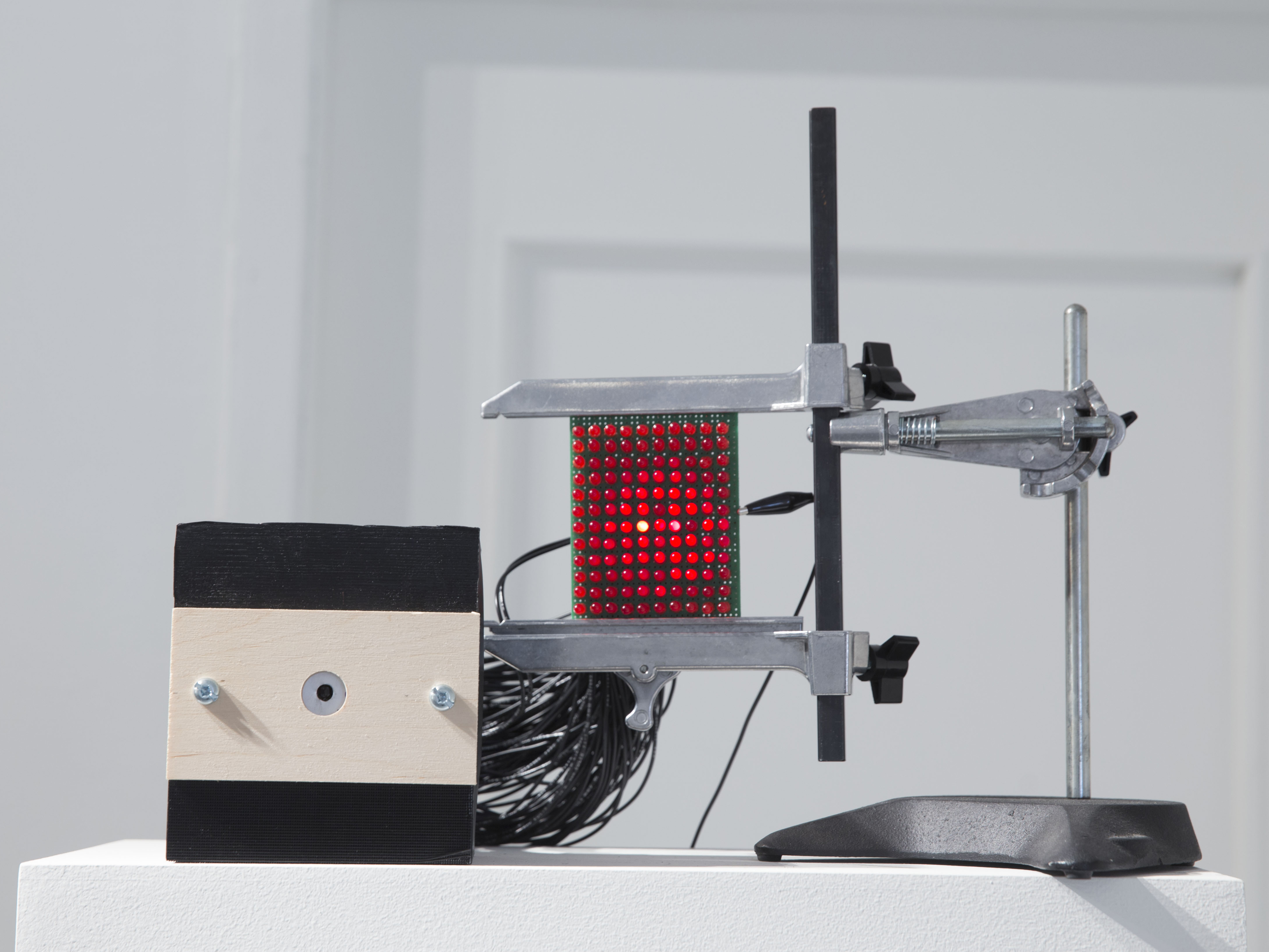
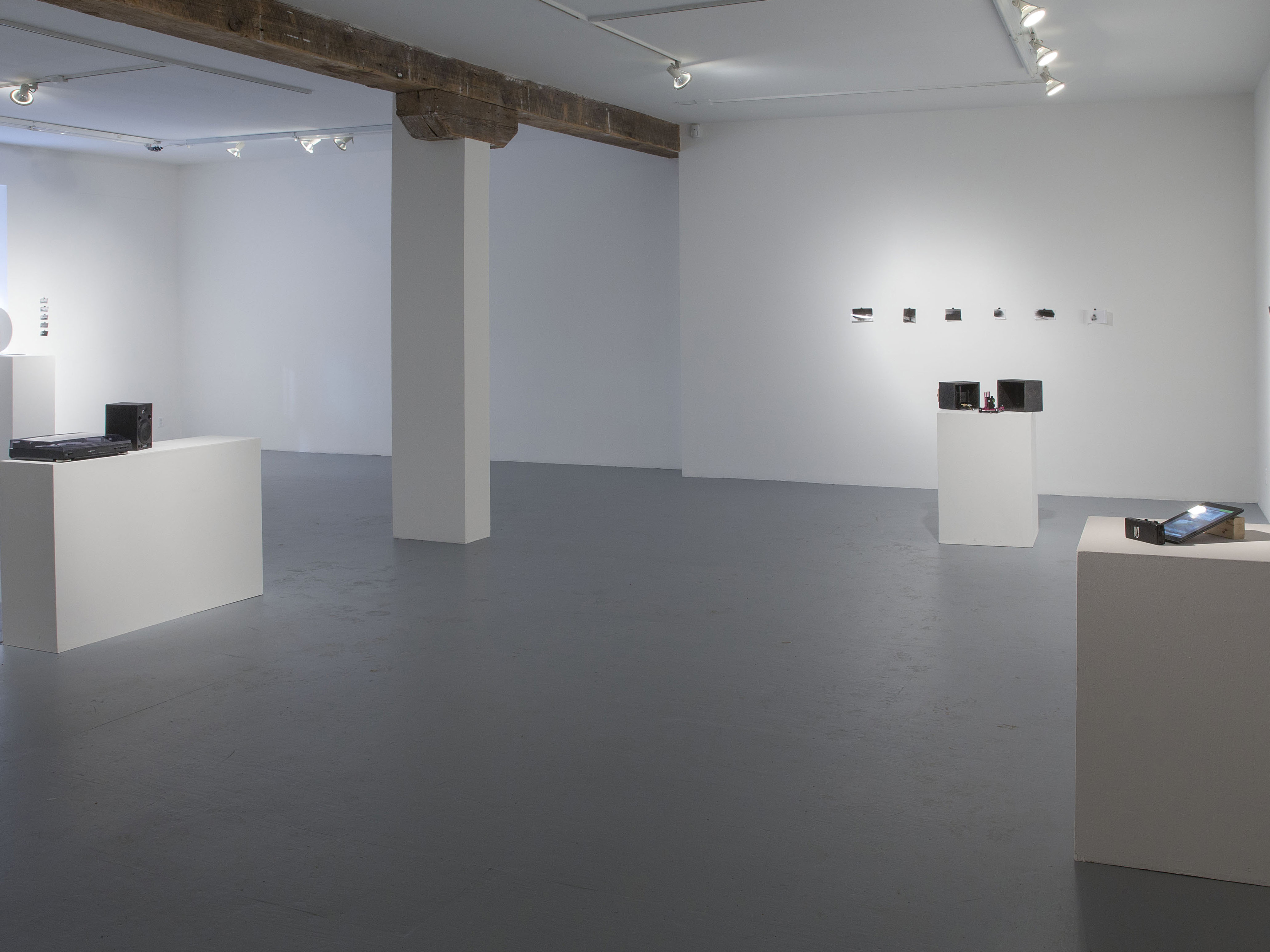
Bruno Caldas Vianna makes traps that capture time. The devices that he creates are produced from technological equipment that is considered out-dated. He acknowledges that the exhibition he presented at LA CHAMBRE BLANCHE could evoke a cabinet of curiosities or even the Wunderkammer, “the room of wonders.” Gathering together equipment that has now become obsolescent, the artist’s process resembles that of someone who collects curious objects. Instead of preserving them in a set time, Vianna gives them new life, attributing new functions that are provided by the immediate environment in which they are found.
crédit photo: Ivan Binet

crédit photo: Ivan Binet

Dependent on noise, movement or light, Vianna’s creations transmit bits of reality that come from the specific devices. Their reassembly gives us the impression that we are able to simultaneously perceive the world various ways. Rather than presenting differing scales of it like a magnifying glass or a telescope would do, these are fragments of time that are captured.

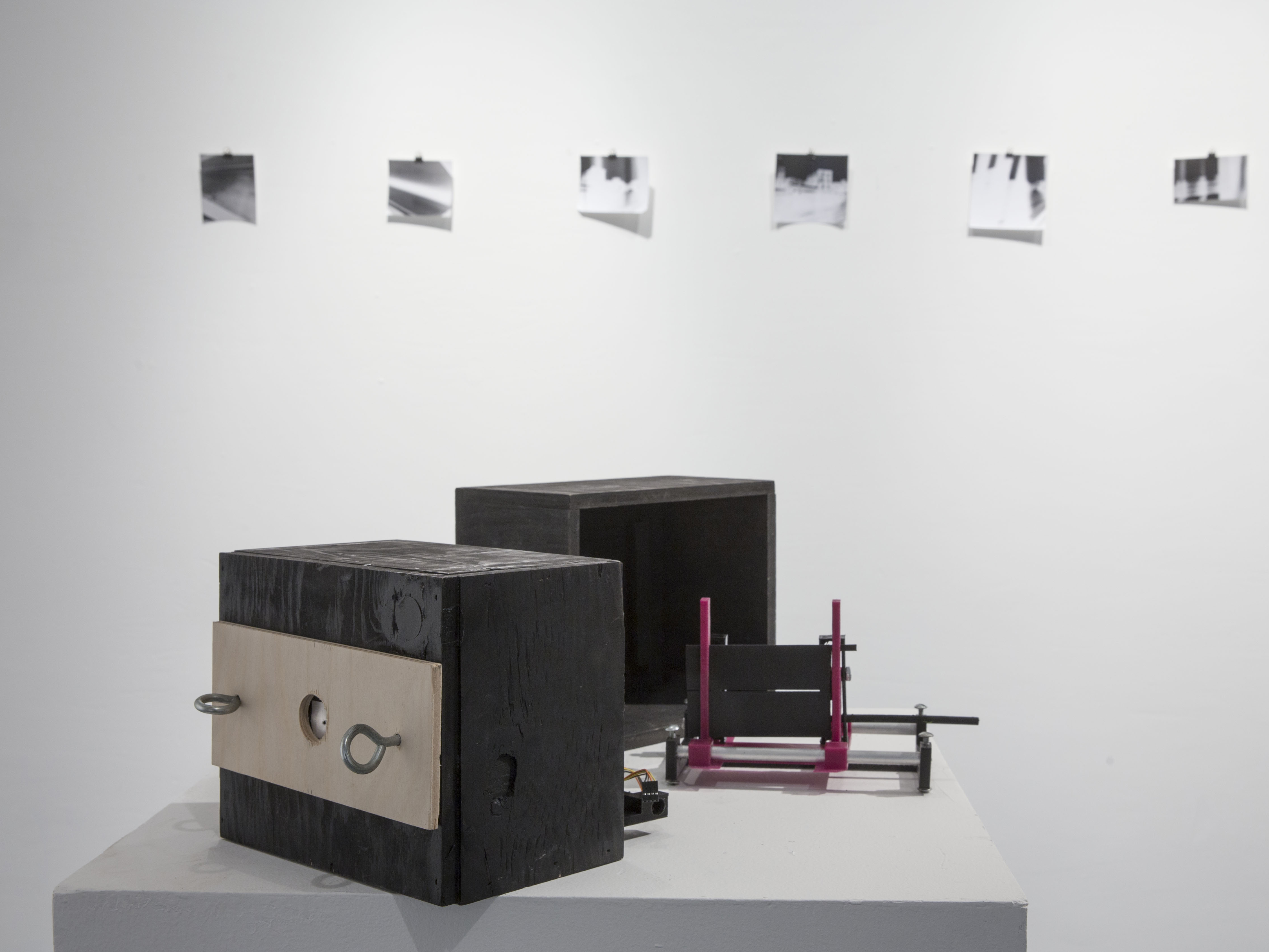
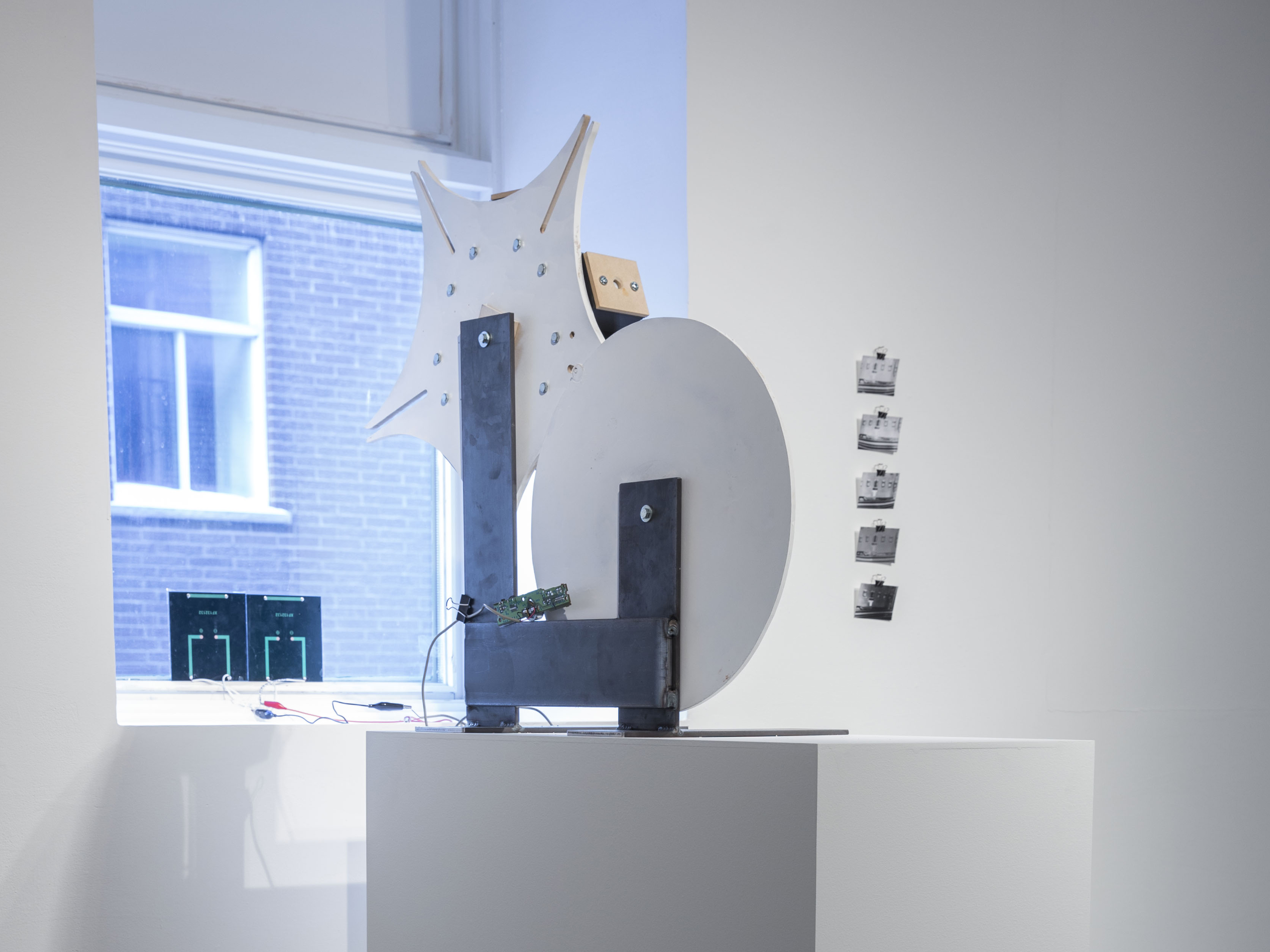
Certain of the device consist of new interpretations of the camera obscura or pinhole camera. One of them was set in motion with the movement of a wheel activated by daylight. Installed on a window, overlooking rue Christophe Colomb, it captured brief moments of exterior light. The resulting photographs, isolated from their initial reality, are presented as fragments of the neighbourhood. Their small size and the re-transcription of the surrounding area that they provide recall Brassaï’s ideas, which considered photography to be made up of “a true but miniaturising copy of the exterior world.”1
crédit photo: Ivan Binet

crédit photo: Ivan Binet

For Vianna, the idea of working with the wheel was inspired by the first cinema recording and projection device, and also by medieval engineering. The artist considers that it is initially this choice of evoking old systems that relates the presentation of his works to those of a cabinet of curiosities. In referring to old processes, the artist captures present time while making allusion to the universal history of the world. The rudimentary nature of some of his machines is closely akin to the archaism of the outmoded processes that he evokes.
crédit photo: Ivan Binet

crédit photo: Ivan Binet

Following the analogy that Vianna establishes between his work and the cabinet of curiosities, one could compare these images to reduced versions of the world, formerly recreated in scholarly collections and exhibited with the intention of explaining something. In the 18th century, under the influence of Diderot’s ideas that recommended establishing an “encyclopaedic dictionary of the human spirit”,2 these collections were often elaborated, with minerals or plants in order to reconstruct the conditions in which the specimens were found in a living state. It also could happen that various species were grouped together to simulate an interaction that never existed in reality. The little known parts of science then were filled in by the collector’s imagination. Strange coincidence, in order to talk about his work, the artist frequently uses expressions associated with acts of predation: he describes his works as “light traps for time” and compares himself to a “hunter” tracking his evanescent “prey.”
crédit photo: Ivan Binet

crédit photo: Ivan Binet

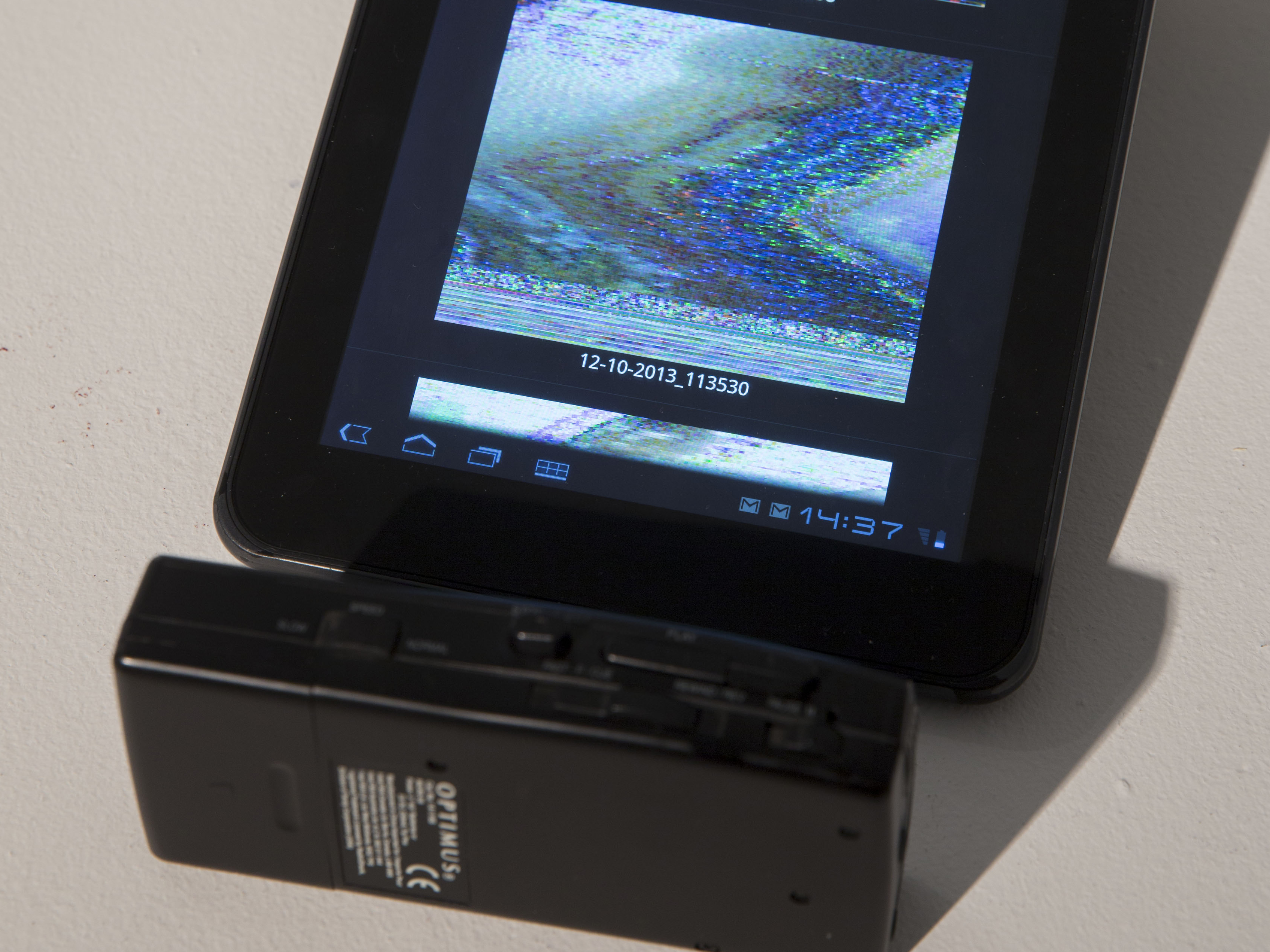
However these moments, even once “captured” and exhibited, are not subjected to the deadly representation usually created by a museum’s immortalization. Because these works depend on the environment in which they are found, in experiencing them, it is the direct capture of time that one witnesses rather than its interruption. One of the devices is used to put together images from ambient noise that is captured in the exhibition gallery. Appearing progressively on a digital tablet, these images present the archaeological interventions made in the city of Rio. Various strata from the distant past resurface due to variations in time, thus producing a revelation of the past in the present.

Another of the devices, reinterpreting the camera obscura, is used to capture various moments of a subject on the same photosensitive surface. The surrounding urban landscape then is revealed in many fragmented moments. The ghostly images are presented in the negative because their capturing is imprinted directly on the paper. These are the variations of light that show the plurality of the moments of the day, coexisting in the same image. Their demarcations recall the erosion of the ground, which shows the passing of time in an area. Unlike a photograph that results in capturing a single moment, this plurality of instants of a same subject presents a version of the world in which time would be abolished by its reduction.
crédit photo: Ivan Binet

crédit photo: Ivan Binet

Because Bruno Caldas Vianna’s devices present various forms of capturing time, bringing them together in the same space opens up the perception of infinity in miniature.3 If the obsolescence attributed to components of the works give the impression that they are out of date, it seems paradoxical that these objects now artefacts, contribute instead to providing for regeneration. On the other hand, the time period that this material comes from is not so long ago. By their simple material presence, this collection of various pieces seems to indicate the world’s acceleration, outmoded by the speed of its technological and media evolution. Consequently, there is very good reason to consider the ensemble as a kind of cabinet of curiosities, which has been adapted to the knowledge and imagination of a time, requiring more exploring and understanding.

  1. Brassaï. 2001, Proust in the Power of Photography. Trans. Richard Howard, Chicago: University of Chicago press. p. 33.
  2. Davenne, Christine et Christine Fleurent. 2011, Cabinets de curiosités: La passion de la collection. Paris: De La Martinière editions. p. 16.
  3. Ibid., p. 66.

Study of a phenomenon or the invention of a memory

From the 26 January to the 25 February 2007, Julie Andrée T. undertook a site-specific residency at LA CHAMBRE BLANCHE. The artist has produced a considerable body of work, and her installations and performances have brought her international recognition. She has been a member of Black Market International since 2002, and regularly collaborates with other artists, including Dominic Gagnon and Benoît Lachambre. From time to time, she co-directs works by the PONI collective and has also been a member of the experimental theatre group PME, directed by Jacob Wren.

crédit photo: Ivan Binet

crédit photo: Ivan Binet

The relationship between the body and space is a fundamental area of exploration in the work of Julie-Andrée T. Étude d’un phénomène ou l’invention d’un souvenir forms part of a body of work that has been ongoing for some time, centering on the relationship between the human and nature. The project is inspired by current interest in climate change, and particularly the natural disasters that it produces, in a context where the media often serves to distort the perception of the population.

Julie Andrée T. presented an installation at LA CHAMBRE BLANCHE that sought to construct the fragmented memory of a natural disaster. Her interpretation of climate was based on a range of references and media, developing an aesthetic of disaster in which it is difficult to gain access to information.

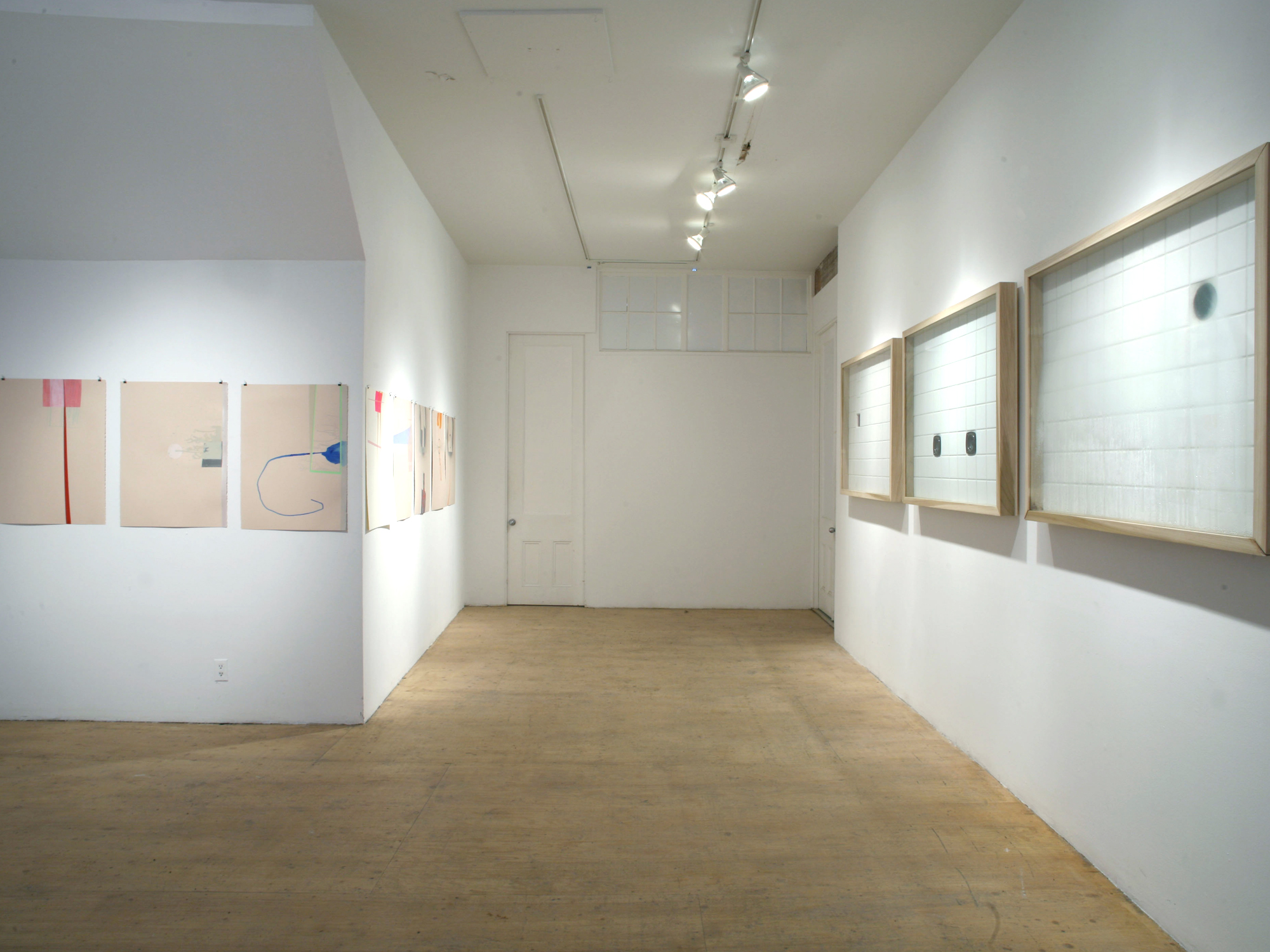
The installation was divided into four sections that interacted to create a strange habitat. The first section consisted of three pictures made of squares of white ceramic. In the first picture, one of the white squares was replaced by a small screen displaying images of an erupting volcano. In the second picture, two small speakers took the place of white squares, and played recordings of disturbing sounds and stories of disaster. Smoke came from the third picture, by means of a similar device. A glass screen placed in front of each picture prevented us from coming directly into contact with the works. As a whole, the triptych conveyed the impression of a natural disaster by means of three different senses: sight, sound and smell. The ensemble evoked the feeling of segmented memory.

crédit photo: Ivan Binet

crédit photo: Ivan Binet

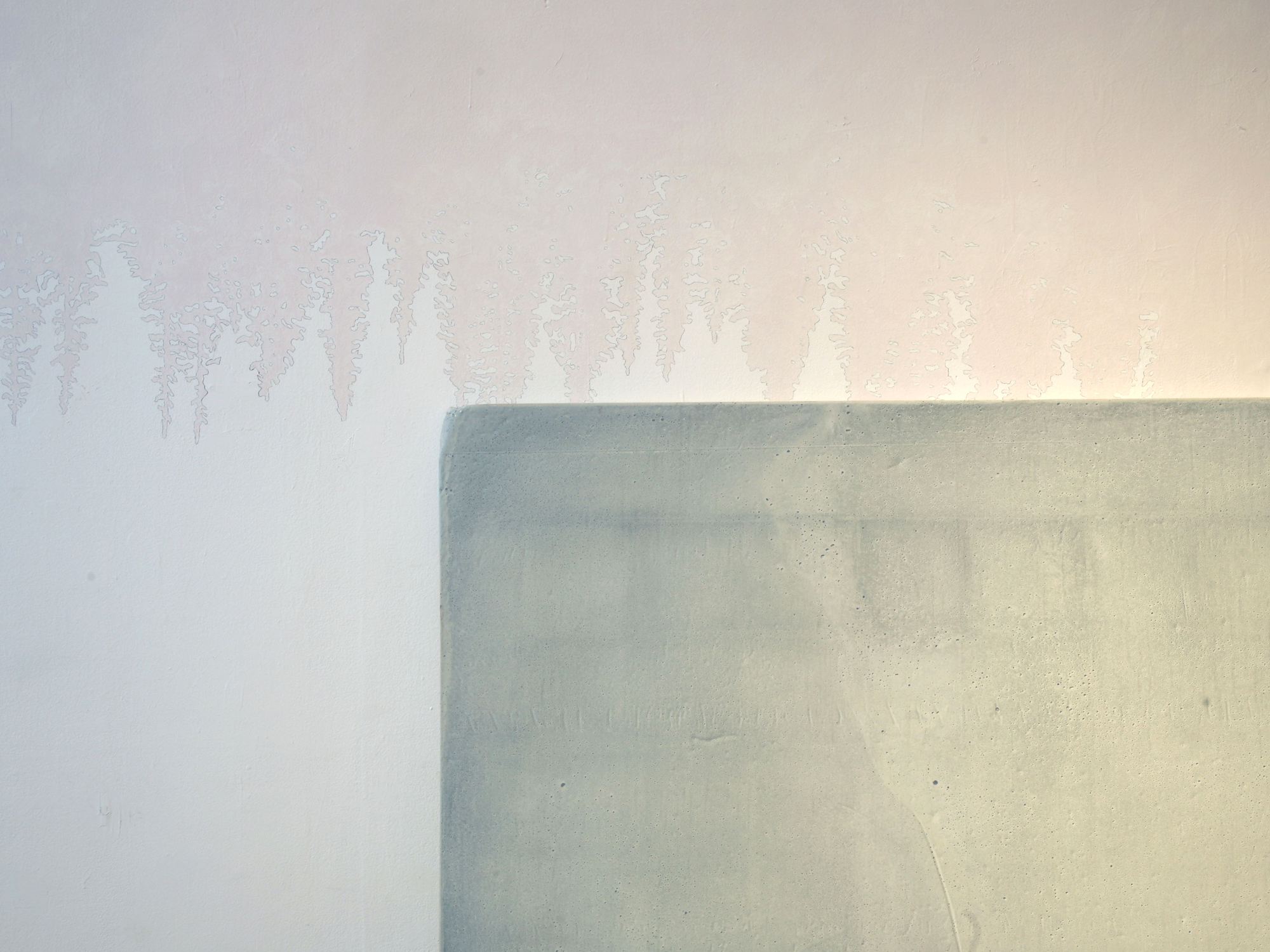
At the far side of the exhibition space, a concrete block leant on a wall that bore the outline of a forest in red and off-white. Drawn upside down, the heads of the trees seemed to flow like blood from the ceiling. On the wall perpendicular to this, another forest, on its side, seemed to fall to the floor. This flood of red, which seemed a response to the block of concrete, signaled another natural catastrophe, laying bare the tension that exists between man and nature.

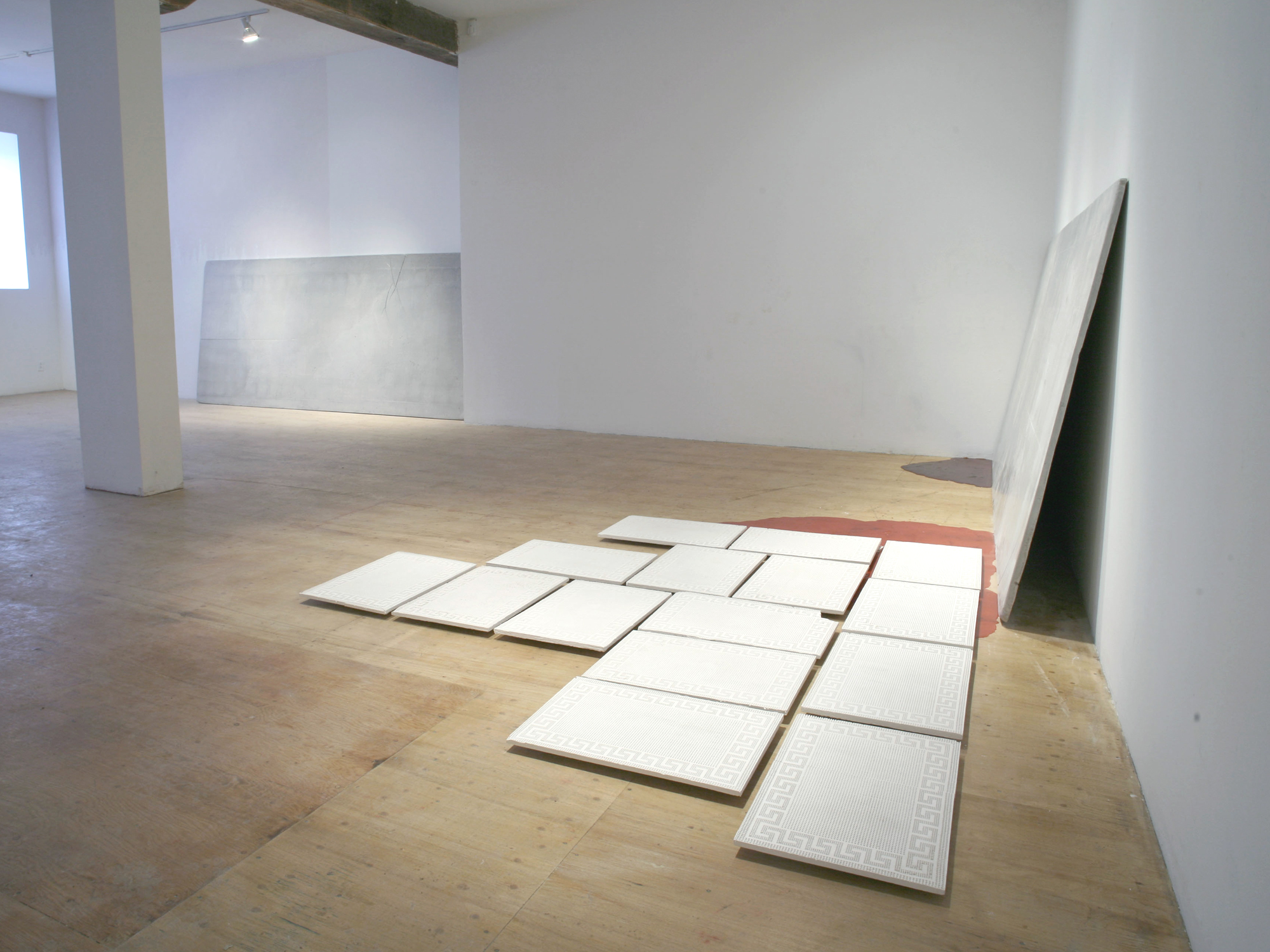
The third section of the installation consisted of another piece of concrete leaning against the wall. To the right, rectangular plaster moulds burst up from the floor. They seemed to float above the ground, as though time stood still. This created the feeling of being witness to a meeting that had been interrupted. The fixed feeling of the scene was accentuated by the weightiness of the materials used. A mysterious substance that resembled blood emerged from the left and right side of the concrete, as though an accident had taken place. Given that the trace on the right was more marked, one surmised that the second accident was more recent. These traces of ‘blood’ gave a pictorial feeling to the space, harmonizing with the drawings that the artist had chosen to include.

Before entering the space, there was a sense that the elements were moving, communicating amongst themselves, and the feeling that they had suddenly frozen to preserve the secret of their story. This effect contrasted with the three pictures, which seemed instead to be communicating something that cannot directly be perceived.

The viewer felt obliged to keep a distance from the elements on show, a distance that marked out this residency from other projects by Julie Andrée T on the theme of climate. For her project Prudence Volontaire, presented at Le Lobe in 2004, the artist created parloirs-isoloirs (self-contained spaces) featuring a series of micro-climates designed as situations that would provoke meeting with viewers. The artist worked again with the reality of climate in Weather Report/Potentiels évoqués, presented at SKOL in 2005. On this occasion, she developed structures in which viewers could enter directly into contact with different artificial climates. The spectator’s senses were thus called to react to conditions of heat, fog and wind…

By contrast, at LA CHAMBRE BLANCHE the artist presented the audience with sealed elements, something like a bottle that it is impossible to open. Instead, viewers had to fix the fragments of the work together, enabling them to re-transcribe, in their own way, the memory of the natural disaster that had taken place.

Julie Andrée T. likes to work outdoors with elements taken directly from nature. On occasions, she creates shelters as with La Salle Commune, which featured in the Espace Blanc event held in Rimouski in 2005. So it was that during her residency at LA CHAMBRE BLANCHE, Julie Andrée T. staged a performance, working along the shores of the Saint-Charles river for the day. This site has born the brunt of pollution and symbolizes natural disaster for the artist.

For the performance, Julie Andrée T. collaborated with Francis Arguin in attempting to create links between the two banks of the frozen river. This action underlined the ephemeral nature of the river and the various conflicts to which it has been subjected in a succession of redevelopments.

The performers began on either side of the river, each tied to their respective riverbank by a cord knotted around the waist that limited their movements. A series of actions followed in which the two protagonists interacted, creating a dialogue between the two riverbanks. With the help of shovels, they exchanged snow. Other actions took place independently, such as the use of traffic cones to call out to moose. The repetition of their movements gradually formed a pathway of water linking the sides of the river. A conversation had been established.

The site gradually changed shaped. Road signs marked the pathway, displaying arrows or circles, always pointing in opposite directions, along with cords that created obstacles to direct contact between the riverbanks. A red liquid appeared in the center of the river, evoking blood: a distress signal. The tensions generated by these communication problems between the human and his environment echoed those in the LA CHAMBRE BLANCHE’s exhibition space.

Further to this series of actions, the performers’ bodies also featured in the aesthetic of the work as a whole. In different sections of the performance they adorned themselves with self-adhesive strips. Those worn by Julie Andrée T. were blue, whilst Francis Arguin wore red strips. As with the road signs, these features further added to the marking out of the space.

After a while, the performers changed positions, each completing the semi-circle on the ground that the other had begun, also exchanging self-adhesive strips. Gradually the differences between them gave way, revealing two bodies linked by the same colors. Although they never met each other directly, through their actions they ended up resembling, merging with and understanding one another.

In devising a new set of markings for the river, Julie Andrée T. gave the river a voice. At the end of the conversation, the site had changed meaning by way of the set of references hat unfolded form the use of natural materials and road traffic objects. This redefining of the relationship and connotations that exist between place, bodies and objects prompted spectators to reflect on their own identity and environment.

crédit photo: Ivan Binet

crédit photo: Ivan Binet

This intervention at the Saint-Charles river can be read as a fragment of the installation presented at LA CHAMBRE BLANCHE. In the case of both works, nature calls out to a humanity that understands little of its distress. In devising a poetry of the unfamiliar by means of everyday references, Julie Andrée T. created the paradoxical feeling of taking the viewer closed to a beyond that is as unknown as it is familiar.